
Thinking about installing a wind energy system in Washington State? Here’s the good news: there are multiple programs to help you calculate your savings. From federal tax credits to state-level rebates, these incentives can significantly reduce the upfront costs of wind energy systems. Here’s a quick breakdown of the top programs available:
- Federal Investment Tax Credit (ITC): Get 30% off the cost of your system through a federal tax credit available until 2032.
- Washington Sales Tax Exemption: Refund up to 75% of sales and use tax on wind energy equipment through 2029.
- Net Metering Policies: Earn credits on your utility bill for excess energy your wind system produces.
- Utility-Specific Rebates: Some local utilities offer additional rebates based on their own programs.
- Inflation Reduction Act Programs: Federal funding includes rebates for low- to moderate-income households.
Acting now can maximize your savings, especially with looming deadlines for some programs. Keep reading for details on eligibility, deadlines, and how to claim these incentives.
1. Federal Investment Tax Credit (ITC) for Wind Systems
Rebate/Credit Amount or Percentage
The Federal Investment Tax Credit offers a 30% credit on the total cost of qualified wind systems, covering both equipment and labor. For instance, if your wind turbine costs $33,600, you’d receive a $10,080 credit that directly reduces your tax bill. There’s no cap on the total dollar amount you can claim.
This 30% rate is available through December 31, 2032. After that, it decreases to 26% in 2033 and 22% in 2034, before expiring unless Congress decides to renew it. Installing your system sooner ensures you lock in the highest savings.
Eligibility Requirements
To qualify for the federal credit, your wind turbine must serve a residence located in the United States. Eligible properties include:
- Traditional houses
- Houseboats
- Mobile homes
- Cooperative apartments
- Condominiums
- Manufactured homes
Both primary residences and second homes are eligible, but rental properties do not qualify for the residential credit.
Additionally, the system must meet established performance standards, such as AWEA 9.1, IEC 61400, or ACP 101-1, to guarantee quality and safety. This credit applies to systems installed in both existing homes and new construction.
Application Deadlines
There’s no separate application process for this credit. You simply claim it on your federal income tax return for the year your wind system becomes fully installed and operational. To receive the full 30% rate, your turbine must be operational by December 31, 2032. Use IRS Form 5695 ("Residential Energy Credits") when filing your annual tax return to claim the credit.
Keep in mind, the credit is non-refundable, meaning it can reduce your tax liability to zero but won’t result in a refund. If your credit exceeds your tax liability, you can carry the unused portion forward to future tax years, following IRS guidelines.
sbb-itb-8db64ac
2. Washington Renewable Energy System Incentive Program
Eligibility Requirements
Washington’s Renewable Energy System Incentive Program provided production-based credits for renewable energy systems, benefiting both residential and commercial utility customers. Managed by the Washington State University (WSU) Energy Program, the initiative supported owners of renewable systems like wind turbines, community solar installations, and shared commercial solar projects. To qualify, participants needed to be customers of a participating utility. These utilities could offer credits up to 1.5% of their 2014 taxable power sales or $250,000 – whichever was higher. However, leased systems were not eligible for this incentive.
Funding caps varied by project type. For example, commercial-scale wind systems were restricted to 25% of the remaining utility funds as of July 1, 2017. Meanwhile, community solar and shared commercial projects combined could not exceed 50% of the remaining funds. Due to these limits, some utilities quickly exhausted their available funding.
Application Deadlines
"As of June 2021, the program is fully subscribed and is no longer taking new applicants." – Washington Utilities and Transportation Commission
Since the program has closed to new applicants, those exploring wind energy incentives today should consider alternatives like the Federal Investment Tax Credit or Washington’s Sales Tax Exemption. This closure highlights why staying informed about state updates is crucial for taking advantage of future funding opportunities.
Key Prerequisites
While this program no longer accepts applications, keeping an eye on the WSU Energy Program website is a good idea for updates on legislative changes or potential future funding rounds.
3. Production Incentive under Renewable Energy Cost Recovery Program
Eligibility Requirements
This incentive program was open to homeowners who were the primary utility account holders and either owned or lived on the property where the wind system was installed. The system had to be located in Washington State, include a way to measure electricity production, and be connected to the grid. Both residential systems (≤12 kW DC) and commercial systems (>12 kW DC) were eligible.
Utility companies participated voluntarily, meaning homeowners could only benefit if their utility provider opted into the program and hadn’t surpassed its credit limit [12, 13]. The program’s $110 million funding cap was reached, and certifications officially closed on June 30, 2021.
These eligibility rules laid the groundwork for the program’s performance-based incentives.
Rebate Amount
Homeowners earned between $0.10 and $0.16 for every kilowatt-hour produced by their wind system. The rate varied depending on the year of certification, with systems certified in 2018 receiving the highest payout of $0.16 per kWh. An additional bonus of $0.02 to $0.05 per kWh was available for systems using turbines or towers manufactured in Washington State.
Annual payments were capped at $5,000 for residential installations and $25,000 for commercial systems [13, 14]. The incentives were offered for up to eight years or until payments covered 50% of the system’s total cost, whichever came first.
Key Prerequisites
To access these rebates, homeowners had to meet specific procedural requirements. This included completing a final electrical inspection and submitting a signed interconnection agreement to the WSU Energy Program. A one-time application fee of $125 was charged to cover administrative expenses. Participants were also required to maintain records for five years to verify incentive payments. Failure to provide these records when requested could result in the loss of future payments.
Session 4: Energy Incentives & the 2021 State Energy Code
4. Utility-Specific Wind Rebates in Washington
Utility-specific rebates in Washington are managed by individual utility companies rather than by federal or statewide programs. Puget Sound Energy (PSE) and other utility providers typically limit these rebates to eligible residential customers. Qualifying properties generally include existing single-family homes, while commercial accounts, new construction, and multifamily buildings with five or more attached units are excluded. Manufactured homes may qualify, but often through separate programs or specialized tracks.
To qualify, the wind system installation must be located within the utility’s service area. Homeowners should also check if their utility requires the use of an approved contractor, as this can directly impact rebate eligibility. Beyond these basic criteria, rebate amounts and application processes differ significantly between utilities.
Rebate Amount
Rebate amounts for wind systems vary widely depending on the utility. Many providers focus more on general energy efficiency incentives than on wind-specific programs. For example, Benton PUD offers rebates ranging from $30 for small appliances to $1,200 for larger system upgrades.
Homeowners interested in wind-specific rebates should reach out to their local utility’s Conservation or Energy Services department for the most accurate and up-to-date information. Keep in mind that rebate amounts and availability are often tied to funding, which can impact application deadlines.
Application Deadlines
Utility rebate programs operate on a "first-come, first-served" basis and may end earlier than expected if funding runs out. For instance, the Washington Families Clean Energy Credit program, which offered a $200 rebate through electric utility companies, concluded on September 15, 2024. Because these programs are localized, deadlines can differ by utility, making it essential to confirm specific timelines directly with the provider.
Key Prerequisites
Before applying for a rebate, homeowners need to ensure their wind system meets the utility’s interconnection standards and energy efficiency guidelines. Most programs require that equipment is listed as "qualified" by either the utility or the Department of Commerce. Proper documentation is critical, and homeowners should confirm funding availability before purchasing equipment, as rebates are only valid while funds last.
5. Sales Tax Exemption for Wind Energy Equipment
Washington offers a noteworthy incentive for wind energy adoption through its sales tax remittance program. This program provides a refund on state and local sales tax for qualifying wind energy equipment. Homeowners initially pay the full tax amount at the time of purchase but can later apply for a refund through the Washington Department of Revenue (DOR). The refund covers machinery and equipment directly involved in generating electricity, including critical wind energy components.
Eligibility Requirements
This program focuses on equipment specifications rather than tax credit calculations. To qualify, your wind energy system must generate at least 1,000 watts AC. Additionally, installation must have started on or after January 1, 2020, and the project must be completed by December 31, 2029. Items covered include eligible machinery and installation labor, but exclusions apply to hand-powered tools, items with a lifespan under one year, repair parts, and non-integral buildings.
Rebate Amount or Percentage
Refund amounts are structured into three tiers – 50%, 75%, or 100% of the sales tax – depending on labor standards met. Projects under a Project Labor Agreement or Community Workforce Agreement qualify for a 100% refund. For the 75% refund, developers must meet the 50% tier requirements and also pay workers prevailing wages per local collective bargaining agreements. The 50% refund tier requires meeting standards for apprenticeship utilization (15%), local hiring (35% or 20% in rural counties), and procurement from minority (5.5%), women (9.5%), and veteran-owned (5%) businesses.
Application Deadlines
The program is set to expire on January 1, 2030. Applications for remittance can only be submitted quarterly to the DOR, and an annual tax performance report must be filed by May 31 of the year following the refund claim.
Key Prerequisites
To qualify for refunds above the base tier, you must apply for Clean Energy Labor Standards Certification with the Department of Labor & Industries (L&I) before starting your project. Detailed records are essential, including invoices, proof of tax payment, and documentation of machinery and equipment, to support your application. For those aiming for the 50% or 75% refund tiers, it’s crucial to work with the Office of Minority & Women’s Business Enterprises and the Department of Veteran Affairs during the planning phase to meet procurement standards. This program is a valuable addition to Washington’s wind energy incentive offerings.
Comparison Table
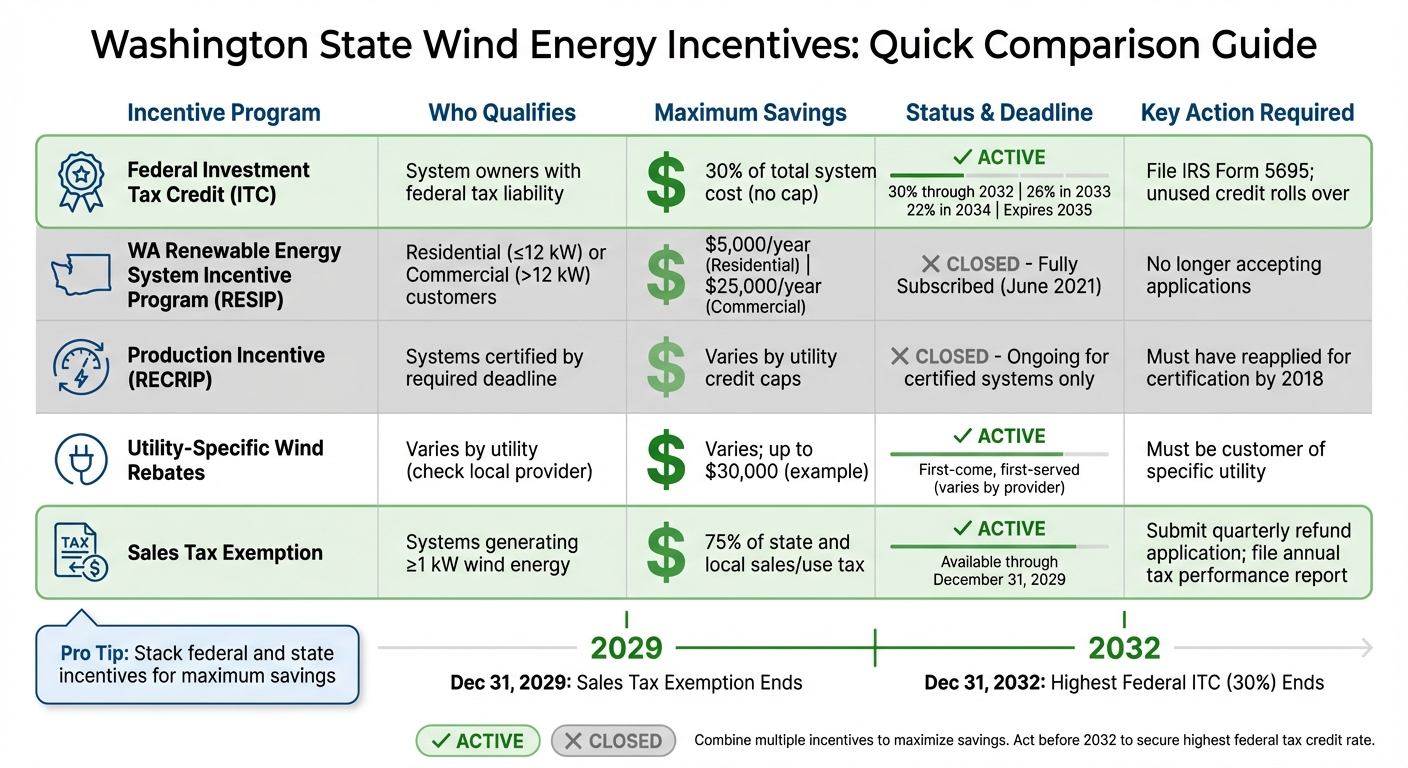
Washington State Wind Energy Incentives Comparison Chart 2024
Choosing the right wind energy incentive means understanding how the options compare. The table below breaks down five programs available to Washington State homeowners, making it easier to pinpoint the one that aligns with your needs and timeline.
| Incentive Program | Eligibility Criteria | Max Rebate/Credit Amount | Deadline/Status | Key Requirements |
|---|---|---|---|---|
| Federal Investment Tax Credit (ITC) | System owners with federal tax liability | 30% of total system cost | 30% through 2032; decreases to 26% in 2033, 22% in 2034; expires 2035 | System ownership required; file IRS Form 5695; unused credit rolls over |
| WA Renewable Energy System Incentive Program (RESIP) | Residential (≤12 kW) or Commercial (>12 kW) customers | $5,000/year (Residential); $25,000/year (Commercial) | Fully Subscribed (Closed June 2021) | Must be a customer of a participating utility |
| Production Incentive (RECRIP) | Systems certified by the required deadline | Varies by utility credit caps | Ongoing for certified systems only | Must have reapplied for certification by 2018 |
| Utility-Specific Wind Rebates/Loans | Varies by utility (e.g., Clark County residents) | Varies by provider; example up to $30,000 | Varies by provider | Must be a customer of the specific utility |
| Sales Tax Exemption | Systems generating ≥1 kW of wind energy | 75% of state and local sales/use tax | Available through 2029 | Submit refund application; file annual tax performance report |
This table simplifies the comparison process, helping you weigh your options based on eligibility, savings potential, and project deadlines. By reviewing these details, you can make a well-informed choice for your wind energy project in Washington State.
Conclusion
Homeowners in Washington State have several ways to lower the cost of wind energy installations through various incentives. The Federal ITC offers a 30% tax credit through 2032, while the state’s sales tax exemption allows for a 75% refund on applicable costs until 2029. Although the Washington Renewable Energy System Incentive Program ended in June 2021, combining federal tax credits with utility-specific rebates still provides opportunities for savings.
Timing plays a key role in maximizing these incentives. The Federal ITC rates will drop after 2032, so acting sooner ensures you take full advantage of the current benefits. Homeowners should also remember to pay the full retail sales tax upfront and file refund applications with the Department of Revenue. Applications can be submitted quarterly to recover 75% of those costs. These deadlines underscore the importance of prompt action and the potential financial benefits of pairing wind energy incentives with other home efficiency upgrades.
Pairing wind energy systems with broader home efficiency improvements can unlock even more savings. By combining wind installations with upgrades like insulation, air sealing, or heat pumps, homeowners can qualify for additional rebates under programs like the Inflation Reduction Act’s HOMES and HEAR initiatives. These rebates are income-based, with households earning up to 150% of the Area Median Income eligible for substantial benefits. However, approval must be obtained before purchasing equipment or beginning any work, as these programs are not retroactive.
Navigating multiple rebate applications and ensuring equipment meets program standards can be overwhelming. That’s where Envirosmart Solution comes in. Specializing in energy efficiency upgrades for Pacific Northwest homeowners, they provide guidance on maximizing rebates and incentives. From insulation and weatherization to HVAC systems, their expertise ensures you don’t miss out on available savings while improving your home’s overall comfort and efficiency.
If you’re considering wind energy or energy-efficient upgrades, professional support can make the process smoother. Acting now helps you maximize savings, avoid mistakes like missing pre-approval deadlines, and stack multiple incentives to get the most out of your investment.
FAQs
Can I combine the federal ITC with Washington’s sales tax refund?
Yes, you can generally take advantage of both the federal Residential Clean Energy Credit (ITC) and Washington’s sales tax exemption for solar purchases since they are distinct incentives. Just remember, the federal ITC applies only to systems installed by December 31, 2025, whereas Washington’s sales tax exemption extends beyond that timeframe.
What does “installed and operational” mean for the 2032 ITC deadline?
“Installed and operational” refers to a renewable energy system that is actively producing electricity and has successfully passed its final electrical inspection. Incentives are available for systems that are in service during the tax year, specifically from January 1, 2022, to December 31, 2032.
How do I find out if my utility offers a wind rebate or net metering?
To find out about wind rebates and net metering programs, start by checking your utility provider’s website. They often have detailed information about renewable energy incentives and policies. Another great resource is the Washington Utilities and Transportation Commission website, which offers insights into statewide renewable energy programs.
For the most accurate and personalized information, it’s a good idea to contact your utility company directly. They are required to provide details about the specific incentives and programs available for your property.