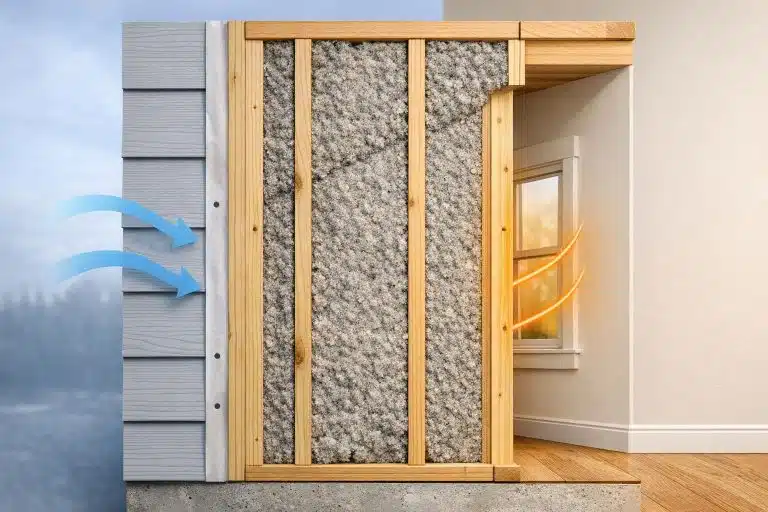

In the Pacific Northwest, upgrading your attic insulation can save you hundreds on energy bills while making your home more comfortable year-round. The good news? There are multiple rebate programs available to help cover the costs. Here’s what you need to know:
- Rebates range from $0.50 to $2.25 per square foot depending on your location and income.
- Puget Sound Energy (PSE) offers up to $3,500 in rebates for attic insulation and air sealing.
- Avista provides rebates of $0.75–$1.50 per square foot, with on-bill payment options.
- Energy Trust of Oregon offers $1.50 per square foot for standard homes and higher rates for income-qualified households.
- Oregon’s HOMES Program covers 50%–100% of project costs, up to $10,000, for energy-saving upgrades.
- Low-income households in Klickitat County, WA, can access full weatherization services through the Klickitat PUD Energy Matchmaker program.
Most programs require using approved contractors and meeting specific eligibility criteria, such as insulation R-values and primary heating sources. Combining local rebates with federal tax credits can maximize your savings, potentially covering the majority of project costs.
For more details on each program, including eligibility and benefits, keep reading.
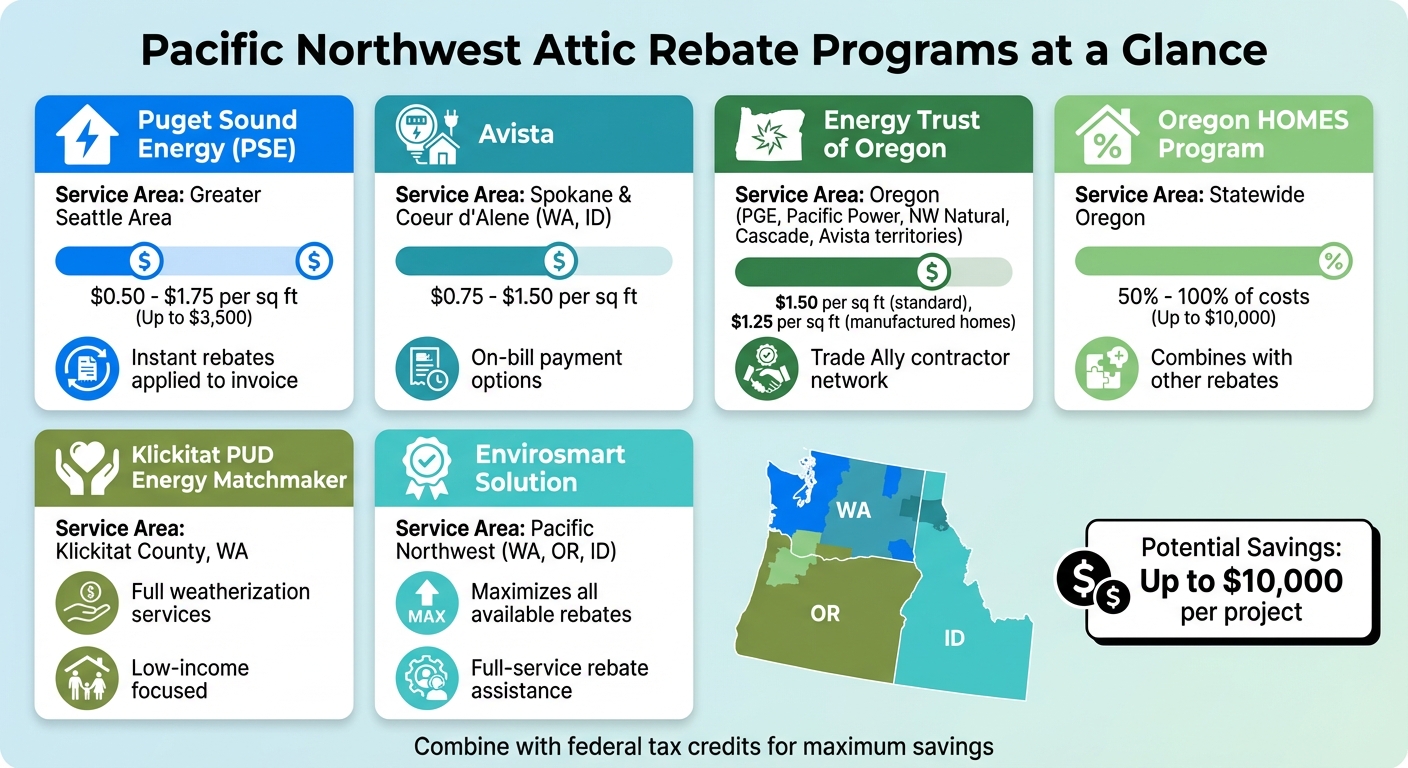
Pacific Northwest Attic Insulation Rebate Programs Comparison Chart
How to Get a Rebate on Insulation
sbb-itb-8db64ac
1. Envirosmart Solution‘s Rebate Assistance and Energy Efficiency Services
Envirosmart Solution simplifies the process of accessing Pacific Northwest utility rebates for attic upgrades. They offer a service that makes it easy for homeowners in Washington and Oregon to maximize rebates without hassle. By streamlining the process, they ensure homeowners can access these benefits quickly and efficiently.
Service Area
Envirosmart Solution operates in both urban and rural areas across Washington and Oregon. This includes major hubs like the Greater Seattle Area and the Spokane/Coeur d’Alene region. Their broad coverage ensures they meet the specific requirements of local rebate programs, no matter where you live.
Rebate Amount or Coverage
As an approved contractor for several utility rebate programs in the Pacific Northwest, Envirosmart Solution provides instant savings by applying rebates directly to your invoice. This eliminates the need to wait for rebate checks, cutting your upfront costs and reducing paperwork.
Their team evaluates your home’s energy usage and selects products that meet utility-specific criteria. This ensures your project qualifies for the highest possible rebate while following detailed guidelines, like those in the PSE Weatherization Specifications Manual.
Additional Benefits or Features
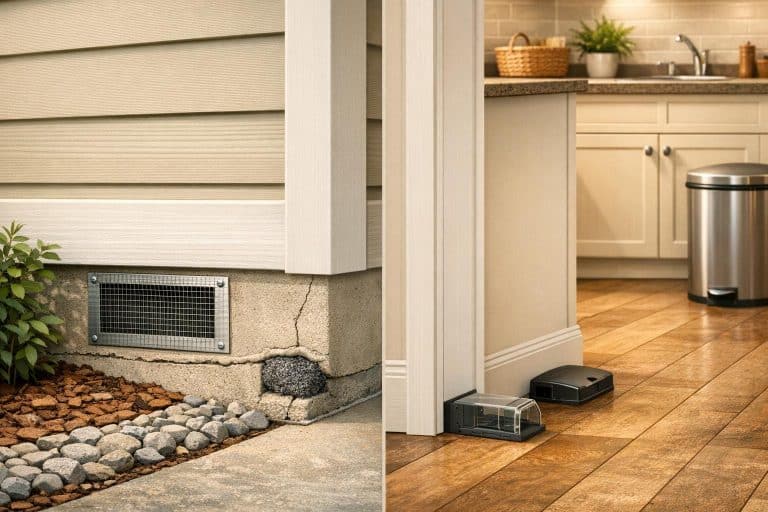
In addition to rebate assistance, Envirosmart Solution offers services like insulation installation, air sealing, mold remediation, and rodent proofing. Their expertise in building science helps identify hidden energy losses, such as gaps and leaks, that could be driving up your energy bills. They also offer annual maintenance packages, which include regular inspections and discounts on services.
2. Avista Home Improvement Program (Spokane & Coeur d’Alene Region)
Avista provides energy-saving rebates to residential and business customers in Washington, Idaho, and Oregon, aiming to lower energy use and enhance comfort. The program covers areas like Spokane in Washington and Kootenai County in Idaho, including towns such as Coeur d’Alene, Post Falls, Rathdrum, Athol, and Spirit Lake. These rebates are designed to help homeowners cut heating costs while improving comfort throughout the year, or calculate your energy upgrade savings to see the full impact. Here’s a breakdown of the key details and eligibility for the Avista Home Improvement Program.
Rebate Amount or Coverage
Rebate amounts vary by location. Homeowners in Washington and Idaho can receive $0.75 per square foot for insulation upgrades in attics, walls, and crawl spaces. In Oregon, the rebate for attic insulation is higher, at $1.50 per square foot, with those meeting income qualifications under the Savings Within Reach program receiving the same rate directly deducted from the contractor’s invoice.
Eligibility Requirements
Eligibility is determined by your location within Avista’s service area. For Oregon residents seeking attic insulation rebates, the current insulation must have an R-value of 18 or less, with upgrades required to reach R-38 or higher. Additionally, most rebates are available only for homes primarily heated by Avista-supplied fuel, such as natural gas. For detailed eligibility criteria, visit the Avista Rebate Overview page or call (800) 227-9187.
Additional Benefits or Features
Oregon customers can take advantage of on-bill repayment options, which allow upgrades to be financed without upfront costs. Across all service areas, Avista also offers project financing options to make energy-saving improvements more affordable over time.
3. Puget Sound Energy Weatherization Rebates (Greater Seattle Area)
Puget Sound Energy (PSE) provides instant attic weatherization rebates, applied directly to your contractor’s invoice. This program is designed for residential customers in the Greater Seattle Area and nearby counties who rely on PSE electricity or natural gas for primary heating. It makes energy efficiency upgrades more accessible while helping reduce heating costs.
Rebate Amount or Coverage
The rebate amounts depend on your home’s current insulation levels:
- Homes with R11 or less insulation: Get $1.75 per square foot when upgrading to R49, with a maximum rebate of $3,500.
- Homes with insulation between R12 and R19: Receive $0.50 per square foot, capped at $1,000.
- Attic air sealing: Qualifies for $0.20 per square foot, up to $400.
- Duct sealing and insulation improvements: Earn up to $1,000 per home.
These rebates help make significant energy-saving upgrades more affordable.
Eligibility Requirements
To qualify, homeowners must meet the following criteria:
- Approved contractors only: All work must be done by a PSE-approved contractor. DIY projects or non-approved contractors are not eligible.
- Age of home: Single-family homes built before 1990 (or manufactured homes built before 2001) qualify.
- Primary heat source: Homes must use PSE electricity or natural gas as the main heating source.
- Property type: The program is limited to single-family residences with four units or fewer.
PSE encourages homeowners to request a referral for pre-screened contractors and to compare multiple quotes for the best fit in terms of specifications, timelines, and warranties.
Additional Benefits or Features
- Higher rebates for income-qualified customers: Through PSE’s Efficiency Boost program, eligible homeowners can access increased rebate amounts.
- Federal tax credits: Combine PSE rebates with federal tax credits that cover up to 30% of qualifying project costs.
- Free weatherization services: PSE partners with local agencies through the HomeWise program to offer free weatherization services for low-income households, which can include insulation, air sealing, and ductless heat pump installations.
Next, learn how state and local incentives can further amplify your energy savings.
4. Energy Trust of Oregon Insulation Incentives (Oregon)
For homeowners in Oregon, Energy Trust offers cash incentives designed to make insulation upgrades more affordable while improving energy efficiency and comfort.
Energy Trust of Oregon partners with five major utilities across the state to provide these incentives. A key advantage? Contractors can often apply the incentive directly to your invoice, which means lower upfront costs for you and immediate savings on energy bills.
Rebate Amount or Coverage
The rebate amounts depend on the type of home and income level:
- Single-family homes and multiplexes (up to four units): $1.50 per square foot for attic insulation upgrades.
- Manufactured homes: $1.25 per square foot.
- Income-qualified households: Through the Savings Within Reach program, all home types – including manufactured homes – receive $1.50 per square foot.
Eligibility Requirements
To qualify, your existing attic insulation must meet specific criteria:
- Site-built homes: Insulation must be R-11 or less, with upgrades reaching at least R-38.
- Manufactured homes: Insulation must be R-18 or less, with upgrades reaching at least R-30.
The program is available for various property types, including owner-occupied and rental properties such as single-family homes, townhouses, manufactured homes, duplexes, triplexes, and fourplexes. However, the home must primarily be heated by one of these utilities: Portland General Electric (PGE), Pacific Power, NW Natural, Cascade Natural Gas, or Avista. Additionally, all work must be completed by an Energy Trust Trade Ally contractor, and applications must be submitted within 60 days of the installation date.
Additional Benefits or Features
Participants can take advantage of on-bill repayment options to finance upgrades, making the process even more accessible. Energy Trust incentives can also be combined with federal tax credits, which cover up to 30% of qualified costs. With an estimated 9 out of 10 homes under-insulated, these combined benefits offer a chance to save money, reduce energy waste, and enjoy a more comfortable living space.
5. Klickitat PUD Rebate Program (Klickitat County, Washington)
Klickitat PUD’s Energy Matchmaker program offers low-income households in Klickitat County attic insulation and other energy-saving upgrades. This initiative is made possible through funding from Washington State, combined with contributions from local utilities and the community, helping to minimize out-of-pocket expenses for participants.
Rebate Amount or Coverage
Rather than offering a standard per-square-foot rebate, the Energy Matchmaker program provides a full suite of weatherization services. These include attic, wall, and floor insulation, along with weatherstripping and furnace modifications. The program is supported by a mix of state and local funding, ensuring comprehensive energy efficiency improvements for eligible households.
Eligibility Requirements
The program is exclusively available to low-income families in Klickitat County. To access services like attic insulation, applicants must meet income requirements as outlined by state guidelines and verified by local community action agencies. The Klickitat-Skamania Development Council handles the screening process to confirm eligibility. Homeowners interested in applying should reach out to their local community action agency for assistance with eligibility and service coordination.
Additional Benefits or Features
In addition to insulation services, the program offers extra benefits for qualifying residents. Low-income seniors aged 62 and older can receive a discount of 5%–35% on winter utility bills by contacting Klickitat County Senior Services at 800-447-7858. Another key feature is Operation Warm Heart, a community-funded emergency energy assistance program. For immediate help, Goldendale residents can call 509-773-5891, while those in White Salmon should contact 509-493-2255. These added resources reflect the program’s focus on community-driven support and its alignment with other local energy-saving initiatives.
6. Oregon State HOMES Program (Statewide)
Oregon’s Home Efficiency Rebates (HOMES) program launched in spring 2026 with $113 million in federal funding from the 2022 Inflation Reduction Act. This program incentivizes homeowners to make energy-saving upgrades, focusing on improvements like attic insulation and air sealing.
Rebate Amount or Coverage
Homeowners can receive rebates covering 50% to 100% of project costs, capped at $10,000 per project. The percentage depends on household income and the level of energy savings achieved. Projects that deliver at least 35% energy savings qualify for higher rebates, while the minimum requirement is a 20% reduction in energy use.
"HOMES Program participants could receive between 50 to 100 percent of project costs up to $10,000, depending on the energy upgrades completed, the household’s income, and the project’s estimated energy savings." – Oregon Department of Energy
Participants can combine HOMES rebates with Energy Trust of Oregon incentives, which helps lower upfront expenses.
Eligibility Requirements
The program is open to both single-family and multifamily homes, including those that are owner-occupied or tenant-occupied. To qualify, an energy assessment must show at least 20% projected energy savings based on your home’s characteristics and energy usage history. Most upgrades must be handled by state-approved contractors, although some insulation projects may be self-installed with prior approval.
The application process involves two steps. First, applicants submit a pre-application through the Oregon Department of Energy portal to confirm income and property eligibility. After that, the contractor submits the project details for final approval. Income verification can be done using tax transcripts or proof of participation in programs like LIHEAP or SNAP. These guidelines apply across the state.
Service Area
The program is available statewide. Energy Trust of Oregon oversees implementation in areas served by investor-owned utilities (PGE, Pacific Power, NW Natural, Cascade Natural Gas, and Avista), while Earth Advantage manages operations in consumer-owned utility territories. Energy Trust of Oregon received about $25 million to manage the HOMES program in its service areas.
Additional Benefits or Features
The program supports a variety of energy-efficient upgrades, including heat pumps, on-demand water heaters, air sealing, and smart thermostats. It also collaborates with Community-Based Organizations to assist immigrant and low-income households with applications and income verification. Applications for individual homes began in spring 2026, with multifamily property upgrades and shared systems slated to start in summer 2026.
Program Comparison Table
The table below provides an easy-to-read summary of the rebate programs covered earlier. It highlights each program’s service area, eligibility requirements, and key benefits.
| Program Name | Service Area | Rebate Amount | Eligibility Criteria | Additional Benefits |
|---|---|---|---|---|
| Envirosmart Solution Rebate Assistance | Pacific Northwest (WA, OR, ID) | Maximizes all available rebates | Homeowners looking for energy efficiency upgrades | Guidance through rebate options and project management |
| Avista Home Improvement Program | Spokane & Coeur d’Alene regions (WA, ID) | Varies by project; on-bill financing available | Avista natural gas customers | On-bill repayment; enhanced incentives for Avista users |
| Puget Sound Energy Weatherization | Greater Seattle Area (PSE territory) | $0.50–$1.75 per sq ft (up to $3,500) | Homes built in 1989 or earlier; PSE must provide primary heating; PSE Trade Ally contractor required | Direct rebates applied to contractor invoices; air sealing rebates up to $400 |
| Energy Trust of Oregon | Oregon & SW Washington (PGE, Pacific Power, NW Natural, Cascade, Avista customers) | $1.50 per sq ft (standard); $1.25 per sq ft (manufactured homes) | Insulation rated R-11 or less; must use approved Trade Ally contractor | Extra incentives for income-eligible households; can combine with HOMES rebates |
| Klickitat PUD Rebate Program | Klickitat County, WA | Varies by project | Klickitat PUD customers | Promotes local energy savings |
| Oregon State HOMES Program | Statewide Oregon | 50%–100% of costs (up to $10,000) | At least 20% energy savings; approved contractors required; income verification may apply | Can be paired with Energy Trust rebates; supports heat pumps, air sealing, and smart thermostats |
Many programs require using approved contractors to qualify for rebates. Combining these rebates with federal tax credits (up to $1,200 annually) can help you save even more. Use the table to find the program that aligns best with your energy upgrade goals.
Conclusion
Attic rebate programs in the Pacific Northwest provide homeowners with a straightforward way to cut energy costs and improve home comfort. Upgrading attic insulation can lower annual energy expenses by at least 10%, while proper weatherization helps maintain consistent indoor temperatures and reduces the workload on your HVAC system.
Time is a key factor here – taking action quickly and working with experienced professionals is crucial. Partnering with pre-screened Trade Ally contractors ensures that your installation meets program requirements and allows you to combine utility rebates with federal tax credits for even greater savings. As Puget Sound Energy highlights:
"Weatherization is the foundation of a home’s energy efficiency. Weatherization prevents the loss of warm or cool air through unseen leaks and seams." – Puget Sound Energy
It’s worth noting that rebate funds often operate on annual budgets and might run out before the year ends. Before starting your project, check your current insulation levels, look for potential moisture or pest issues, and confirm that your home meets program criteria, such as age requirements or specific R-value targets.
For homeowners in Washington, Oregon, and Idaho, Envirosmart Solution simplifies the process. They offer end-to-end support – from evaluating your home to completing the installation – helping you take full advantage of available incentives while making your home more energy-efficient and comfortable.
FAQs
How do I find out my current attic insulation R-value?
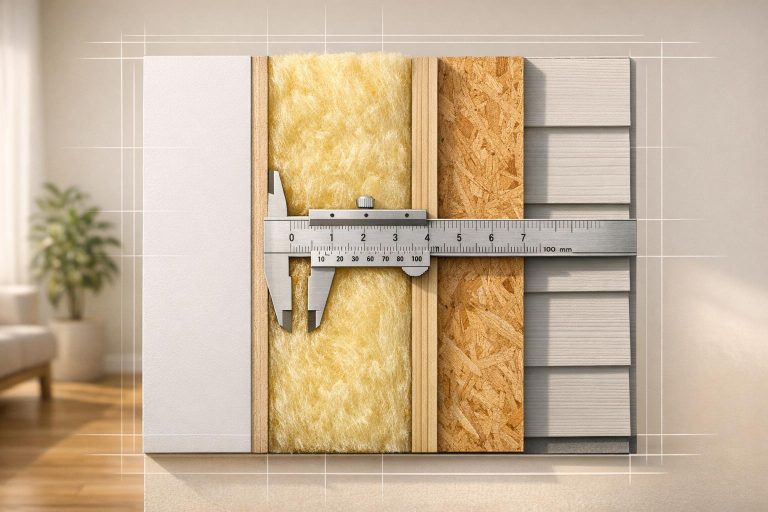
You can figure out your attic insulation’s R-value by either measuring its thickness or reviewing any available documentation. For instance, insulation with an R-30 rating is usually about 10 inches thick, while R-49 tends to be closer to 16 inches, though this can vary depending on the material used.
If reaching the insulation is tricky or you’re uncertain about your findings, it might be a good idea to bring in a professional energy auditor or insulation specialist. They can provide an exact measurement and recommend upgrades that align with current energy efficiency standards.
Can I combine utility rebates with federal tax credits for the same project?
You can absolutely combine utility rebates with federal tax credits for the same project. Thanks to the Inflation Reduction Act, federal tax credits are available through the end of 2025. Even better, these credits can be paired with local utility incentives in Oregon and other Pacific Northwest states. This combination lets you save even more on energy-efficient upgrades for your home.
What paperwork do I need before hiring an approved contractor?
Before bringing on a contractor for attic insulation or energy upgrades, you’ll usually need to provide documentation to qualify for rebates or incentive programs. This can include approvals from your utility company or proof that the work has been completed. For federal tax credits, such as the insulation tax credit, you’ll need to file IRS Form 5695 along with your receipts. Make sure to keep detailed records of all work performed, receipts, and certifications – this will help you stay compliant and make the claims process smoother.