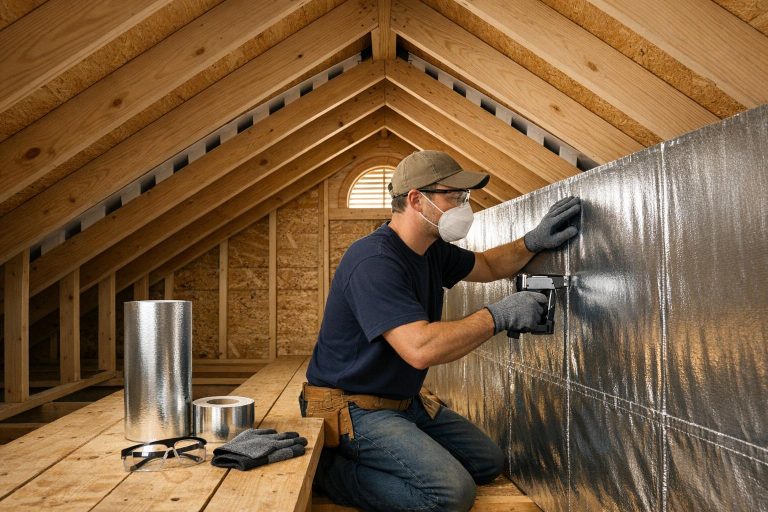

Want better home insulation? Start with R-value. It’s the key to measuring how well insulation resists heat transfer. Higher R-values mean better energy efficiency and lower utility bills. Here’s what you need to know:
- What is R-value? A measure of insulation’s resistance to heat flow. Materials like spray foam (R-6 to R-7 per inch) and fiberglass (R-2.2 to R-4.3 per inch) vary in effectiveness.
- Why it matters: Proper insulation reduces heating/cooling costs, keeps your home comfortable, and lowers strain on HVAC systems.
- Climate zones: The U.S. has 8 zones. Colder zones need higher R-values (e.g., R60 for attic insulation in Zone 4C and above).
- Where to insulate: Attics lose the most heat, so aim for R49–R60. Floors, walls, and basements also have specific R-value needs.
- Rebates and incentives: Programs like those in the Pacific Northwest offer rebates up to $2.50 per square foot for upgrades.
Pro tip: Combine insulation with air sealing for maximum savings. Upgrading insulation during construction is more cost-effective than retrofitting later.
Factors to Consider When Selecting R-Value
Climate Zones and R-Value Requirements
The U.S. is divided into eight climate zones, ranging from Zone 1 (the warmest areas like Hawaii and Guam) to Zone 8 (the coldest regions in Alaska). Your climate zone plays a key role in determining the minimum R-value you’ll need. As temperatures drop and the gap between indoor and outdoor conditions widens, insulation with higher R-values becomes crucial for maintaining comfort and energy efficiency.
In colder climates, insulation must provide greater thermal resistance to handle extreme temperature differences. For example, in Zone 1, an uninsulated attic typically requires R30 to R49, while Zones 4 through 8 call for R60 insulation to meet demands. Local building codes are another critical resource – they establish minimum insulation requirements based on your region and serve as a starting point for your project.
From here, it’s important to dive into the specific R-value needs for individual areas of your home.
R-Value Requirements by Home Area
Heat loss isn’t uniform across your home. Different areas require different R-values. Attics are a top priority because heat naturally rises, making the roof a major escape point. If your attic currently has less than 3 to 4 inches of insulation, upgrading to R49–R60 (depending on your climate zone) is one of the most effective ways to improve energy efficiency.
For unheated floors, R-value recommendations range from R13 in southern zones to R38 in northern zones. Walls, however, present unique challenges. A standard 2×4 wood-frame wall can hold cavity insulation up to R15, while a 2×6 wall can accommodate up to R21. In basement and crawlspace walls, Zones 4C and 5 through 8 require R15 continuous insulation or R19 batts to meet current standards.
Next, think about how your long-term energy goals might shape your insulation strategy.
Energy Efficiency and Long-Term Goals
If you’re aiming for a highly efficient or "Zero Energy Ready" home, you’ll likely want to go beyond the minimum requirements set by building codes. According to the U.S. Department of Energy, "it is more cost-effective to add insulation during construction than to retrofit it after the house is finished". This makes new construction the perfect time to invest in higher R-values for long-term savings.
Upgraded insulation often pays for itself in just a few years through lower utility bills. However, insulation works best when paired with proper air sealing. In fact, energy losses from air leaks can surpass those from conductive heat loss, even in a well-insulated home. To get the most out of your investment, consider conducting a home energy audit. This will help you assess current insulation levels and identify the areas where upgrades will have the biggest impact.
Understanding Insulation and R-Value | Ask This Old House

Recommended R-Values by U.S. Climate Zone
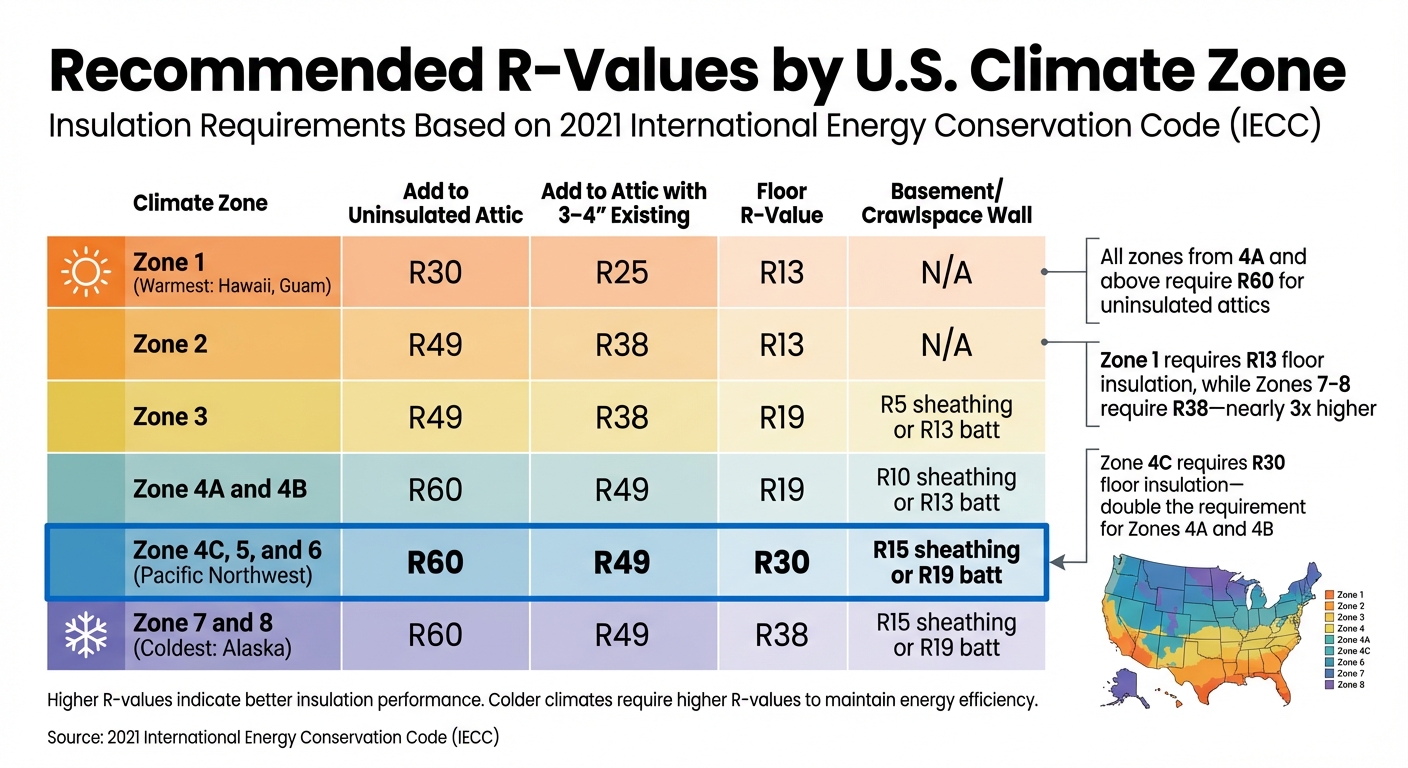
Recommended R-Values by U.S. Climate Zone for Attics, Floors, and Walls
R-Values for Pacific Northwest (Zone 4C)
The Pacific Northwest, which includes areas like the Greater Seattle and Puget Sound region, is classified as Climate Zone 4C, often referred to as a "Marine" climate. This zone is characterized by mild winters with average temperatures between 27°F and 65°F, cooler summers that stay below 72°F, and a distinct dry season during the summer months. Insulation requirements in Zone 4C are comparable to those in colder zones, such as Zones 5 and 6.
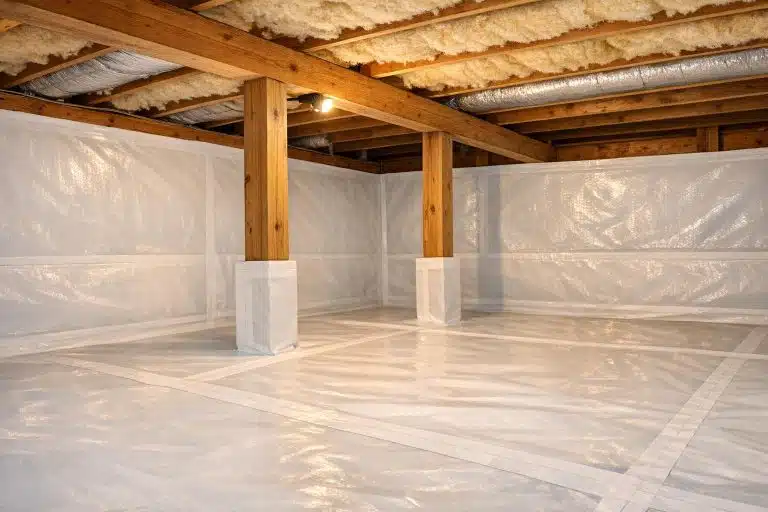
To meet Zone 4C standards, uninsulated attics should be upgraded to R60, while attics with 3–4 inches of existing insulation should be increased to R49. For floors above unconditioned spaces, such as crawlspaces, the recommended insulation level is R30, which is twice the R19 standard used in other Zone 4 areas. This additional insulation is essential for managing the damp and cool conditions typical of the Puget Sound climate.
For walls, basement or crawlspace walls should have either R15 insulative sheathing or R19 batt insulation. When replacing siding, it’s advised to use blown-in insulation for wall cavities and add R5–R10 sheathing beneath the new exterior. These measures align with the 2021 International Energy Conservation Code (IECC) standards, helping to reduce heat loss through the wood framing.
R-Value Comparison Table by Climate Zone
The table below highlights how insulation requirements vary across U.S. climate zones, reflecting differences in temperature and weather patterns. Notice that Zone 4C mandates R30 floor insulation, which is double the requirement for Zones 4A and 4B, despite all three sharing the same zone number.
| Climate Zone | Add to Uninsulated Attic | Add to Attic with 3–4" Existing | Floor R-Value | Basement/Crawlspace Wall |
|---|---|---|---|---|
| 1 | R30 | R25 | R13 | N/A |
| 2 | R49 | R38 | R13 | N/A |
| 3 | R49 | R38 | R19 | R5 sheathing or R13 batt |
| 4A and 4B | R60 | R49 | R19 | R10 sheathing or R13 batt |
| 4C, 5, and 6 | R60 | R49 | R30 | R15 sheathing or R19 batt |
| 7 and 8 | R60 | R49 | R38 | R15 sheathing or R19 batt |
Source: 2021 International Energy Conservation Code (IECC)
In the coldest zones, such as Zones 7 and 8, floor insulation requirements reach R38, nearly three times the R13 recommended for Zone 1. For homes in Zone 3 and above, slab edge insulation is also suggested to reduce heat loss through concrete foundations.
sbb-itb-8db64ac
Common Insulation Types and Their R-Values
Choosing the right insulation means balancing performance with installation needs. Among the most popular options – fiberglass, spray foam, and cellulose – each offers distinct R-value ranges and installation considerations. Let’s break down what makes each type unique.
Fiberglass Insulation
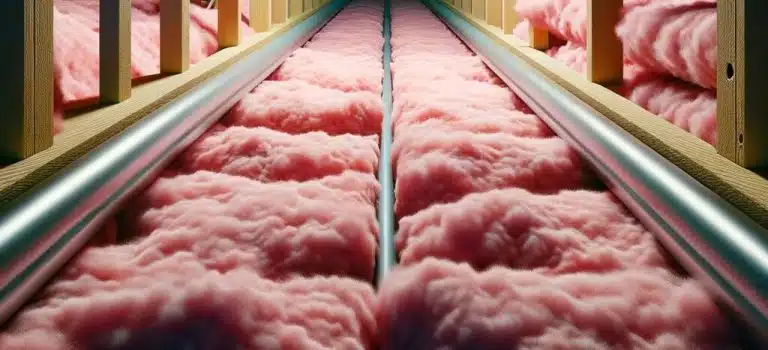
Fiberglass is widely used and comes in batts, rolls, or loose-fill forms. For standard 2×4 walls, you’ll typically find R-13 or R-15 batts, while 2×6 walls can accommodate R-19 or R-21 products. Made with 40%-60% recycled glass, fiberglass is an eco-conscious choice. It’s a solid option for unfinished walls, floors, and ceilings with standard stud spacing, and it’s well-suited for DIY projects. However, fiberglass alone doesn’t block airflow, so sealing any air leaks beforehand is critical for optimal energy efficiency.
Spray Foam Insulation
Spray foam offers higher R-values per inch compared to other materials. It comes in two types: closed-cell and open-cell. Closed-cell foam is denser, provides better moisture resistance, and delivers higher R-values, making it suitable for areas prone to dampness. Open-cell foam, while lighter and less expensive, isn’t ideal for below-ground use due to its tendency to absorb water. Unlike fiberglass, spray foam also acts as an air barrier, sealing small gaps and cracks throughout your home. Installation requires a professional, and though it’s pricier upfront, spray foam can eliminate the need for additional air-sealing measures like caulking or housewrap.
Cellulose Insulation
Cellulose is a loose-fill material made from recycled newsprint, offering an eco-friendly option. Its R-value depends on factors like settled density and thickness, with manufacturers providing charts to guide material usage for specific R-values. Over time, cellulose settles under its own weight, which means its R-value doesn’t increase proportionately with added thickness. It’s especially effective for unfinished attics, enclosed walls, and hard-to-reach spaces. Professional installation is usually necessary to achieve the right density and maintain consistent R-values as the material settles.
Understanding these insulation options can help you select the best fit for your R-value requirements and installation preferences.
How to Access Rebates and Incentives for Insulation Upgrades
You can make insulation upgrades more affordable by tapping into federal, state, and local utility rebates in the Pacific Northwest. These rebates are often applied directly as discounts on your contractor’s invoice, making the process straightforward and cost-effective.
Pacific Northwest Rebates and Incentives
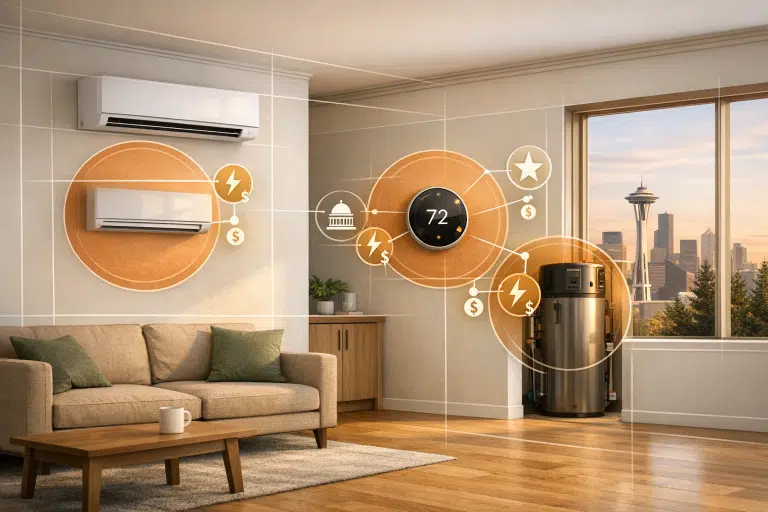
In the Pacific Northwest, major utilities offer rebates that significantly reduce upfront costs. For example, Puget Sound Energy provides rebates ranging from $0.50 to $1.75 per square foot for attic insulation and $2.50 per square foot for wall and floor insulation. Similarly, Energy Trust of Oregon offers rebates of up to $2.25 per square foot for qualifying homes.
Washington State is also gearing up to roll out two key rebate programs under the Inflation Reduction Act (IRA): the Home Appliance Rebate Program (HARP) for electrification projects and the Whole Home Efficiency Rebates (HOMES) for energy-saving retrofits. These programs will be accessible to households earning up to 150% of the Area Median Income (AMI). However, it’s important to note that rebates are not retroactive. As the Washington State Department of Commerce clarifies, "We can’t issue rebates for any purchases or work done before you’re approved for a rebate".
For income-qualified households, there are even greater savings opportunities. Programs like Oregon’s "Savings Within Reach" and Washington State’s Weatherization Program offer enhanced rebates for low-to-moderate-income families. Additionally, Puget Sound Energy has provided bundle bonuses of up to $400 for completing four weatherization measures. These programs aim to make energy efficiency upgrades accessible while simplifying the process for homeowners.
How Envirosmart Solution Can Help

Understanding the available rebates is just the first step – navigating the process to maximize savings requires expertise. That’s where Envirosmart Solution comes in. As a pre-approved Trade Ally with leading Pacific Northwest utilities, they specialize in helping property owners take full advantage of government, local, and vendor incentives. Their team handles everything, from verifying eligibility and conducting pre-installation assessments to applying rebates directly to your invoice.
With an estimated 90% of U.S. homes under-insulated, upgrading to the appropriate R-value not only improves comfort immediately but also delivers long-term energy savings. Envirosmart Solution ensures you get the most out of these financial incentives while making your home more energy-efficient.
Conclusion
Choosing the right R-value for your home is a practical way to lower energy costs, boost comfort, and even enhance your property’s value. Upgrading insulation not only provides immediate comfort but also offers long-term savings.
Start by understanding the requirements of your climate zone and focus on areas that make the biggest difference, like attics, which are major culprits for heat loss. R-value increases with layered insulation, but don’t forget to address air sealing first. For homeowners in the Pacific Northwest’s Climate Zone 4C, achieving an R-60 rating in uninsulated attics is ideal for year-round efficiency and comfort. These basics lay the groundwork for a smart insulation upgrade.
Proper insulation does more than keep your home cozy – it helps cut energy bills. By sealing air leaks and insulating key areas like attics, floors, and basements, you can reduce your total energy costs by an average of 11%. Plus, these upgrades often pay for themselves within just a few years through energy savings.
To make it even more affordable, rebates and incentives can significantly lower upfront costs. Federal tax credits, utility rebates, and regional programs, especially in the Pacific Northwest, make now the perfect time to upgrade your insulation. Envirosmart Solution, a pre-approved Trade Ally, can help you navigate these programs to ensure you get the most savings while achieving the optimal R-value for your home.
Investing in the right R-value is a cost-effective step toward greater comfort, energy efficiency, and long-term property value.
FAQs
How can I choose the right insulation R-value for my home?
Choosing the right insulation R-value is all about understanding your climate, the specific part of your home you’re insulating (like the attic, walls, or floors), and your energy-saving goals. The U.S. Department of Energy (DOE) has a handy guide that recommends R-values based on geographic location and climate zones, making it easier to decide what works best for your home.
In colder climates, higher R-values are essential to keep the heat in, while warmer areas benefit from lower R-values to help manage cooling costs. To get started, find your climate zone using an official map, and then match the recommended R-values to the different areas of your home for better energy efficiency and comfort.
If you’re feeling unsure or want expert advice, reaching out to professionals like Envirosmart Solution can make a big difference. They specialize in insulation installation and energy efficiency upgrades, offering personalized recommendations and helping you take advantage of local rebates and incentives.
Why is it beneficial to combine insulation with air sealing in your home?
Combining insulation with air sealing is a great way to boost your home’s energy efficiency and comfort. Air sealing works by cutting down on drafts and reducing uncontrolled air leaks, which helps maintain a steady indoor temperature. Pair that with insulation – designed to slow heat transfer through walls, floors, and ceilings – and you’ve got a powerful duo that enhances your home’s thermal performance. The payoff? Up to 20% lower heating and cooling costs, plus a cozier living space free of cold spots and pesky drafts.
Air sealing also adds an extra layer of protection for your insulation by keeping moisture out. This reduces the chances of mold growth and structural damage. On top of that, it can improve indoor air quality by limiting the entry of outdoor pollutants and allergens. Together, these two upgrades make your home more energy-efficient, durable, and healthier to live in – all while helping you save on utility bills in the long run.
How can I qualify for rebates and incentives when upgrading my insulation?
You can benefit from rebates and incentives for insulation upgrades through various federal, state, and local programs. For instance, the federal government provides a 30% tax credit (up to $1,200) for insulation and air sealing products installed between January 1, 2023, and December 31, 2032. To claim this credit, you’ll need to use IRS Form 5695 when filing your federal tax return.
On top of that, many states and local organizations offer additional rebates. Some utility companies or programs provide cash incentives to encourage homeowners to improve energy efficiency. It’s worth reaching out to your local energy provider or state energy office to see what options are available in your area.
If you’re located in the Pacific Northwest, Envirosmart Solution can help you navigate and maximize these rebates and incentives. They specialize in energy efficiency upgrades and offer expert advice to help you save money while making your home more comfortable and efficient.