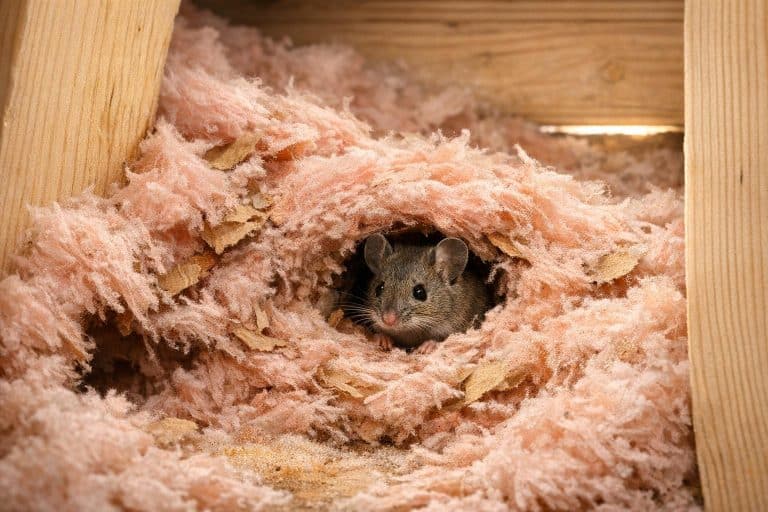

Rodent-proofing your home doesn’t have to rely on harmful chemicals. Instead, eco-friendly materials can provide long-lasting, safe, and effective solutions. Here are the top five materials to consider, each offering unique benefits for durability, ease of use, and performance in damp climates like the Pacific Northwest:
- Stainless Steel Wool: Rust-resistant and chew-proof, ideal for sealing small gaps.
- Hardware Cloth: Affordable steel mesh for larger openings; opt for stainless steel in wet areas.
- Copper Mesh: Flexible, rustproof, and perfect for irregular spaces.
- Aircrete Insulation: A professional-grade option that seals gaps and resists moisture.
- Cement-Bonded Wood Fiber: Tough, rodent-resistant boards that repel water and prevent rot.
Quick Tip: For small DIY fixes, stainless steel wool and copper mesh are simple and effective. For larger projects or maximum durability, consider professional installation of aircrete or cement-bonded wood fiber.
Below, we’ll break down the pros, costs, and suitability of each material to help you choose the best option for your home.
1. Stainless Steel Wool
Chew Resistance
Stainless steel wool creates a tough barrier that rodents simply can’t chew through. Its sharp, hard fibers are beyond the gnawing capabilities of most pests. For best results, tightly pack it into gaps and seal it with caulk or spray foam to keep it firmly in place.
Recyclability
This material is a long-lasting, non-toxic solution for pest control. Unlike traditional steel wool, which rusts and falls apart over time, stainless steel wool remains intact and is highly recyclable, aligning with sustainable construction practices.
Cost Range ($ per sq ft)
While more expensive than galvanized steel, stainless steel wool justifies its higher price with exceptional durability and resistance to rust. Prices can vary depending on the supplier and the quantity purchased.
Installation Ease
Installing stainless steel wool is straightforward. Simply pack it tightly into gaps smaller than 3/4 inch, then seal it with spray foam for added security. Be sure to wear gloves during installation to protect your hands from the sharp fibers.
Moisture Resistance (Pacific Northwest Suitability)
In regions like the Pacific Northwest, where moisture is a constant challenge, stainless steel wool outshines regular steel wool. It resists rust, maintaining its strength and appearance even in damp conditions. This makes it an excellent choice for sealing gaps around plumbing, foundations, and crawl spaces. By choosing stainless steel wool, you’re opting for a durable and eco-friendly solution to protect your home, setting the stage for exploring other resilient materials like hardware cloth.
2. Hardware Cloth
Chew Resistance
Hardware cloth, made from durable steel, is tough enough to withstand rodent gnawing. For the best results, use 19-gauge wire for rats and 24-gauge wire for mice, paired with a 1/4-inch by 1/4-inch mesh size .
Sustainability (Recyclability, Embodied Energy)
If you’re looking for a non-toxic way to keep rodents out, hardware cloth is a solid choice. It creates a physical barrier, eliminating the need for chemical rodenticides, which can harm both the environment and wildlife. For instance, barn owls rely on healthy rodent populations to survive. Made from galvanized or stainless steel, hardware cloth is fully recyclable and typically lasts 5 to 10 years .
Cost Range ($ per sq ft)
When it comes to affordability, hardware cloth stands out as one of the cheapest metal mesh options for rodent-proofing . Galvanized versions are the most budget-friendly, while stainless steel and vinyl-coated options offer better durability at a higher price point . Even so, it’s far less expensive than concrete solutions often used for protecting foundations.
Installation Ease
Installing hardware cloth is straightforward and requires only basic tools. You can cut it with tin snips, secure it with a staple gun, and shape it to fit gaps before sealing with foam or mortar . For extra protection, embed the mesh in fast-drying patching compound or expanding foam to prevent rodents from chewing exposed edges. In areas with high moisture, it’s better to use screws and washers instead of staples for added durability.
"Hardware cloth is cheap, and it can be installed at construction time with a staple gun and tin snips."
– Bill Wichers, Expert Member, Green Building Advisor
Moisture Resistance (Pacific Northwest Suitability)
In damp climates like the Pacific Northwest, galvanized hardware cloth can eventually rust. Opt for stainless steel mesh for longer-lasting protection in moisture-heavy areas. As Bill Wichers points out, "Stainless steel is impervious… you spend more money up front but you’re pretty much safe forever". This makes it an excellent choice for protecting crawl spaces, foundations, and other areas prone to moisture damage.
3. Copper Mesh
Chew Resistance
Copper mesh creates a tough barrier that rodents struggle to chew through. Its woven design, combined with sharp fiber edges, makes it unappealing for rodent teeth. When tightly packed into gaps, it eliminates any grip for their incisors to latch onto, effectively blocking their entry points.
Sustainability (Recyclability, Embodied Energy)
For those looking to maintain an eco-conscious home, copper mesh offers a chemical-free way to keep rodents out. It’s fully recyclable and built to last for years without losing its effectiveness. Made from pure copper, high-quality mesh is rustproof, stain-resistant, and even helps prevent bacterial growth.
Cost Range ($ per sq ft)
Copper mesh is available in different roll sizes to suit various needs. A 20-foot roll costs about $12.09, while larger 100-foot rolls range between $26.55 and $39.99. For a standard roll that’s 5 inches wide, this translates to approximately $0.54 to $1.45 per square foot, depending on the size you purchase.
Installation Ease
One of the standout features of copper mesh is how easy it is to install. No special tools are needed – just crumple it and press it firmly into gaps, like cracks, weep holes, or openings near plumbing and vents. For a more permanent fix, you can combine it with a quick-drying patching compound before inserting it. Its flexibility allows it to fit snugly into irregular spaces, making it especially useful for sealing tricky areas like A/C vents.
Moisture Resistance (Pacific Northwest Suitability)
Unlike steel wool, which rusts and can leave unsightly stains, copper mesh is completely rustproof and doesn’t stain surfaces. This makes it an excellent choice for areas with high humidity, like the Pacific Northwest. Its resistance to corrosion ensures it holds up in damp conditions, and its low thermal expansion means it keeps its shape even with temperature changes. This durability makes it a reliable option for wet climates.
4. Aircrete Insulation
Chew Resistance
Aircrete, a cement-based foam that hardens into a solid mineral structure, is excellent at sealing gaps and keeping rodents out. Its inorganic makeup isn’t appealing to rodents and is tough enough to withstand their incisors. When injected into wall cavities, it expands to fill every gap and hardens fully, leaving no room for burrowing or pathways.
Sustainability
For homeowners looking for an eco-conscious option, aircrete stands out. It’s nontoxic, nonflammable, and crafted from minerals like magnesium oxide, which is sourced from seawater. It delivers up to 10 times the insulating power of standard concrete while being around 80% air by volume. Unlike petroleum-based foam insulations, its mineral-based composition makes it a more environmentally responsible choice for long-lasting rodent defense.
Cost Range ($ per sq ft)
Aircrete pricing is comparable to polyurethane foam, reflecting the need for professional installation and specialized tools. Costs will vary depending on the size and location of your project.
Installation Ease
Aircrete installation isn’t a DIY job – it requires trained professionals using specialized equipment. The material is pumped as a liquid foam, similar in texture to shaving cream, into closed wall cavities. This method ensures complete coverage without gaps, which is critical for keeping rodents out. Plus, the process enhances aircrete’s durability, even in damp environments.
Moisture Resistance (Pacific Northwest Suitability)
Aircrete’s inorganic composition means it doesn’t support mold or mildew, making it a good fit for humid climates. However, in areas like the Pacific Northwest, adding a vapor retarder might be necessary since some building codes don’t classify aircrete as a vapor barrier. This additional layer helps manage moisture while keeping its rodent-proof qualities intact.
5. Cement-Bonded Wood Fiber Insulation
Chew Resistance
Cement-bonded wood fiber offers a hard, smooth surface that is well-known for being resistant to rodents. Its dense structure turns ordinary wood chips into a tough barrier, far more durable than standard wood siding. Matt Greenfield, a home improvement expert, highlights this advantage:
"Wood siding is an open invitation for rodents, as it’s easy to chew through. Opt for fiber cement boards instead – they’re much tougher and rodent-resistant".
Unlike softer insulation materials, this rigid option is uncomfortable for rodents to chew or tunnel through. For the best results, use boards that are at least 2 inches thick if reinforced, or 3.75 inches thick if not.
Sustainability
Cement-bonded wood fiber has the added benefit of storing atmospheric carbon throughout its lifecycle. It’s made using softwood chips and lumber scraps, turning what would otherwise be waste into a durable building material sourced from responsibly managed forests. Thomas Basciani, owner of Basciani and Sons Company, shares:
"Timberfill is made in the USA… and is manufactured with recycled wood scrapes from sustainably managed forests. Healthy for our customers, staff and the environment".
The combination of recycled wood fiber and cement sets this material apart from other rodent-resistant options, offering both durability and eco-conscious benefits.
Installation Ease
Installing cement-bonded wood fiber boards is straightforward with standard tools. A circular saw fitted with 20 to 30 teeth ensures clean cuts. The material is non-irritating and free from VOCs and formaldehyde, making it more comfortable to handle than fiberglass. To maximize effectiveness, seal any gaps larger than 1/4 inch with caulk or metal mesh to block rodent entry. For exterior use, maintain at least 6 inches of clearance between the insulation and soil to deter wood-destroying pests. This ease of installation, paired with its environmental benefits, makes it a practical and eco-friendly choice for rodent-proofing.
Moisture Resistance (Pacific Northwest Suitability)
In damp regions like the Pacific Northwest, moisture resistance is crucial. Cement-bonded wood fiber boards are vapor-open, meaning they repel liquid water while allowing humidity to escape. TimberBoard products, for example, have vapor permeability ratings of 15–22 perms at 1 inch thickness, which helps building envelopes dry quickly. Additives like paraffin wax further enhance water resistance in rainy conditions. This breathability prevents mold and rot, which often attract pests, making it an excellent choice for areas with both high rainfall and rodent concerns.
sbb-itb-8db64ac
How To Prevent Rats & Mice Rodent Proofing Your Home For Rat Control Without Poisons Or Rat Traps.
Material Comparison Table
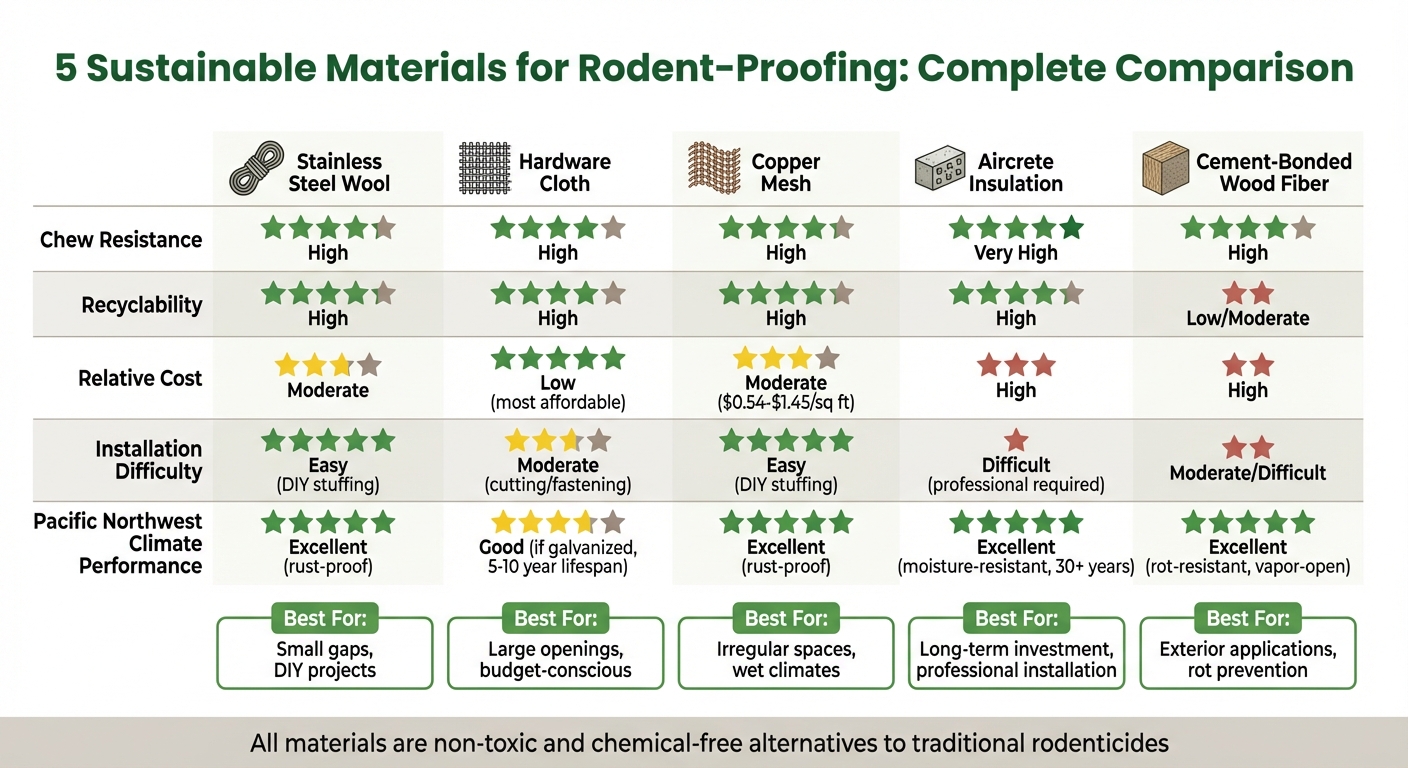
Comparison of 5 Sustainable Rodent-Proofing Materials: Cost, Durability, and Climate Performance
Selecting the best rodent-proofing material involves weighing factors like durability, cost, ease of installation, and how well it holds up in the Pacific Northwest (PNW) climate. The table below outlines how five materials stack up across these criteria.
| Material | Chew Resistance | Recyclability | Relative Cost | Installation Difficulty | PNW Climate Performance |
|---|---|---|---|---|---|
| Stainless Steel Wool | High | High | Moderate | Easy (Stuffing) | Excellent (Rust-proof) |
| Hardware Cloth | High | High | Low | Moderate (Cutting/Fastening) | Good (If galvanized) |
| Copper Mesh | High | High | Moderate | Easy (Stuffing) | Excellent (Rust-proof) |
| Aircrete Insulation | Very High | High | High | Difficult (Professional) | Excellent (Moisture-resistant) |
| Cement-Bonded Wood Fiber | High | Low/Moderate | High | Moderate/Difficult | Excellent (Rot-resistant) |
Key Insights on Each Material
- Hardware Cloth: This is the most budget-friendly choice for covering large openings like vents. When not galvanized, it typically lasts 5 to 10 years. Installation involves cutting and fastening, which requires some tools but is manageable for most DIYers.
- Stainless Steel Wool and Copper Mesh: These materials are perfect for sealing smaller gaps, especially in the PNW’s wet climate. Both are rust-proof and offer long-term value. Their simplicity makes them ideal for DIY projects – just stuff them into gaps for quick and effective protection.
- Aircrete Insulation: While it offers unmatched durability (lasting over 30 years), aircrete comes with higher upfront costs and requires professional installation. Its moisture resistance makes it a strong contender for long-term rodent-proofing in damp climates.
- Cement-Bonded Wood Fiber: This material provides excellent protection against rodents and resists rot in wet conditions. However, it’s less recyclable and can be trickier to install, sometimes requiring professional assistance.
Each material has strengths tailored to different needs. For a cost-effective solution, hardware cloth is a great starting point. For smaller gaps or wet climates, stainless steel wool and copper mesh strike a good balance between affordability and ease of use. If you’re ready to invest in a long-term solution, aircrete or cement-bonded wood fiber might be worth considering. Match the material to your budget, climate, and DIY skills for the best results.
Professional Rodent-Proofing Services
While DIY methods can be helpful, professional rodent-proofing services offer a more thorough and lasting solution. Experts conduct detailed inspections of areas like attics and crawl spaces, identifying hidden vulnerabilities such as plumbing gaps, foundation cracks, and roofline openings that are often missed.
The focus of professional rodent-proofing is on permanent exclusion rather than quick fixes. Instead of relying on traditional extermination techniques, specialists seal entry points using materials like premium wire mesh and metal flashing – both of which are resistant to gnawing. By addressing these gaps and safeguarding elements like insulation and HVAC systems, this approach not only keeps rodents out but also improves home security and energy efficiency.
One example is Envirosmart Solution’s CRAWL SPACE & ATTIC CARE™ plan, which costs $199 annually. This plan includes regular rodent inspections and a 15% discount on recommended rodent-proofing or repairs. This proactive maintenance ensures exclusion measures remain effective, even as weather or structural changes create new vulnerabilities. This is especially crucial during the Pacific Northwest’s wet seasons, when rodents are more likely to seek shelter indoors.
Professional services also address health and safety concerns. They remove contaminated insulation, nesting materials, and moisture-damaged items that attract pests. Rodent droppings and urine can spread diseases like Hantavirus, Salmonella, and Leptospirosis. To put it in perspective, a single rat can eat about half a pound of food per week while contaminating up to ten times that amount.
Technicians also bring valuable insights into rodent behavior. For instance, they recommend trimming vegetation and tree limbs so they’re at least 6 to 10 feet away from rooflines to prevent rodents from using them as highways. They also advise on managing outdoor attractants like woodpiles and overgrown shrubs. By combining these strategies with durable materials, professionals create a robust defense system that not only keeps rodents out but also supports energy-efficient and sustainable home management. These integrated measures ensure your home stays protected in the long run.
Conclusion
Opting for sustainable materials to rodent-proof your home does more than just keep pests at bay. Materials like stainless steel wool, copper mesh, and hardware cloth act as long-lasting physical barriers, far outperforming the temporary fixes offered by chemical solutions. Unlike traditional poisons that only provide short-term population control, these eco-conscious methods tackle the root of the problem while safeguarding your family, pets, and local wildlife from harmful toxins. This fits seamlessly into the broader approach to sustainable home maintenance outlined earlier.
The risks of traditional methods can’t be ignored. Rodenticides, for example, not only endanger children through accidental poisoning but also disrupt the food chain by introducing toxins into the environment.
"Choosing eco-friendly rodent control is more than a pest management strategy – it’s a commitment to your home, your family, and the world we all share." – Rodent Control Inc.
While sustainable materials might require a higher initial investment, they pay off in the long run by reducing repair costs and improving energy efficiency. For instance, sealing air leaks with these materials can cut winter heating losses by as much as 33%. These financial and energy savings emphasize the value of focusing on long-term home efficiency.
For the best results, professional installation is key. Experts ensure that every potential entry point – from utility openings to foundation cracks – is properly sealed, creating a durable and energy-efficient barrier. Take, for example, Envirosmart Solution’s CRAWL SPACE & ATTIC CARE™ plan, which offers annual inspections for $199 to maintain the effectiveness of your rodent-proofing system. By choosing sustainable materials, you’re not only managing pests but also making a meaningful investment in environmental responsibility and the long-term care of your home.
FAQs
What makes eco-friendly materials a better choice for rodent-proofing your home?
Eco-friendly materials for rodent-proofing bring a range of benefits compared to traditional methods. For starters, they’re much safer for both your home and the environment. By avoiding harmful chemicals and pesticides, these materials reduce risks to people, pets, and local wildlife, offering a healthier alternative for pest control.
Many of these options rely on durable physical barriers like steel mesh or other chew-resistant materials. These barriers create a long-lasting defense, cutting down on the need for repeated treatments. Over time, this approach not only proves more effective but also saves money.
Opting for eco-friendly materials reflects a commitment to both health-conscious living and sustainable home care. It’s a responsible way to protect your home while minimizing environmental impact.
What are the best rodent-proofing materials for my home and climate?
Choosing the right materials to keep rodents out depends on factors like your local climate, the types of rodents in your area, and the specific needs of your home. For sealing small gaps, heavy-duty metal mesh or steel wool with openings no larger than 1/4 inch is a solid choice and works well in most settings. In colder climates, insulating foam with a bittering agent can help block gaps, but it’s best to pair it with stronger materials to withstand temperature fluctuations.
If you’re dealing with areas where rodents might nest, consider using pest-resistant insulation such as cellular glass, which is durable and discourages gnawing. Other sturdy options include aircrete or cement-bonded wood fiber products, which are both long-lasting and naturally rodent-resistant. To further protect your home, you can use smooth, hard surfaces on lower exterior walls and install metal screens over vents to minimize entry points and nesting spots.
By combining these rodent-resistant materials with effective sealing techniques, you can create a tailored solution that keeps your home protected.
Can I install sustainable rodent-proofing materials myself, or should I hire a professional?
Sealing up small gaps around pipes and vents with materials like steel wool, caulk, or mesh can be a straightforward DIY project. With the right tools and some careful attention to instructions, these smaller tasks are often manageable on your own.
But when it comes to more challenging jobs – like closing off larger openings, installing vent screens, or setting up rodent-proof barriers – bringing in a professional is usually the smarter move. Professionals have the expertise to seal every potential entry point and use materials designed to last. Plus, they minimize the risk of errors that could leave openings for rodents to sneak back in. For thorough and dependable protection, professional help is often the way to go.