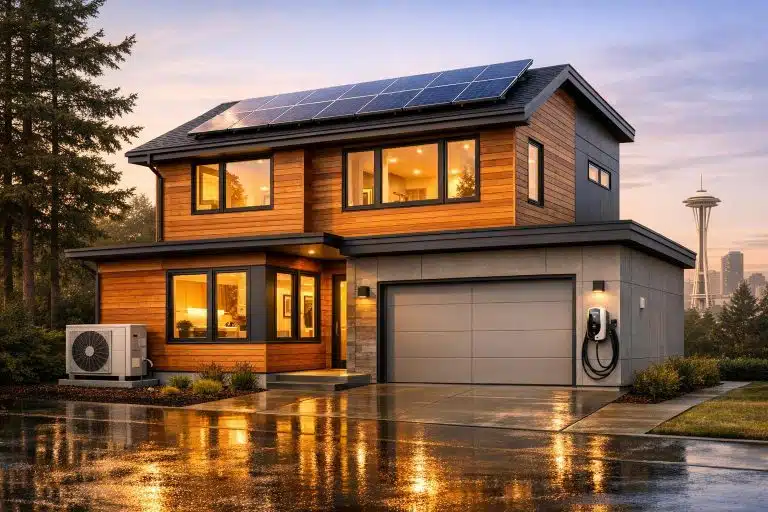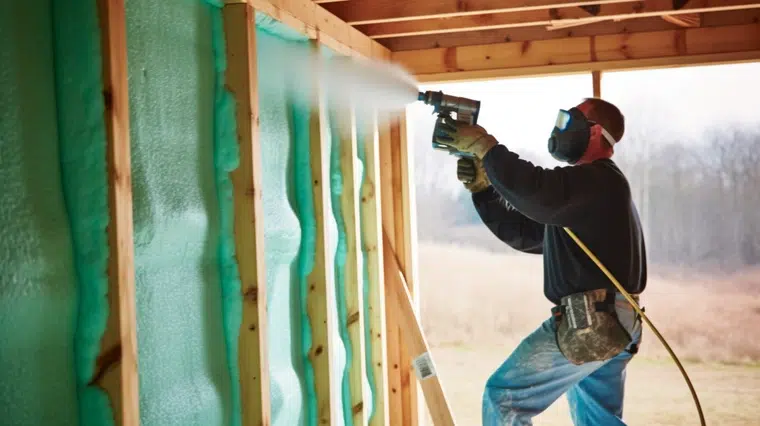

R402.2 is a section of the International Energy Conservation Code (IECC) that sets insulation requirements for residential buildings. These standards ensure energy efficiency, lower heating and cooling costs, and improve indoor comfort. Key highlights include:
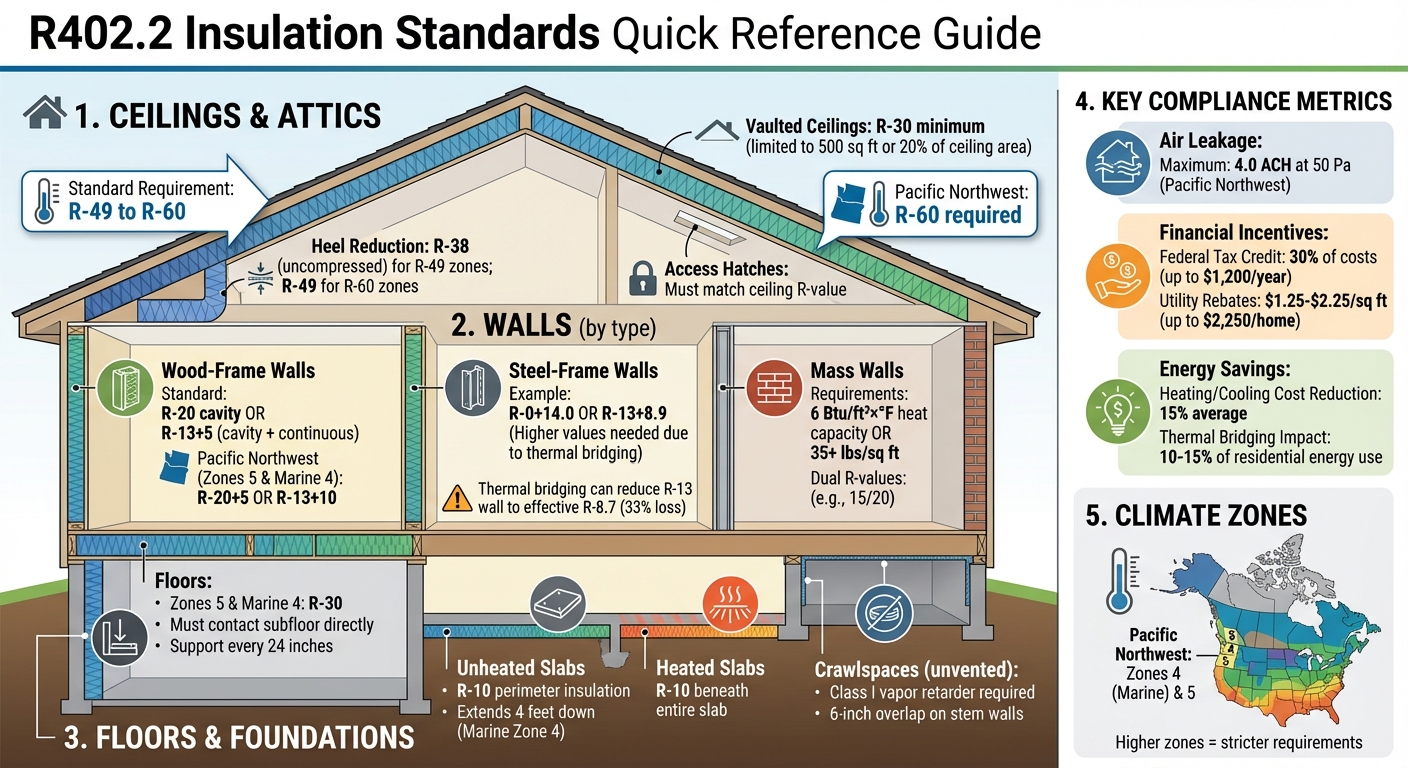
- Ceilings and Attics: Insulation levels range from R-49 to R-60, with allowances for reduced R-values in specific cases (e.g., vaulted ceilings).
- Walls: Requirements vary by material and climate zone, with wood-frame walls typically needing R-20 cavity insulation or combinations like R-13 cavity + R-5 continuous insulation.
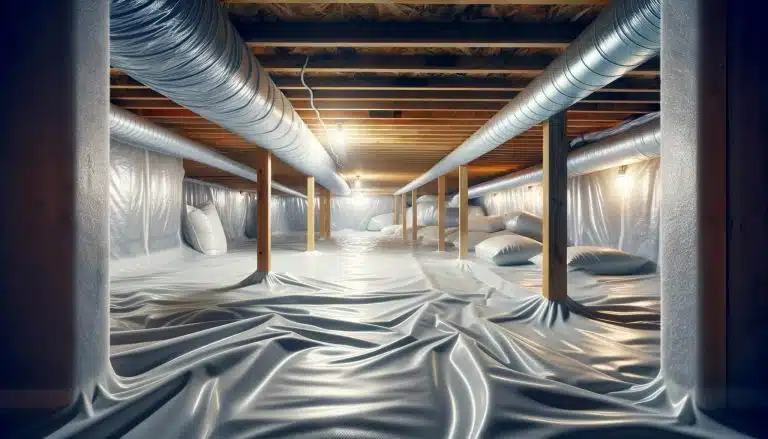
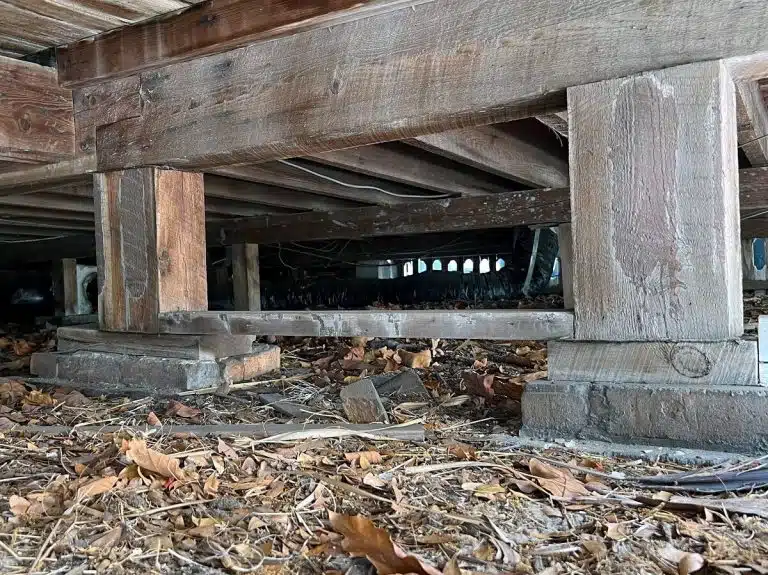
- Floors and Crawlspaces: Insulation must stay in direct contact with subflooring, and unvented crawlspaces require vapor barriers.
- Climate Zones: Insulation values differ based on the home’s location, with stricter rules in colder zones like the Pacific Northwest (e.g., R-60 for ceilings).
Proper installation and air sealing are critical, as they maximize energy savings and qualify homeowners for tax credits and rebates, such as a 30% federal tax credit (up to $1,200 annually) and local utility incentives.
This guide helps you understand how to meet R402.2 requirements and benefit from energy-efficient upgrades.
R402.2 Insulation Requirements by Building Component and Climate Zone
Key Insulation Requirements in R402.2
Ceilings and Attic Spaces
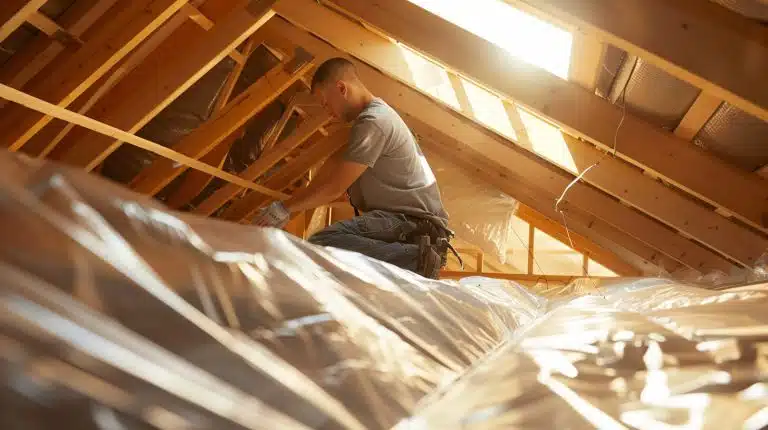
R402.2 outlines insulation standards for ceilings and attic spaces, specifying R-values between R-49 and R-60 to help homes maintain comfortable indoor temperatures year-round.
The "heel" reduction rule allows for some flexibility: in zones requiring R-49, uncompressed R-38 insulation can cover the full wall top plate; similarly, uncompressed R-49 insulation meets the R-60 requirement.
For areas with limited space, like vaulted ceilings, the code permits R-30 insulation as a minimum. However, this reduction is capped at 500 square feet or 20% of the total insulated ceiling area, whichever is smaller. Access hatches and doors must also match the surrounding ceiling’s R-value. In Climate Zones 0 through 4, horizontal pull-down stair hatches can use R-10 insulation if at least 75% of the panel reaches R-13.
Vented attics with air-permeable insulation require baffles to ensure airflow and prevent blockages. Steel-frame ceilings demand higher R-values compared to wood-frame assemblies. For example, where wood framing requires R-30, steel trusses might need R-38 or an equivalent combination like R-30 cavity insulation paired with R-3 continuous insulation.
The next section of R402.2 focuses on wall insulation, with specific guidelines based on construction type and climate.
Wall Insulation Types and R-Values
R402.2 sets distinct insulation standards for walls, tailored to different materials and climates.
For wood-frame walls, the typical requirement is R-20 cavity insulation or a combination such as R-13 cavity insulation plus R-5 continuous insulation (noted as 13+5). In Washington State’s Climate Zones 5 and Marine 4, the standards increase to 20+5 or 13+10.
Steel-frame walls have stricter requirements to counteract thermal bridging. For instance, a wood-frame standard of R-20 might translate to steel-frame methods like R-0+14.0 or R-13+8.9. Reference steel-frame equivalency tables to determine the appropriate values.
For mass walls – built from materials like concrete block, insulated concrete forms (ICF), or solid timber – specific guidelines apply. These walls must have a heat capacity of at least 6 Btu/ft²×°F or weigh at least 35 pounds per square foot. They often list two R-values (e.g., 15/20), with the second value applying when more than half the insulation is placed on the interior side.
Basement walls, which fall under below-grade assemblies, must be insulated from the top of the wall down to either 10 feet below grade or the basement floor, whichever is less. In Climate Zones 6 and 7, this typically involves R-15 continuous or cavity insulation.
Floors, Crawlspaces, and Slabs
Floor insulation must maintain direct contact with the subfloor. In Climate Zones 5 and Marine 4, R-30 insulation should be installed with supports every 24 inches to ensure thermal consistency [[8]](https://lawfilesext.leg.wa.gov/law/WACArchive/2024/htm/WAC 51 – 11R CHAPTER/WAC 51 – 11R-40220.htm).
For slab-on-grade foundations, unheated slabs require R-10 insulation around the perimeter, extending 4 feet downward in Marine Zone 4. Heated slabs, on the other hand, need R-10 insulation beneath the entire slab area [[8]](https://lawfilesext.leg.wa.gov/law/WACArchive/2024/htm/WAC 51 – 11R CHAPTER/WAC 51 – 11R-40220.htm).
In crawlspaces, wall insulation is mandatory unless the crawlspace is vented to the outdoors and the floor above meets code insulation standards. For unvented crawlspaces, a Class I vapor retarder must cover the ground, with overlapping joints sealed or taped. The barrier should extend at least 6 inches up the stem walls and be securely attached.
When insulating the interior of below-grade walls, the code specifies using R-5 rigid board as a thermal break between the concrete wall and floor slab. This prevents heat conduction through the concrete [[8]](https://lawfilesext.leg.wa.gov/law/WACArchive/2024/htm/WAC 51 – 11R CHAPTER/WAC 51 – 11R-40220.htm). Additionally, any slab or foundation insulation extending outward must be protected from damage and UV exposure, either by pavement or by covering it with at least 10 inches of soil [[8]](https://lawfilesext.leg.wa.gov/law/WACArchive/2024/htm/WAC 51 – 11R CHAPTER/WAC 51 – 11R-40220.htm).
sbb-itb-8db64ac
How Climate Zones Impact Insulation Standards
Understanding Climate Zone Classifications
Climate zones play a critical role in determining the level of insulation your home needs to maintain a comfortable indoor environment throughout the year. In North America, the International Energy Conservation Code (IECC) has divided the region into 8 distinct climate zones. These classifications are based on historical weather patterns and help establish minimum R-value standards for walls, ceilings, and floors.
Knowing your specific climate zone can help you avoid costly issues like thermal bridging. This occurs when heat escapes through framing members, significantly lowering the insulation’s overall effectiveness. For example, a typical 2×4 wall with R-13 cavity insulation may only deliver an effective whole-wall R-value of R-8.7 due to thermal bridging – a staggering 33% drop in performance. To combat this, building codes often require continuous insulation (ci) to supplement cavity insulation. Continuous insulation creates an uninterrupted thermal barrier, significantly boosting energy efficiency.
Proper insulation not only reduces the strain on HVAC systems but also enhances the durability of your home by managing moisture and temperature fluctuations. In fact, combining insulation with air sealing can cut heating and cooling costs by up to 15%.
These zone-specific guidelines are particularly important for regions like the Pacific Northwest, which face unique climate challenges.
Insulation Requirements for the Pacific Northwest
Washington State, which spans Climate Zone 4 (Marine) and Climate Zone 5, has some of the most stringent insulation requirements. Gus Koedding from Pacific Insulation & Remediation explains:
"The state falls into Climate Zones 5 and Marine 4, requiring robust insulation and airtight construction."
For both zones, homes must feature high-performance building envelopes. Specifically, ceilings and attics must meet a prescriptive insulation requirement of R-60. Wood-frame walls are required to achieve a U-factor of 0.056, which is typically met through one of two methods:
- R-20 cavity insulation combined with R-5 continuous insulation, or
- R-13 cavity insulation paired with R-10 continuous insulation.
Additionally, slab-on-grade floors must have R-10 insulation extending 4 feet from the slab edge. Air leakage rates are also tightly controlled, with a maximum of 4.0 air changes per hour (ACH) for any dwelling, regardless of the compliance path. These rigorous standards address the Pacific Northwest’s diverse climate conditions – ranging from the humid, mild winters of Marine Zone 4 to the colder, drier weather in Zone 5.
To help homeowners in the Pacific Northwest navigate these requirements, Envirosmart Solution offers tailored insulation services. They ensure homes meet or exceed R402.2 standards while also helping residents take full advantage of energy efficiency rebates and incentives. Their expertise ensures your home is both energy-efficient and compliant with local codes.
Ensuring Compliance with R402.2
Professional Installation and Inspection
Complying with R402.2 standards involves precise scheduling, thorough testing, and third-party verification. After cavity insulation is installed, professional inspections are required to verify compliance. Certified inspectors conduct blower door tests to confirm air leakage stays below 4.0 ACH at 50 Pa, with detailed reports submitted for code approval. They also check critical areas such as eave baffles, weatherstripped access hatches, and consistent R-values throughout the building envelope – common issues that often lead to inspection failures.
This detailed process not only ensures compliance but also enhances your home’s energy efficiency. Companies like Envirosmart Solution specialize in guiding homeowners in the Pacific Northwest through these steps. Their services cover everything from pre-concealment inspections to final air-tightness testing, helping homeowners meet or exceed R402.2 standards while avoiding costly mistakes. Plus, these upgrades often qualify for financial incentives, adding even more value.
Maximizing Rebates and Incentives
Upgrading your home to meet R402.2 standards can be pricey, but federal tax credits and utility rebates can help offset those expenses significantly. Homeowners can claim a 30% federal tax credit on project costs, up to $1,200 per year, for insulation and air sealing. On top of that, local utility programs offer cash rebates ranging from $1.25 to $2.25 per square foot, with some rebates reaching up to $2,250 per home.
To qualify for most rebate programs, you’ll need to work with an approved contractor and submit your applications within 60 days of installation. Required documentation typically includes professional invoices and insulation certificates. Envirosmart Solution simplifies this process by helping homeowners identify eligible rebates, handling the paperwork, and ensuring all installations meet R402.2 standards as well as rebate requirements. Their expertise transforms compliance into a smart, cost-effective investment in your home’s energy performance.
Module 5 Insulation Installation Requirements
Key Takeaways for Homeowners
R402.2 standards are designed to help homeowners save money while keeping their homes comfortable throughout the year. These standards address significant energy issues, like thermal bridging – which accounts for 10% to 15% of residential energy use – and air leakage, which can lead to mold growth and even structural damage. When insulation and air sealing are done correctly, they can cut heating and cooling costs by an average of 15%.
However, the benefits of these energy-saving measures rely on proper, professional installation. Even small errors can have a big impact on your home’s efficiency. In fact, only about half of homes meet the "Grade I" installation standard, which is necessary for peak performance. Professional installers ensure everything is done right, avoiding costly mistakes and meeting all testing requirements. As Gus Koedding from Pacific Insulation & Mold Remediation explains:
"For homeowners, it [code compliance] means lower utility bills and higher indoor comfort".
A qualified contractor takes care of every detail, from installing eave baffles and weatherstripping access hatches to arranging third-party blower door tests. They also handle the documentation needed to qualify for rebates, saving you time and hassle.
On top of improving performance, these upgrades come with financial perks. Federal tax credits and local rebates can significantly offset the cost of these improvements. Companies like Envirosmart Solution specialize in helping Pacific Northwest homeowners take full advantage of these incentives by managing both the technical requirements and all necessary paperwork.
FAQs
How do I find my home’s IECC climate zone?
To determine your IECC climate zone, start by consulting the climate zone map, which categorizes regions based on weather patterns and other conditions. If you need precise details, reach out to your local building department – they can provide accurate zoning information specific to your area. Additionally, the International Energy Conservation Code (IECC) offers detailed maps and resources to help you pinpoint your zone.
What’s the difference between cavity insulation and continuous insulation?
Cavity insulation fits between wall framing members, but these framing elements can act as thermal bridges, allowing heat to pass through and reducing the insulation’s overall efficiency. In contrast, continuous insulation creates an uninterrupted layer over structural components, significantly cutting down on thermal bridging and boosting energy efficiency. This difference plays a key role in complying with energy codes like R402.2 and enhancing a home’s thermal performance.
What documents do I need to claim insulation tax credits and rebates?
To qualify for insulation tax credits and rebates, make sure you keep receipts and any documentation that shows the product meets the necessary standards. This includes things like manufacturer certifications and proof that the insulation complies with energy efficiency requirements. Double-check that all your records are accurate and store them securely for future use.