
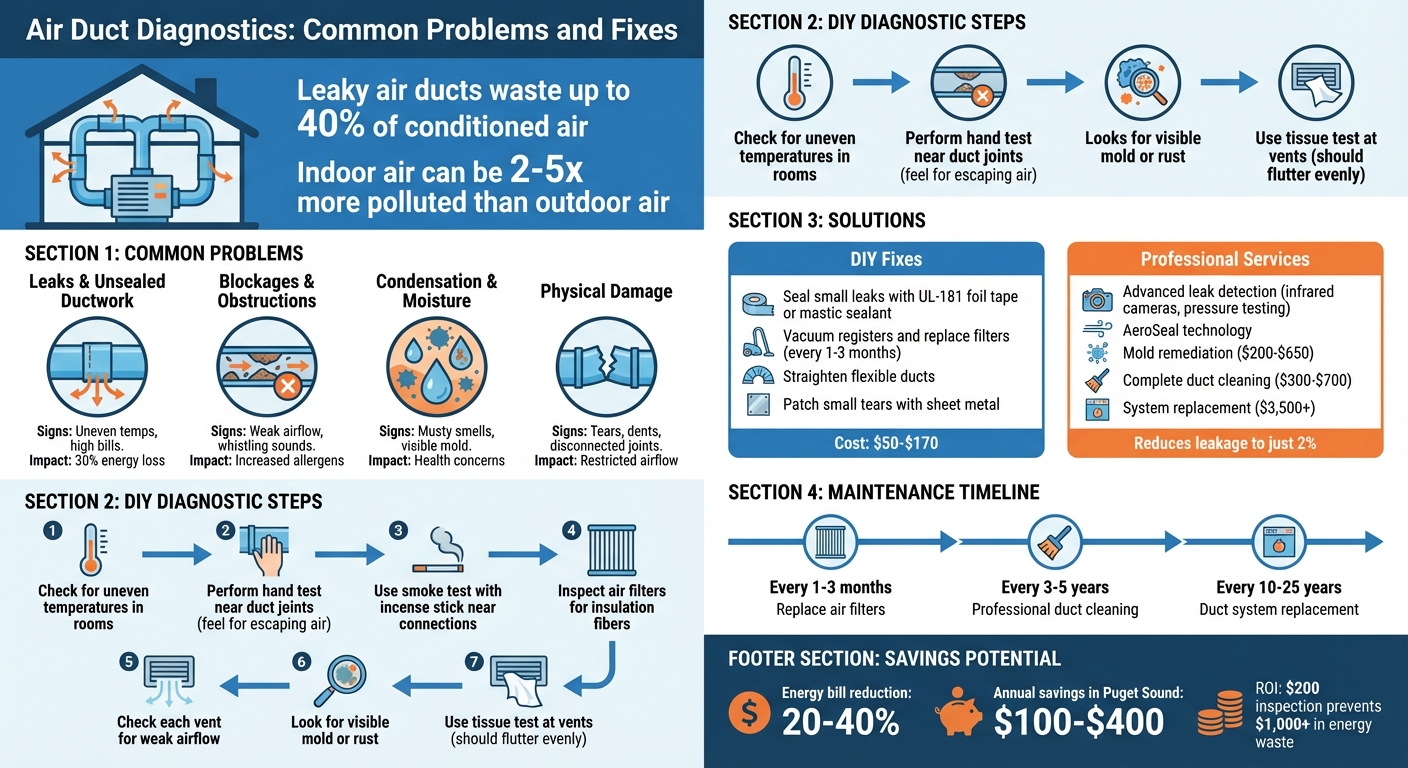
Did you know that leaky air ducts can waste up to 40% of your conditioned air while driving up energy bills and causing uneven temperatures? Faulty ducts not only hurt your HVAC system’s efficiency but can also circulate dust, mold, and allergens, leading to health concerns.
Here’s what you need to know:
- Common Issues: Leaks, blockages, condensation, and poor installation.
- Signs to Watch For: Hot/cold spots, weak airflow, musty smells, or rising energy costs.
- Fixes: Seal leaks with mastic or foil tape, clean blockages, insulate ducts, and repair damage.
- DIY vs. Professional Help: Simple repairs like sealing small leaks can often be done yourself, but larger issues like mold or extensive damage require expert attention.
How to Diagnose and Fix Air Duct Problems: A Step-by-Step Guide
Find & seal leaky ductwork – CHEAP!
sbb-itb-8db64ac
How to Identify Air Duct Problems
Catching air duct issues early can help you avoid high energy bills and keep your home comfortable. The good news? You don’t need any fancy tools – just a bit of observation and a few simple checks.
Leaks and Unsealed Ductwork
One of the first signs of duct leaks is a sudden spike in your utility bills. When air escapes through gaps or poorly sealed connections, your HVAC system has to work harder to keep your home at the desired temperature, which eats up energy. Another clue is uneven heating or cooling – some rooms might feel too warm or chilly, while others barely get any airflow.
To check for leaks, try a hand test. Set your thermostat to "On" so the blower runs continuously, then head to areas like your attic or crawl space. Feel around the duct joints – escaping air will be noticeable. For smaller leaks, use a smoke test: hold a lit incense stick near the connections, and if the smoke wavers, you’ve found a problem. Also, if you notice insulation fibers on your air filter, it could mean return ducts are pulling in unconditioned, contaminated air.
Once you’ve ruled out leaks, it’s time to look for blockages.
Blockages and Obstructions
Dust, debris, or even pests can clog your ducts, restricting airflow. Reduced airflow at certain vents is a key sign – check each register while the system is running to see if some feel weaker than others.
Unusual noises like whistling or rattling can also point to blockages. As noted by Duct Brothers:
"Whistling happens when air squeezes through a gap or blockage, creating a high-pitched sound".
Blockages force your HVAC system to work harder, which not only increases energy costs but can also lead to more dust buildup on vent grills. You might even notice more sneezing or allergy symptoms due to allergens circulating through your home. Regular professional duct cleaning every three to five years can help prevent major clogs.
If blockages aren’t the issue, check for moisture problems.
Condensation and Moisture Problems
Musty smells coming from your vents often mean there’s a moisture issue. When ducts run through unconditioned spaces like attics or crawl spaces, temperature differences can cause condensation to form on duct surfaces. This dampness creates a perfect environment for mold and mildew to grow. Keep an eye out for visible mold near vent openings or rust on metal ducts – both are signs of ongoing moisture exposure.
Mold spores circulating through your system can trigger allergy symptoms, sneezing, or even respiratory problems. Poor insulation is often to blame, as it allows ducts to get too cold in winter or too hot in summer, leading to condensation. Leaks can also pull in damp air from basements or crawl spaces, compounding the problem.
Finally, don’t overlook the condition of the ductwork itself.
Damaged or Poorly Installed Ducts
Physical damage like tears, dents, or cracks can restrict airflow just as much as leaks. During your inspection, look for disconnected joints, holes, or kinks in flexible ducts. If you see duct tape peeling away, it’s a sign that the connections have failed – standard duct tape isn’t durable enough for long-term use.
Poor installation can also cause issues. Sagging ducts or loose connections are common signs of improper setup. Over time, ducts older than 15 years may deteriorate, further reducing performance. A simple tissue test can help you identify problem areas: hold a tissue near each vent. If it barely moves at one but flutters at another, you’ve likely found a spot that needs attention.
Solutions for Air Duct Problems
Once you’ve pinpointed issues with your air ducts, the next step is to resolve them. While some fixes are straightforward enough for DIY enthusiasts, others require professional expertise. Below, we’ll go over practical solutions for common air duct problems.
Sealing and Repairing Leaks
Before applying any sealant, clean the duct surface with a damp cloth to remove dust and grease. For lasting results, use UL-181 rated foil tape or mastic sealant – avoid standard grey duct tape, as it dries out and loses its grip when exposed to temperature changes.
- Foil tape works well for small holes and flat seams.
- Mastic sealant is better for larger gaps or irregular joints. Apply it with a brush or putty knife, ensuring a thickness equivalent to a nickel.
- For larger holes, cut a patch from sheet metal or aluminum, secure it over the hole, and seal the edges with mastic or foil tape.
Tom Moor from HVAC.com emphasizes the importance of addressing leaks:
"Leaky air ducts can lose up to 30% of conditioned air, underscoring the need for regular duct inspections, repairs, and, if necessary, duct replacement".
Properly sealing leaks can lower energy bills by as much as 20%. For hard-to-reach areas or hidden leaks, professionals may use advanced techniques like AeroSeal, which seals ducts from the inside, or conduct pressure testing to locate leaks. If your ducts are older, moldy, or inaccessible, professional help is highly recommended.
Clearing Blockages and Restoring Airflow
Start by vacuuming air registers and replacing filters every 1–3 months. Turn on your HVAC system and check airflow at each register – weak airflow in one area might signal a blockage in that duct branch. For accessible duct ends, use a high-powered HEPA vacuum to clear dust and debris.
If you have flexible ducts in your attic or crawl space, make sure they are as straight as possible, with the inner liner pulled taut. As Allison A. Bailes III, PhD, from Energy Vanguard explains:
"Removing excess duct length is an easy way to improve the air flow in your system… The plastic liner between adjacent pieces of the embedded helical wire should be as flat as possible".
If airflow doesn’t improve after cleaning, it’s time to call in the pros. For deeper blockages, pest issues, or hard-to-reach areas, professional cleaning services use tools like cameras and industrial vacuums. Expect to pay between $300 and $700 for professional duct cleaning, while DIY cleaning supplies typically cost $50 to $150. Daphne Hunt from A&E Heating and Cooling highlights the benefits of maintenance:
"Investing in regular duct maintenance improves air quality, enhances HVAC performance, and can help prevent costly repairs down the road".
For most homes, professional duct cleaning every three to five years using effective cleaning methods is a good practice.
Fixing Condensation and Moisture
Condensation often occurs when ducts in unconditioned spaces like attics or crawl spaces face temperature differences between the air inside and the surrounding environment. To address this:
- Seal leaks with UL-181 rated mastic or foil tape to prevent humid air from entering the system.
- Allow the mastic to cure for 24 to 48 hours before using your HVAC system.
- Insulate ducts in unconditioned areas using fiberglass insulation blankets or spray foam to reduce temperature fluctuations.
Leaky return ducts are particularly troublesome, as they can draw in humid air from attics or wall cavities. Check your air filters for signs of insulation particles or moisture, which could indicate leaks on the return side. On average, 10% to 25% of conditioned air escapes through duct leaks, with approximately 75% of buildings experiencing some level of leakage.
DIY sealing and insulation supplies cost between $55 and $170, while professional repairs can average around $2,250, depending on the system’s complexity and accessibility.
Repairing or Replacing Damaged Ductwork
Physical damage like tears, dents, or disconnected joints should be addressed immediately. For loose connections, use screws, clamps, or zip ties to secure the ducts – don’t rely solely on tape. Once fastened, seal the seams with mastic or foil tape. For small tears, patch them with sheet metal and seal the edges.
If the damage is extensive, or if the duct system is over 15 years old, replacing the affected sections may be more cost-effective than repeated repairs. Keep in mind that duct systems typically last between 10 and 25 years.
Improving airflow or sealing your ducts can sometimes alter your home’s pressure balance. It’s a good idea to have a professional check for backdrafting risks with gas appliances, such as water heaters, to ensure that carbon monoxide isn’t being pulled into your living spaces.
When to Use Professional Air Duct Services
While tackling minor air duct issues yourself might seem like a good idea, bigger problems call for professional help. Knowing when to call in the experts can save you money, prevent further damage, and keep your HVAC system running smoothly for years.
Professional Air Duct Diagnostics
If you’re noticing uneven temperatures, rising utility bills, or worsening air quality, it’s time to consider a professional inspection. Other warning signs include strange noises like rattling or whistling, musty smells, weak airflow from vents, or visible damage to your ductwork.
Professionals bring specialized tools to the table – like infrared cameras, pressure gauges, and smoke pencils – to pinpoint hidden leaks, measure airflow, and check the condition of your ducts without tearing them apart. According to the U.S. Department of Energy, faulty ductwork can waste up to 30% of your HVAC system’s energy, making accurate diagnostics a must.
The cost of professional duct cleaning usually ranges from $150 to $795, depending on the size of your system and the amount of buildup. If repairs are needed, ductwork replacement can run about $3,500, while rerouting might cost around $4,500. Mold remediation, if required, adds another $200 to $650. While these expenses may seem high, professional sealing can cut system leakage down to just 2%, compared to the 20% or more typically lost in most systems.
These detailed diagnostics often lead to reliable annual maintenance plans that ensure your system stays efficient.
Annual Maintenance Plans
Regular maintenance is key to avoiding costly breakdowns. Companies like Envirosmart Solution offer annual packages tailored for homeowners in the Pacific Northwest. Their Smart Gold plan starts at $699 and includes inspections for your furnace, air ducts, dryer vents, attic, and crawl space. These plans also come with perks like 20% off additional services, priority scheduling, and waived diagnostic fees.
If you have pets, smokers in your home, or have recently completed renovations, you may need more frequent service. Envirosmart Solution backs their work with a 100% customer satisfaction guarantee and is fully licensed, bonded, and insured.
Getting Rebates and Incentives
Professional services don’t just stop at maintenance – they can also help you save money through rebates. Energy-efficient upgrades often qualify for government and vendor rebates, but navigating the process can be tricky. Envirosmart Solution simplifies this by handling the paperwork for you. In the Puget Sound area, sealing duct leaks can save you between $100 and $400 annually on utility bills. Professional sealing can also reduce energy waste by 20% to 40%.
Matt Rohman highlights the value of inspections:
"A $200 duct inspection can prevent $1,000+ in energy waste in Portland".
Conclusion
Air ducts play a key role in keeping your home comfortable and energy-efficient. However, leaking ducts can waste up to 30% of your conditioned air, leading to higher energy bills and uneven temperatures. Damaged ductwork can also spread dust, mold spores, and allergens, making indoor air up to 2 to 5 times more polluted than outdoor air.
The good news? Most duct issues are fixable. Sealing leaks, removing blockages, and addressing moisture problems can bring your system back to peak performance while improving the air you breathe. Simple maintenance steps – like replacing filters every 90 days and scheduling professional inspections every three to five years – can help you avoid costly repairs down the line.
If you’re dealing with uneven temperatures, rising energy costs, or odd noises from your vents, don’t wait. Professional air duct cleaning services and diagnostics can uncover hidden issues using advanced tools, and many energy-efficient upgrades come with rebates to help reduce costs. For those in the Pacific Northwest, Envirosmart Solution provides comprehensive air duct services and can guide you through available rebates to maximize your savings.
Whether you choose to tackle the problem yourself or call in the pros, acting quickly protects your health, extends the life of your HVAC system, and helps you save money.
FAQs
Are leaky ducts or poor insulation causing my uneven room temperatures?
Yes, leaky ductwork and poor insulation are often behind uneven room temperatures. When ducts have leaks, the conditioned air escapes before it can reach specific rooms, leaving them less comfortable. Similarly, inadequate insulation allows unwanted heat transfer, which disrupts the balance of temperatures throughout your home. Fixing these problems not only enhances comfort but also boosts energy efficiency.
How can I tell if duct odors are mold, dust, or a moisture issue?
A musty or moldy smell is often a red flag for mold growth, which tends to thrive in damp, humid areas. If the odor seems dust-related, it might be due to an excessive buildup of dust circulating through the air. On the other hand, a burning smell could point to electrical or mechanical problems. Pinpointing the exact source of the odor is key to tackling the issue properly.
When should I call Envirosmart Solution instead of attempting DIY duct repairs?
If you spot leaks, notice poor connections, or see significant duct damage, it’s time to call Envirosmart Solution. These issues require expert attention to ensure proper sealing and maintain efficiency. You should also reach out if you’re dealing with uneven heating or cooling, excessive dust, or unusually high energy bills – these can all be signs of duct-related problems.
While DIY fixes might seem tempting, they often fail to address the root cause. Professional services, on the other hand, can restore your system’s performance and help you save on energy costs in the long run.