
Your HVAC air filter is essential for maintaining indoor air quality and protecting your HVAC system. Picking the right filter ensures cleaner air and prevents costly system issues. Here’s what you need to know:
- MERV Ratings: Filters are rated on a scale of 1 to 16. Higher MERV ratings offer better filtration but may restrict airflow if your system isn’t designed for them.
- MERV 8: Basic filtration for dust and pollen.
- MERV 11: Better for homes with pets or mild allergies.
- MERV 13: Ideal for severe allergies, asthma, or smoke but may strain older systems.
- Household Needs: Consider pets, allergies, and environmental factors like smoke or dust when choosing a filter.
- System Compatibility: Check your HVAC manual to ensure your system can handle the filter’s airflow resistance. Using the wrong filter can increase energy costs by up to 40% and damage components.
- Replacement Schedule: Replace 1-inch filters every 30–90 days, depending on usage. Thicker filters (like 4-inch) last longer, up to 12 months.
For optimal performance, balance filtration efficiency with your system’s airflow capacity. If unsure, consult an HVAC professional to avoid system strain and maintain energy efficiency.
MERV Ratings Explained
What MERV Ratings Mean
MERV, or Minimum Efficiency Reporting Value, is a standard created by the American Society of Heating, Refrigerating, and Air Conditioning Engineers (ASHRAE). This rating system measures how effectively an air filter captures particles ranging from 0.3 to 10 microns in size. To put it into perspective, a micron is just one-millionth of a meter.
The MERV scale generally spans from 1 to 16 for residential and commercial filters, with higher numbers indicating better filtration. Filters are tested on their ability to capture particles in three size categories: E1 (0.3–1.0 µm), E2 (1.0–3.0 µm), and E3 (3.0–10.0 µm). For instance, a MERV 8 filter captures at least 70% of large particles and 20% of medium particles. In contrast, a MERV 13 filter captures at least 90% of large particles, 85% of medium particles, and 50% of smaller particles.
It’s worth noting that these ratings apply to clean, unused filters. Over time, as a filter collects dust and debris, its efficiency may change. HEPA filters, which remove 99.97% of particles as small as 0.3 microns, are not rated on the MERV scale but would generally correspond to MERV 17–20.
How MERV Ratings Impact System Performance
Filters with higher MERV ratings use denser materials with smaller pores, which increases resistance to airflow (known as pressure drop). As the Energy Trust of Oregon explains:
"The rule of resistance to airflow is the higher the filter’s MERV rating, the greater its airflow resistance, and the greater the airflow resistance, the less air moved by the HVAC fan."
This restricted airflow can cause your HVAC system to work harder to maintain the desired temperature. The result? Higher energy bills and added strain on key components like the blower motor. In extreme cases – such as using a HEPA filter in a system not designed for it – restricted airflow can lead to overheating, frozen coils, or even system failure.
To keep your system running efficiently, filters should ideally maintain a pressure drop below 0.10 inches of water column. For most residential HVAC systems, this means sticking with filters rated between MERV 8 and MERV 13 unless modifications are made. Before upgrading to a higher-rated filter, check your system’s manual or consult a professional to ensure it can handle the added resistance.
If you’re looking for better filtration without compromising airflow, consider 4-inch media filters. These thicker filters provide more surface area, allowing for higher filtration efficiency with less airflow restriction compared to standard 1-inch filters. Striking the right balance between clean air and system performance starts with understanding your home’s specific air quality needs.
Evaluating Your Home’s Air Quality Needs
Key Household Factors to Consider
Before choosing an air filter, take a close look at your home’s unique conditions. For example, if you have pets – especially multiple animals – it’s a good idea to use at least a MERV 11 filter and replace it every 60 days to keep up with the extra dander and fur floating around.
If anyone in your household suffers from allergies or asthma, MERV 11–13 filters are a better choice. These filters are designed to catch mold spores, fine dust, and pollen. Kevin Dickson, President of Energy Services Air Conditioning, Heating and Electrical, explains:
"Higher MERV ratings, such as 11–13, can capture smaller particles like pollen, pet dander, mold spores, and even some bacteria, which can be especially beneficial for families with allergies, asthma, or other respiratory concerns."
For homes dealing with more severe respiratory issues, MERV 13 filters are the way to go. These filters can trap bacteria and virus carriers that lower-rated filters might miss.
Environmental conditions also play a big role. If your home is near construction sites, located in dusty areas, or exposed to wildfire smoke, you’ll need stronger filtration. MERV 13 filters are capable of capturing microscopic particles, including wildfire smoke. In these situations, it’s smart to inspect your filters monthly, as indoor pollutant levels can be 2 to 5 times higher than outdoor levels. By carefully evaluating these factors, you can choose a filter that aligns with your air quality needs.
Aligning Filters with Your Air Quality Goals
Once you’ve identified your home’s air quality challenges – whether it’s pet dander, allergens, or environmental pollutants – you can select a filter that fits your goals. Here’s a quick breakdown:
- MERV 8 filters: Great for basic dust control in homes with minimal risks.
- MERV 11 filters: Ideal for pet owners and those with mild allergies.
- MERV 13 filters: Best for severe allergies, asthma, or areas with high pollution.
MERV 13 filters are particularly effective, capturing at least 50% of fine particles sized between 0.3 to 1.0 microns.
Keep in mind, though, that higher-rated filters can cost 20%–30% more and may increase airflow resistance. It’s a good idea to consult an HVAC professional before upgrading to a MERV 13 filter. To maintain both air quality and energy efficiency – since clogged filters can increase energy bills by up to 15% – allergy and asthma sufferers should aim to replace their filters every 30–45 days.
How to Choose the BEST Furnace Air Filter (MERV Ratings & More Explained)
Verifying HVAC System Compatibility
Once you’ve determined the right MERV rating for your air quality needs, it’s essential to confirm that your HVAC system can handle the chosen filter.
Airflow and Filter Resistance
Before upgrading your filter, check whether your system can manage the increased resistance that often comes with higher-rated filters. A filter with too much resistance forces your HVAC system to work harder, which can reduce airflow. For older units equipped with a permanent split capacitor (PSC) motor, high resistance can cause the motor to slow down, leading to reduced airflow throughout your home. On the other hand, newer systems with brushless permanent magnet (BPM/ECM) motors will adjust by increasing speed and power draw, potentially causing motor burnout over time.
Most residential HVAC systems are designed to operate efficiently with a total pressure drop between 0.4 and 0.5 inches of water column (IWC). Using a dirty or mismatched filter can increase energy costs by as much as 40%. Warning signs of excessive resistance include banging noises, uneven temperatures, or frozen evaporator coils after installing a new filter. If this happens, consider switching from a 1-inch filter to a 4-inch option. The deeper pleats in a 4-inch filter provide more surface area, lowering resistance without compromising the MERV rating. This adjustment helps maintain proper system performance while improving air quality.
Checking Manufacturer Guidelines
After evaluating airflow, consult your HVAC system’s manufacturer guidelines to confirm filter compatibility. Your system’s manual will specify the maximum MERV rating and allowable pressure drop it can handle. Check for labels on your furnace or air handler that indicate the design airflow (measured in cubic feet per minute, or CFM) and the maximum initial resistance (measured in IWC). You can also inspect your current filter for printed dimensions, such as 16x25x1, or measure the filter slot directly with a tape measure to ensure proper fit. Never force a filter into place; gaps can compromise efficiency.
For older systems or when manufacturer specifications are unavailable, consult a licensed HVAC technician. They can use a manometer to measure your system’s total external static pressure and recommend the highest MERV rating your equipment can safely handle. If your system can’t support the resistance of a high-MERV 1-inch filter, a technician can install a larger cabinet to fit 4-inch or 5-inch media filters, offering improved filtration without overburdening your system.
sbb-itb-8db64ac
MERV 8, 11, and 13 Filter Comparison
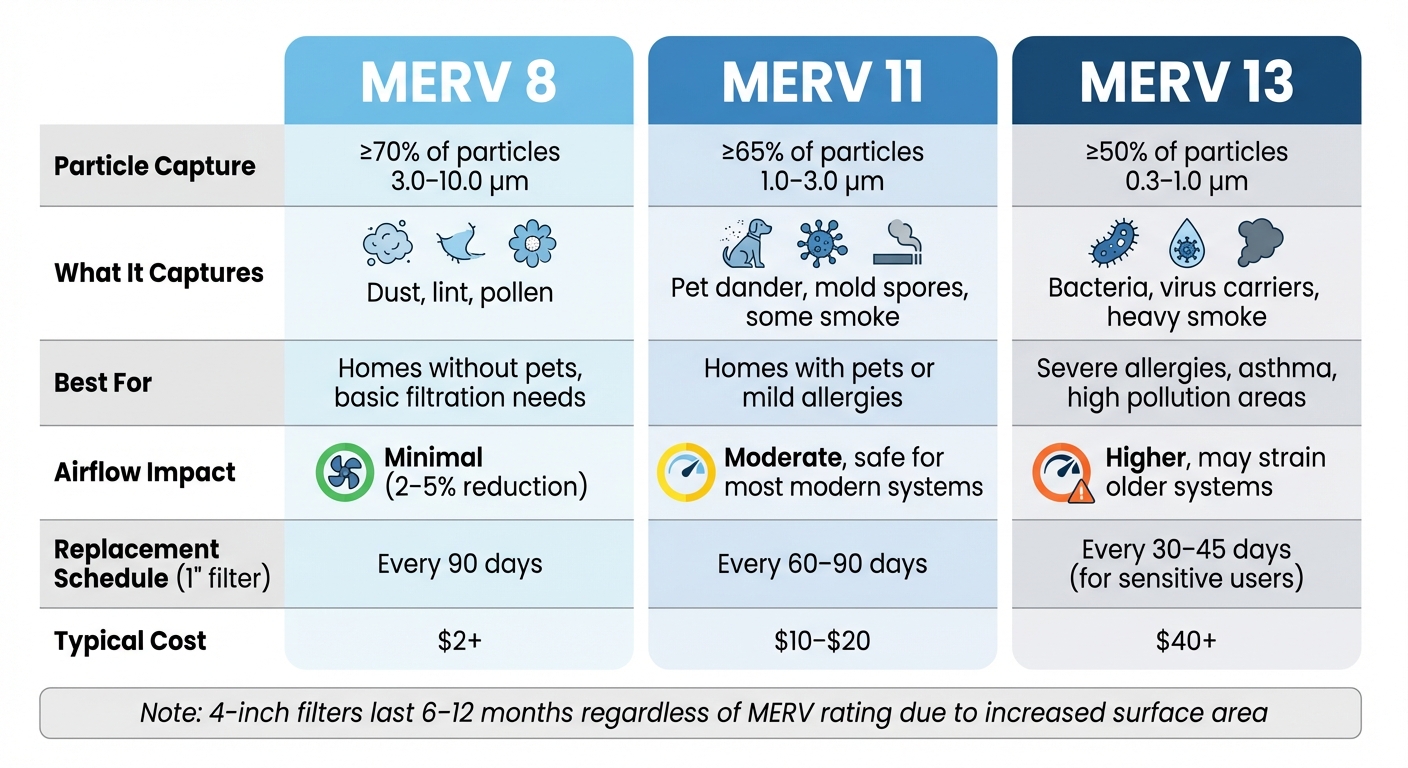
MERV 8 vs 11 vs 13 Air Filter Comparison Chart
Once you’ve confirmed your HVAC system’s capacity, the next step is to choose a filter that aligns with your household’s air quality needs. The right filter rating – MERV 8, 11, or 13 – depends on the level of air filtration your home requires and your system’s ability to handle airflow resistance.
MERV 8 filters are a solid choice for general residential use. They capture at least 70% of particles in the 3.0–10.0 micron range, which includes common culprits like dust, lint, and pollen. These filters are easy on airflow, reducing it by only 2–5%, making them compatible with nearly all residential systems. If you’re on a budget, fiberglass versions start at just $2, while pleated options provide better filtration at a slightly higher cost.
MERV 11 filters step up the filtration game by capturing at least 65% of particles in the 1.0–3.0 micron range, such as pet dander, mold spores, and even some smoke. They’re a great fit for homes with pets or for those dealing with mild allergies. These filters effectively trap smaller contaminants, offering a noticeable air quality boost. While they create moderate airflow resistance, most modern HVAC systems can handle it without a problem.
MERV 13 filters are the heavy lifters of the group, capturing at least 50% of fine particles sized 0.3 to 1.0 microns. This includes bacteria, virus carriers, and heavy smoke. If your household includes someone with severe allergies, asthma, or other respiratory issues, these filters are a top recommendation. However, they can cost $40 or more per unit. The U.S. Environmental Protection Agency advises:
"If you decide to upgrade to a higher efficiency filter, choose a filter with at least a MERV 13 rating, or as high a rating as your system fan and filter slot can accommodate".
Filter Performance Comparison Table
| MERV Rating | Particle Capture | Best-Fit Applications | Airflow Impact | Replacement Schedule (1" Filter) | Typical Cost |
|---|---|---|---|---|---|
| MERV 8 | ≥70% (3.0–10.0 μm) | Homes without pets; dust, lint, pollen | Minimal (2–5% reduction) | Every 90 days | $2+ |
| MERV 11 | ≥65% (1.0–3.0 μm) | Homes with pets or mild allergies; pet dander, mold spores | Moderate; safe for most modern systems | Every 60–90 days | $10–$20 |
| MERV 13 | ≥50% (0.3–1.0 μm) | Severe allergies, asthma, smoke; bacteria, virus carriers | Higher; may strain older systems | Every 30–45 days (for sensitive users) | $40+ |
Keep in mind that replacement schedules can vary depending on your household conditions and usage. For instance, 4-inch filters offer a longer lifespan, lasting 6–12 months, even at higher MERV ratings, thanks to their increased surface area. This table provides a straightforward guide to help you select the filter that best fits your needs.
How to Select and Install Your Air Filter
Step 1: Identify the Right Filter Size and MERV Rating
Start by checking the cardboard frame of your current filter for the dimensions (Length x Width x Thickness, e.g., 20"x25"x1"). If the size isn’t printed, grab a tape measure and check the dimensions of the filter slot. Keep in mind that the nominal size listed might be slightly larger than the actual measurements – a 1-inch filter, for instance, often measures closer to 0.75 inches thick.
Next, confirm the maximum MERV (Minimum Efficiency Reporting Value) rating your HVAC system can handle. This information is usually found in the owner’s manual. If you’re unsure, a MERV 8 pleated filter is a safe, all-purpose option for most homes. Be cautious with filters rated MERV 14 or higher, as they can restrict airflow and may even harm your system over time.
Once you’ve nailed down both the size and MERV rating, you’re ready to shop for a new filter.
Step 2: Buy a Reliable Filter
With your filter size and MERV rating in hand, purchase a filter from a trustworthy source. Expect to pay about $8–$9 each for MERV 8 filters when buying multi-packs, while MERV 13 filters will cost more. If you’re aiming for better air quality, avoid cheap fiberglass filters. These basic filters only capture larger particles and don’t offer the efficiency of pleated filters.
After your purchase, it’s time to install the new filter.
Step 3: Install the Filter Correctly
Before doing anything, turn off your HVAC system. You can do this at the thermostat or the breaker to ensure safety. Open the filter compartment and remove any plastic wrap from the new filter. Look for the airflow direction arrow printed on the filter. This arrow should point toward the furnace or air handler, not the return duct. Insert the filter snugly to avoid gaps that would let unfiltered air pass through. Finally, use a permanent marker to write down the installation date on the filter and set a reminder for when it needs replacing.
Professional HVAC Maintenance with Envirosmart Solution

Why Professional Maintenance Matters
Choosing the right filter and installing it properly are just the beginning when it comes to keeping your HVAC system running smoothly. Professional maintenance takes things further by addressing issues that filters alone can’t fix. For instance, technicians measure static pressure – filters typically contribute to 20%–50% of the total pressure drop – to determine if a MERV upgrade is safe. If static pressure hits 1 inch of water column (in. WC), it can damage the ECM motors that power most modern HVAC systems. Regular maintenance helps reduce the strain on key components like the blower motor and fan, which not only extends the system’s lifespan but also keeps it running efficiently during peak seasons.
Envirosmart Solution provides annual maintenance plans starting at $199, with options like their FURNACE CARE™ or SMART DUCTS™ services. For a more all-inclusive approach, their SMART GOLD™ package costs $699 and includes a furnace inspection, air duct cleaning, dryer vent service, and attic or crawl space checks. Plus, it comes with a 20% discount on additional services, priority scheduling, and emergency response. These packages are designed to offer reliable, year-round comfort and peace of mind.
Accessing Rebates and Energy Incentives
Beyond smart filter choices, taking advantage of rebates can make energy-efficient upgrades much more affordable. Professional HVAC care becomes even more valuable when paired with these savings. While upgrading to high-efficiency HVAC systems or improving insulation can involve significant upfront costs, Envirosmart Solution helps homeowners in the Pacific Northwest maximize rebates from government programs, local initiatives, and vendors to offset these expenses. Their team even handles the paperwork, ensuring you don’t miss out on any available incentives.
Whether you’re installing a new high-efficiency furnace or adding insulation to cut down on heating costs, Envirosmart Solution simplifies the process. They coordinate expert installation, handle ongoing maintenance, and secure financial incentives – all in one place. This streamlined approach ensures you receive both top-notch service and the financial benefits you’re entitled to.
Conclusion
Finding the right HVAC air filter boils down to three main factors: understanding MERV ratings, assessing your household’s air quality needs, and ensuring compatibility with your HVAC system. For basic dust and pollen control, a MERV 8 filter does the job. If you have pets, smokers, or family members with allergies, MERV 11–13 filters provide stronger filtration and better indoor air quality.
However, using a filter that’s too restrictive can backfire. It may strain your HVAC system, hike up energy bills, or even lead to system failure. Always refer to your owner’s manual to confirm the maximum recommended MERV rating and the correct filter size. If you’re thinking about upgrading to a MERV 13 or higher, it’s a good idea to have a professional check your system’s static pressure. Filters contribute to 20%–50% of the total pressure drop, and exceeding 1 inch of water column pressure can harm modern ECM motors. This highlights why sticking to your system manufacturer’s guidelines is so important.
Once you’ve evaluated your system and air quality needs, the right filter will strike a balance between cleaner air and efficient HVAC performance. Don’t forget to replace 1-inch filters every three months and 4-inch filters annually. Proper installation is key, too – make sure the arrow on the filter frame points toward the blower to keep everything running smoothly.
To round out your HVAC care routine, Envirosmart Solution is here to help. Serving the Pacific Northwest, their team can assess your system, recommend the best MERV rating, and manage everything from installation to ongoing maintenance. They’ll also help you take advantage of rebates and energy incentives, making upgrades more budget-friendly. Visit https://envirosmartsolution.com to keep your HVAC system running efficiently and your indoor air clean year-round.
FAQs
How can I choose the best MERV rating for my HVAC air filter?
Choosing the right air filter for your HVAC system starts with understanding your home’s air quality needs and the system’s capacity. For most homes, a MERV rating between 8 and 13 strikes the perfect balance. A MERV 8 filter is excellent for capturing everyday pollutants like dust, pollen, and pet dander, making it a solid choice for general use. On the other hand, if someone in your household suffers from allergies, asthma, or other sensitivities, a MERV 13 filter is more effective, as it can trap smaller particles like bacteria, smoke, and fine dust.
That said, filters with higher MERV ratings can sometimes restrict airflow, putting extra strain on your HVAC system. This could lead to reduced efficiency or even potential damage. Before making the switch to a higher-rated filter, it’s essential to check your system’s specifications or consult a professional to ensure compatibility. For personalized guidance, Envirosmart Solution offers expert HVAC services and can help you choose the right filter to enhance your home’s air quality while maintaining energy efficiency and comfort.
What happens if you use an HVAC filter with a higher MERV rating than recommended?
Using an HVAC filter with a higher MERV rating than your system is built for can cause some serious headaches. These filters are denser, which means they can restrict airflow. When airflow is limited, it increases pressure in the system, potentially reducing efficiency and putting extra strain on your HVAC components. This could lead to problems like a frozen coil or even an overloaded compressor.
To keep things running smoothly, stick to the MERV rating recommended for your system. Not sure what that is? Reach out to a professional who can guide you in choosing a filter that works best for your setup while keeping your system in top shape.
How often should I replace my HVAC air filter to keep my system running efficiently?
To ensure your HVAC system operates smoothly and maintains clean air in your home, it’s typically a good idea to replace the air filter every 90 days. That said, if you have pets, deal with allergies, or rely heavily on your system, swapping it out more often – every 30 to 60 days – might be a smarter choice.
Changing your filters regularly doesn’t just boost indoor air quality. It also helps prevent strain on your system, which can lower energy costs and reduce the chances of expensive repairs in the future.