
Bottom line: HVAC energy modeling helps you weigh upfront costs against long-term savings. Tools like EnergyPlus, eQuest, and IESVE simulate HVAC performance based on factors like system efficiency, local climate, and usage. The goal? To save money over a system’s lifespan while taking advantage of rebates and incentives.
Here’s what you need to know:
- Energy Costs: Heating and cooling make up nearly half of the average U.S. household’s $2,200 annual energy bill.
- Savings Example: A high-efficiency HVAC system costing $5,000 can save $100/month, adding up to $12,000 in 10 years.
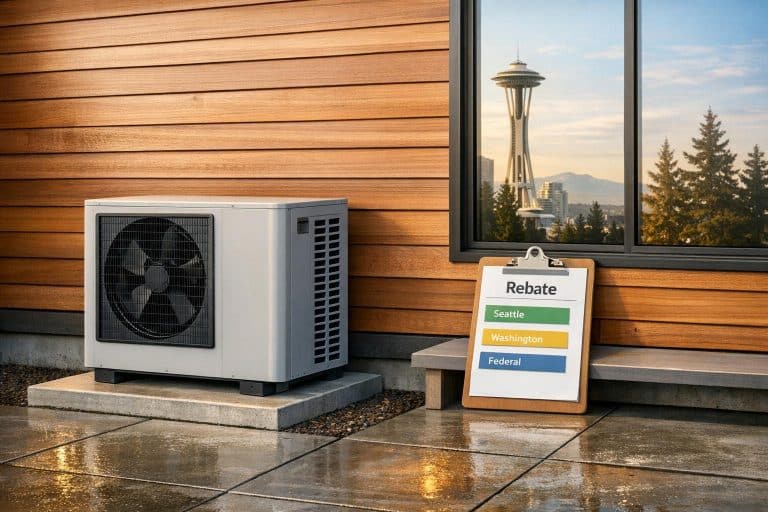
- Rebates: Federal tax credits cover up to 30% of costs – up to $2,000 for heat pumps and $600 for air conditioners or furnaces. Local rebates can add even more.
- Modeling Tools:
- EnergyPlus: Free, precise, but complex – best for professionals.
- eQuest: Free, user-friendly, ideal for smaller projects.
- IESVE: Paid, detailed, and suited for large-scale or complex systems.
Key takeaway: Modeling tools help you make informed decisions about HVAC upgrades. When combined with rebates, you can significantly reduce costs and improve energy efficiency.
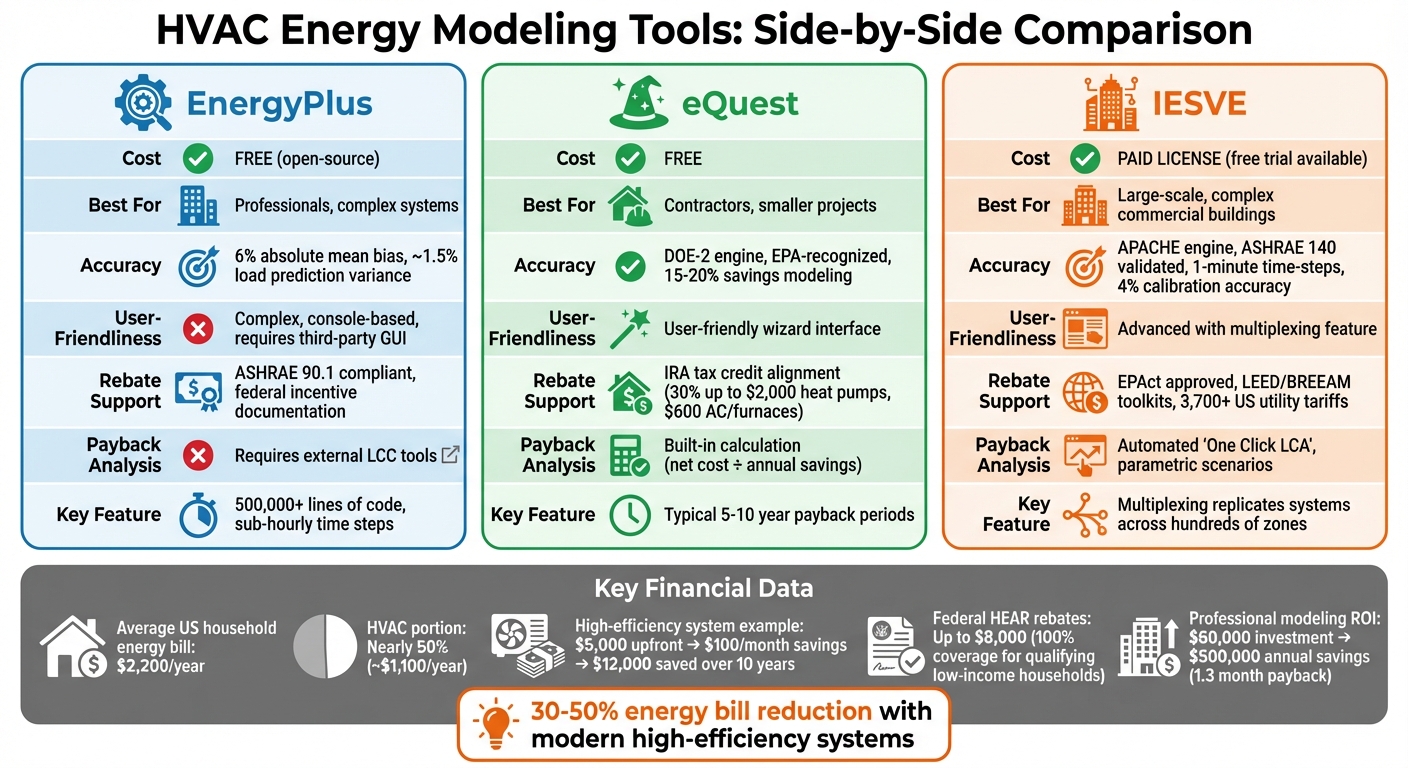
HVAC Energy Modeling Tools Comparison: EnergyPlus vs eQuest vs IESVE
1. EnergyPlus
Initial Cost
EnergyPlus is completely free to use. Developed and funded by the U.S. Department of Energy’s Building Technologies Office, it’s an open-source tool with no licensing fees or subscriptions. However, it’s not exactly user-friendly for the average homeowner. This console-based program is designed with engineers and architects in mind. To make it more accessible, you’ll likely need a third-party graphical interface. Some options, like OpenStudio, are free, while others come with a price tag.
For homeowners, the cost of using EnergyPlus often includes hiring a professional to run the software. For large-scale buildings, energy modeling services can range from $30,000 to $200,000, but residential projects are typically far less expensive. Despite the upfront costs, these models often pay for themselves within a couple of months by identifying energy savings and avoiding unnecessary HVAC expenses. This makes it an important factor when weighing the costs and benefits of energy-efficient HVAC upgrades.
Simulation Accuracy
EnergyPlus is known for delivering highly precise predictions, with a daytime absolute mean bias of about 6% compared to real-world measurements. In a 2020 study conducted at Lawrence Berkeley National Laboratory‘s FLEXLAB test facility, researchers tested EnergyPlus v8.8 against measured heat fluxes and airflow. The results showed the software typically overestimates cooling loads or underestimates heating loads by approximately 1.5%, with a Root Mean Square Error of roughly 10% for peak HVAC loads.
"EnergyPlus typically overpredicts the cooling load and/or underpredicts the heating load by ~1.5%." – Lawrence Berkeley National Laboratory
This level of precision makes it invaluable for modeling complex systems like radiant slabs, mixed-mode ventilation, and radiant ceiling panels – situations where simpler tools fall short. With over 500,000 lines of code and the ability to model sub-hourly time steps, EnergyPlus can handle intricate heat flows and dynamic HVAC configurations. This accuracy helps homeowners make informed decisions about long-term energy savings when considering high-efficiency systems.
Rebate Integration Support
EnergyPlus doesn’t calculate rebates directly, but it plays a crucial role in securing them. It’s widely used across the U.S. to demonstrate compliance with building energy codes like ASHRAE 90.1, which is often required for federal and state incentive programs. The Department of Energy also relies on EnergyPlus to assess whether energy-efficient building proposals meet cost-effectiveness criteria for programs like the Energy Efficient Home Improvement Credit.
For homeowners in regions like the Pacific Northwest, companies such as Envirosmart Solution use EnergyPlus simulation data to validate high-efficiency HVAC upgrades that qualify for rebates. These simulations provide the necessary documentation to access incentives, which can significantly affect the overall cost-benefit picture. As Anica Landreneau, Director of Sustainability Consulting at HOK, notes:
"Owners and project managers do not accept reduced HVAC systems based on engineering judgment – they demand to see numbers!"
Payback Estimation Capabilities
While EnergyPlus produces detailed energy consumption data, it’s not designed for life cycle cost analysis. To calculate financial payback periods, you’ll need to export its results into a dedicated life cycle cost tool. The Department of Energy often uses EnergyPlus in combination with such tools to analyze residential buildings over a 30-year period, aligning with the typical lifespan of a mortgage.
"EnergyPlus is not… a life cycle cost analysis tool. It produces results that can then be fed into an LCC program." – EnergyPlus Documentation
The potential savings can be enormous. For instance, the Consolidated Forensic Lab in Washington, D.C., invested $60,000 in EnergyPlus modeling to justify a hydronic HVAC system. This decision led to over $500,000 in annual energy savings, with the modeling costs recouped in just 1.3 months.
Next, we’ll take a closer look at eQuest to compare its modeling capabilities.
sbb-itb-8db64ac
2. eQuest

Initial Cost
eQuest can be downloaded and used without any upfront cost. Its user-friendly graphical interface makes it a practical choice for HVAC contractors and energy consultants, eliminating the need for additional software purchases. For homeowners, the primary expense lies in hiring a professional to conduct the analysis, which is typically far less expensive than the costs associated with large-scale commercial energy modeling.
Simulation Accuracy
When it comes to accuracy, eQuest delivers reliable results. It operates using the DOE-2 engine, an hourly simulation program widely recognized across the industry. In fact, the EPA relies on DOE-2 to set energy savings benchmarks for residential improvements like air sealing and insulation. According to ENERGY STAR, these models suggest homeowners can save an average of 15% on heating and cooling costs with such upgrades, with savings climbing to 20% in Climate Zone 4C.
"Field experience from seasoned building science contractors confirms these modeled savings." – ENERGY STAR
The precision of eQuest’s simulations hinges on the quality of the input data. Factors such as equipment sizing, the condition of ductwork, thermostat settings, and local utility rates all play a role. For example, switching from a SEER 10 system to SEER 16 can result in around 37% savings on cooling costs, while upgrading further to SEER 22 could add another 27% in savings.
Rebate Integration Support
eQuest also supports rebate integration, which can be a game-changer for homeowners. Its energy savings calculations align with federal tax credits under the Inflation Reduction Act, offering incentives like 30% (up to $2,000) for heat pumps and 30% (up to $600) for central air conditioners and furnaces. The software helps determine if planned upgrades meet the efficiency standards required for utility rebates, such as SEER2 ≥ 15 for air conditioners or AFUE ≥ 95% for furnaces.
In the Pacific Northwest, companies like Envirosmart Solution use eQuest simulations to identify equipment that qualifies for both federal and local utility incentives. This combination of rebates can significantly lower out-of-pocket costs and reduce the time it takes to recoup the investment.
Payback Estimation Capabilities
eQuest also excels at estimating payback periods. It calculates payback by dividing the net cost of the upgrade (equipment price minus incentives) by the annual energy savings. For most residential HVAC upgrades, a payback period of 5–10 years is typical. In areas with extreme climates, where systems run more frequently, the payback period can be even shorter.
Modern high-efficiency systems (SEER 16+ and 96%+ AFUE) can cut heating and cooling bills by 30–50% compared to older models. Considering that HVAC systems account for about 12% of a home’s cooling energy use and 29% of heating energy use, these upgrades can lead to substantial reductions in annual energy costs. Up next, we’ll take a closer look at IESVE to further explore the cost-benefit analysis.
3. IESVE
Initial Cost
IESVE takes a distinct approach when it comes to cost and setup. It operates under a paid license model but does offer a free trial option for users to explore its features. One of its standout capabilities is its ability to simplify complex modeling tasks. For example, the "multiplexing" feature lets users replicate HVAC systems across hundreds of zones at once. This is a game-changer for large buildings with repetitive systems, saving significant time during the setup process.
Simulation Accuracy
The software uses the APACHE simulation engine, which meets industry standards by being both ASHRAE 140 validated and EPAct approved. It runs simulations with time-steps as precise as 1 minute, allowing for highly detailed performance metrics. A noteworthy example is a 2023 UMC project where the model was calibrated within 4% of actual data, leading to recommendations that reduced energy consumption by 45%.
"Our main reason for choosing IESVE was the detail of the analysis that can be achieved, from the geometry, through to loads, shading effects, and natural ventilation."
– David Park, Building Analysis & Modeling Manager, UMC
Another impressive feature is the Tariff Tool, which imports electricity rate structures from the OpenEI database. Covering over 3,700 US utilities, this tool ensures precise cost predictions by factoring in Time-of-Use charges and tier-based natural gas rates from providers like SoCal Gas and PG&E. These capabilities make IESVE a strong choice for detailed and accurate simulations, especially when robust rebate documentation is required.
Rebate Integration Support
The accuracy of IESVE simulations plays a key role in streamlining rebate integration, enhancing cost-benefit analyses. Its EPAct approval and ASHRAE 140 validation make it eligible for federal tax deduction modeling. Additionally, the software automates the creation of energy code baseline models, which are essential for compliance with major energy codes. It also includes specialized toolkits for LEED (applicable in the USA and India) and BREEAM daylighting and energy credits. For homeowners in regions like the Pacific Northwest, companies such as Envirosmart Solution rely on IESVE to pinpoint HVAC upgrades that qualify for federal incentives and local utility rebates, helping maximize savings.
Payback Estimation Capabilities
IESVE offers advanced tools for life-cycle cost planning and integrates automated "One Click LCA" analysis, taking cost estimation to a higher level. Its parametric simulation capabilities allow users to run thousands of scenarios to find the most cost-effective solutions. Detailed reports on peak loads and plant sizing help optimize equipment investments. Plus, its multiplexing feature ensures that changes – like adjusting fan speed in one layer – are automatically applied across all identical systems, maintaining consistency and reliability in payback estimates. These features make financial evaluations more precise, empowering homeowners to make smarter decisions about long-term energy savings.
Fully Leveraging Your Energy Model, A Field Guide
Advantages and Disadvantages
Each modeling tool comes with its own set of trade-offs, which can significantly influence your cost-benefit analysis. For instance, EnergyPlus and eQuest are completely free, making them appealing to homeowners who want to explore energy upgrades without spending on software upfront. That said, EnergyPlus requires manual configuration or API scripting, which can slow down the process for those unfamiliar with the tool. On the other hand, eQuest simplifies the process with a wizard-based system that automates HVAC setup for each floor, making it more user-friendly.
When it comes to commercial-grade tools, IESVE offers a different approach. It requires a paid commercial license but includes a multiplexing feature that allows a single HVAC network to be replicated across multiple zones. This is particularly useful for large-scale buildings. However, its high subscription cost makes it less practical for single-family homes, where the unique designs of each zone may not align well with its automation.
All three tools provide simulation accuracy that meets the requirements for ASHRAE 90.1 compliance, ensuring they are suitable for various energy modeling needs.
The Role of Rebates in Financial Feasibility
Beyond the software’s cost and setup, rebate integration is a crucial factor in determining the financial viability of HVAC upgrades. Federal Home Efficiency Rebates, for example, require the use of BPI-2400 compliant software to model savings. Without compliance, homeowners risk losing up to $8,000 in federal funding. For households earning less than 80% of the area median income, rebates can cover up to $8,000 or 80% of project costs if modeled savings exceed 35%. Companies like Envirosmart Solution use these tools to pinpoint HVAC installation and upgrade services that maximize both federal incentives and local utility rebates, particularly for homeowners in the Pacific Northwest.
Trade-Offs to Consider
One notable feature of IESVE is its multiplexing capability, which streamlines the modeling process by replicating configurations across multiple zones. While this can save time, it also comes with risks – any error in the base setup can propagate across all zones, making troubleshooting more complex. For residential projects with unique system designs in each zone, the transparency offered by EnergyPlus (often accessed via OpenStudio) can be a better fit than automation features aimed at commercial-scale buildings.
These trade-offs highlight the importance of carefully balancing upfront investments with long-term energy savings and rebate opportunities when choosing a modeling tool.
Conclusion
Choosing the right tool for energy modeling requires balancing detail and cost. Free options like EnergyPlus and eQuest provide powerful simulation capabilities. EnergyPlus allows for precise control, while eQuest offers a more user-friendly interface. For those seeking advanced features, IESVE is a strong contender, though it comes at a higher price point.
Rebate programs play a critical role in determining overall savings. Federal HEAR programs can provide up to $8,000 in rebates, even covering the full cost of equipment for lower-income households. For families earning less than 80% of the area’s median income, these programs may cover 100% of eligible equipment costs. However, navigating the complexities of HEAR and HOMES programs, ensuring contractor certification, and layering multiple incentives often requires expert assistance.
Partnering with a professional service, like Envirosmart Solution, helps simplify this process. Their team handles the technical aspects, such as performing Manual J load calculations, ensuring proper air sealing, and optimizing ductwork. They also maximize federal, state, and utility-specific rebates available in the Pacific Northwest. Importantly, they help avoid oversized equipment, which can lead to inefficiencies and additional costs.
In addition to financial savings, professional installation enhances comfort. Benefits include quieter operation, better humidity control, and consistent indoor temperatures – all of which improve the quality of living. Proper installation also safeguards your warranty, maintains system efficiency, and extends the lifespan of your HVAC system by 3–5 years, saving over $1,000 in replacement costs. When considering both financial and comfort benefits, professional installation proves to be a smart, long-term investment in both efficiency and quality of life.
FAQs
Do I really need energy modeling before replacing my HVAC system?
When you’re considering replacing your HVAC system, conducting a cost-benefit analysis with energy modeling is a smart move. This process helps you evaluate whether the long-term savings and efficiency of a new system outweigh the initial investment. It also gives you a better picture of potential energy savings and the overall return on your money.
What information do I need to get an accurate HVAC energy model for my home?
To build a precise HVAC energy model, you’ll need to collect some essential details about your existing system and home. Start by identifying the type of heating and cooling system you have, such as central ducted, split, or boiler/radiators. Note the system’s size, measured in BTUs or tons, and the total square footage of the space it heats or cools. Also, include the system’s installation date. If you have a smart thermostat, be sure to mention it – it can improve the accuracy of the energy model by reflecting your usage patterns. These details help create a more accurate picture of your energy efficiency needs.
How do I use modeling results to estimate payback after rebates and tax credits?
To figure out the payback period, start by calculating the net upfront cost. This means taking the total purchase and installation cost and subtracting any rebates or tax credits you qualify for. Next, figure out your annual energy savings by comparing the efficiency of your current system to the new one. Once you have these numbers, divide the net upfront cost by the annual savings. The result will give you the estimated payback period.
You can make your estimate more accurate by factoring in things like potential changes in energy costs or maintenance expenses. These adjustments can help you better understand the long-term savings of your investment.