
The ENERGY STAR Rebate Finder is a free tool from the EPA that helps you find rebates, tax credits, and special offers for energy-efficient upgrades in your area. Simply enter your ZIP code to discover potential savings on products like heat pumps, water heaters, insulation, and more. Key highlights:
- Federal Tax Credits: Cover 30% of project costs (up to $3,200/year) through December 31, 2025.
- Rebate Opportunities: Electric upgrades can qualify for up to $14,000 in combined rebates, such as $8,000 for heat pumps and $1,750 for heat pump water heaters.
- Product Categories: Includes heating and cooling systems, appliances, EV chargers, and building materials.
This tool simplifies the process of finding savings, connecting you with local programs and installers. Whether you’re upgrading appliances or improving home efficiency, it’s an easy way to reduce costs and energy use. Visit energystar.gov to get started.
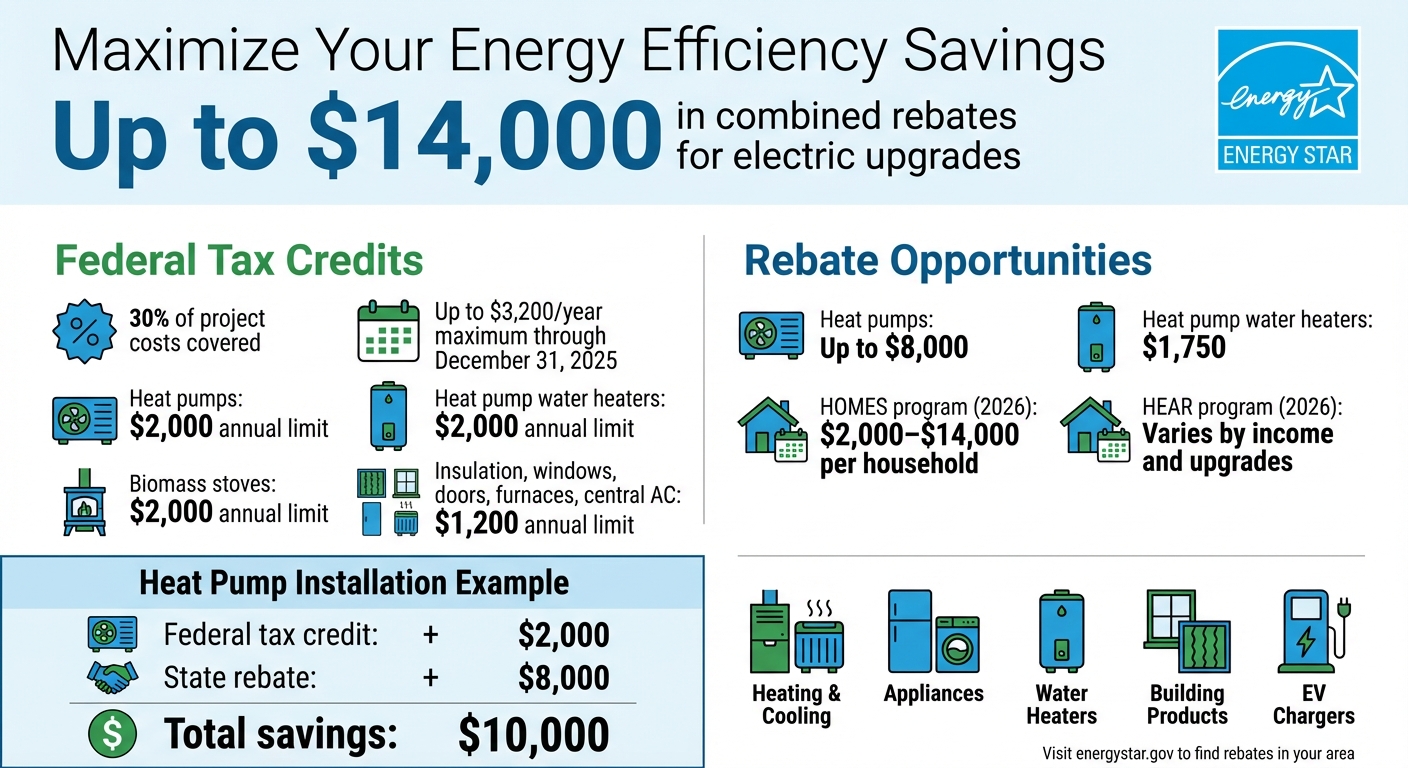
ENERGY STAR Rebate Savings Breakdown: Federal Tax Credits and State Rebates
Inflation Reduction Act Appliance Rebates HeeHra Heat Pump & Stove. Solar Tax Credit 2025
sbb-itb-8db64ac
Using the ENERGY STAR Rebate Finder
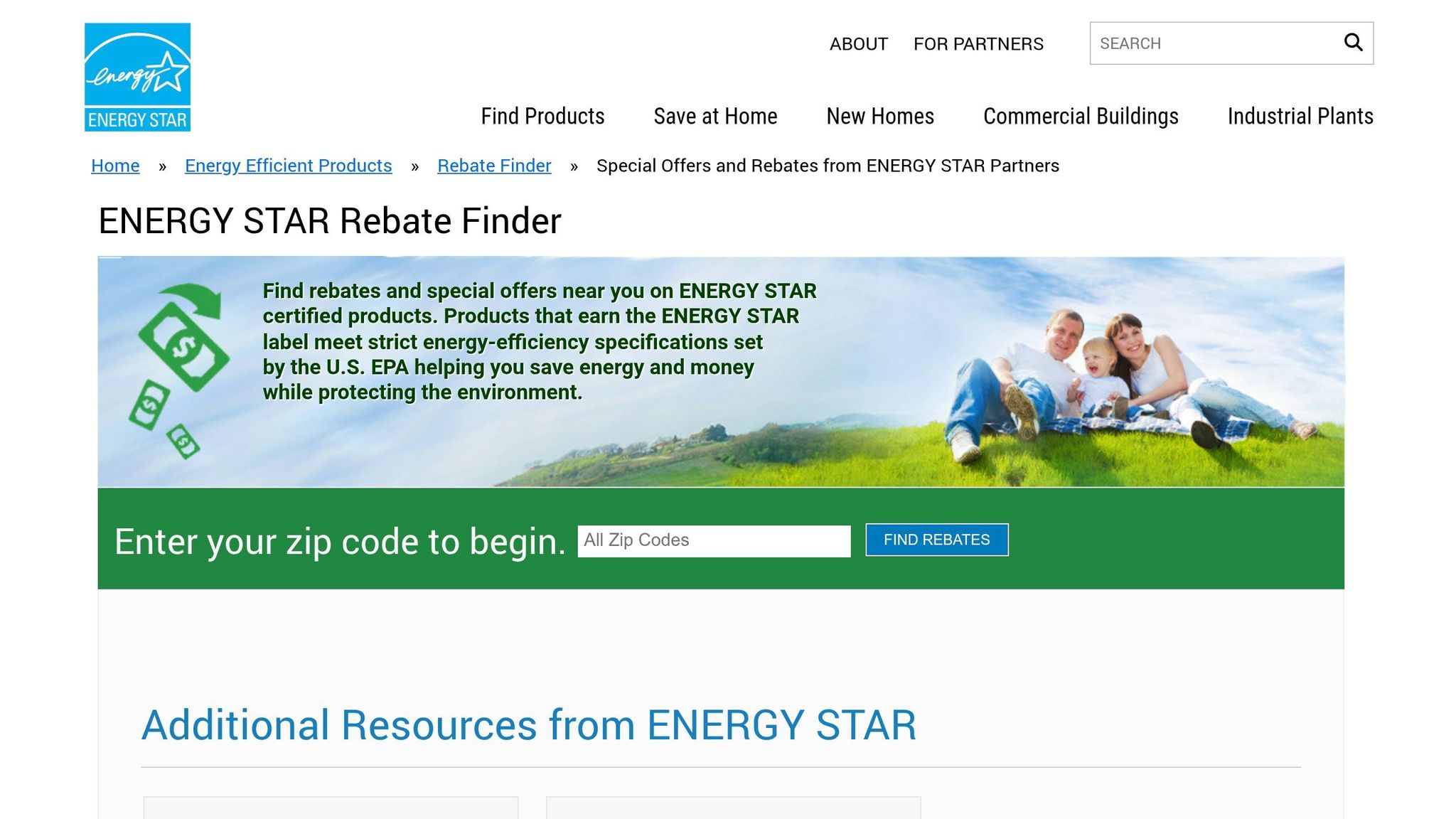
The ENERGY STAR Rebate Finder, managed by the EPA, is a free tool that helps you discover rebates and special offers on energy-efficient products. It’s quick and straightforward to use, and in just a few steps, you can find savings tailored to your location. Here’s how to make the most of it.
Step 1: Access the Rebate Finder Tool
Start by visiting energystar.gov. From there, go to either "Energy Efficient Products" or "Find Savings" under the "Efficient Home Upgrades" section. Enter your ZIP code to get started. The rebates available depend on your location, as they’re typically offered through local utility companies, state energy programs, or nearby installers. Double-check your ZIP code to ensure you’re viewing accurate rebate options for your area.
Step 2: Search by Product Category
Once your ZIP code is entered, the tool allows you to browse rebates by product category. These categories include:
- Heating & Cooling: Options like air-source heat pumps, smart thermostats, and furnaces.
- Appliances: Items such as clothes washers, dryers, and refrigerators.
- Water Heaters: Includes heat pump water heaters or tankless gas models.
- Building Products: Covers windows, doors, and insulation.
If you’re planning a specific project – like replacing an old furnace or upgrading your home’s insulation – select the relevant category to see all the rebates available for that type of product. To ensure your chosen model qualifies, you can also cross-check it using the Product Finder tool, which verifies if it’s ENERGY STAR certified and meets the rebate’s technical criteria.
Step 3: Filter and Review Results
After selecting a product category, the tool will show you a list of rebates and tax credits available. Each result provides key details, including:
- The incentive amount
- How to access the rebate
- Eligibility requirements
For instance, a heat pump might qualify for a federal tax credit of up to $2,000, along with a state rebate of up to $8,000. Be sure to review the documentation requirements carefully – some programs may require professional installation or proof that the product meets specific efficiency standards. If needed, you can adjust the filters to explore more options.
Lastly, check out the "Tax credits for residential energy efficiency" section. Many products qualify for both rebates and federal tax credits, which can add up to significant savings. Once you’ve gathered all the necessary details and documentation, you’re ready to claim your rebate.
Rebate Types and Eligibility
The ENERGY STAR Rebate Finder categorizes rebates into three main types: federal tax credits, state and utility company rebates, and manufacturer and retailer rebates. Each category has its own set of rules and application processes, so understanding these distinctions can help you calculate your energy upgrade savings.
Federal Tax Credits
Federal tax credits allow you to offset 30% of your upgrade costs – up to $3,200 per year – on your tax return. Specific caps apply to certain products: heat pumps, heat pump water heaters, and biomass stoves have a $2,000 annual limit, while upgrades like insulation, windows, doors, furnaces, and central air conditioners are capped at $1,200 annually.
Eligibility depends on the type of home and your residency. For example:
- Home envelope improvements (like insulation, windows, and doors) apply only to your principal residence. Residents in the Pacific Northwest can also find specific tips on saving money on energy bills in Puget Sound through better insulation.
- Heat pumps and water heaters can qualify for both primary and secondary homes.
- Renters may claim credits for upgrades like heat pumps, water heaters, and energy audits if the property is their main residence.
Starting in 2025, products must include a four-digit Qualified Manufacturer (QM) code provided by the manufacturer to qualify for credits. To claim your credit, you’ll need to file IRS Form 5695. If you plan multiple improvements, consider spreading them across several years to stay within the annual limits.
State and Utility Company Rebates
State and utility company rebates focus on regional energy efficiency incentives. These rebates vary by ZIP code and are offered by state governments or local utility providers. They are available only for ENERGY STAR-certified products and often have different application methods compared to federal credits. Some rebates are applied at the point of sale, while others require mail-in applications.
Unlike federal tax credits, these programs may also extend to renters and even commercial properties. To find rebates specific to your area, enter your ZIP code into the Rebate Finder tool.
Manufacturer and Retailer Rebates
Manufacturers and retailers also offer rebates to encourage the purchase of ENERGY STAR-certified products. These promotions are often tied to specific brands and models, and you can search for them by ZIP code using the Rebate Finder.
Some rebates are applied instantly at checkout, while others require you to submit a rebate form along with your purchase receipt. To ensure eligibility:
- Confirm that your product is ENERGY STAR certified using the Product Finder tool.
- Review all documentation requirements before purchase.
- If planning to claim a federal tax credit in 2025, make sure to obtain the four-digit QM code at the time of purchase.
Additional Resources for Savings
When you’re searching for ways to save on energy-efficient upgrades, there are several resources you can tap into to verify product details and discover local incentives.
ENERGY STAR Product Finder
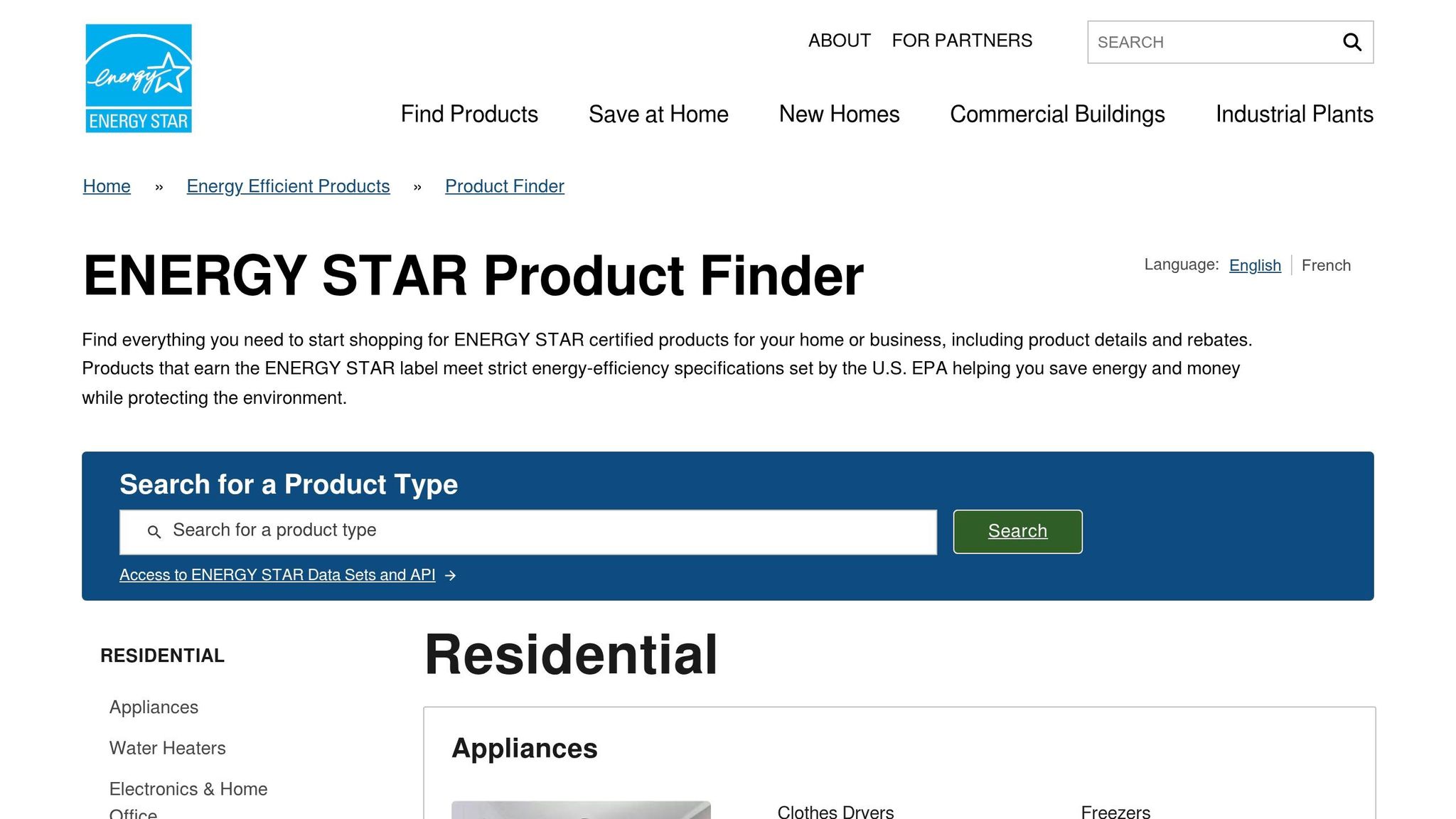
The ENERGY STAR Product Finder is a powerful tool that’s updated daily. It allows you to confirm that your chosen model meets EPA efficiency standards. You can filter by category, brand, or technical features, making it easy to narrow down your options. Plus, it offers the ability to export product data in different formats, which is super helpful when comparing multiple models side by side.
Local Utility and State Energy Programs
Don’t overlook the rebates offered through local utility companies and state energy programs. These programs often provide additional savings that might not appear in the Rebate Finder. Starting in 2026, state-administered initiatives like the Home Owner Managing Energy Savings (HOMES) program and the Home Electrification and Appliance Rebates (HEAR) will become key sources for rebates. Depending on your household income and the upgrades you choose, these incentives can range from $2,000 to $14,000 per household.
What’s even better? Many utility companies allow you to combine their rebates with state programs, giving you an opportunity to maximize your savings. To stay up-to-date, check your state energy program’s website and explore your utility provider’s online tools to uncover all available incentives.
If the process feels overwhelming, professional assistance can make navigating these options much easier.
Envirosmart Solution‘s Rebate Assistance
For homeowners in the Pacific Northwest, Envirosmart Solution offers a concierge-style rebate assistance service. They specialize in identifying and securing every available rebate, whether it’s from the government, local utilities, or vendors. Their team helps you at every stage – from selecting ENERGY STAR-certified equipment like heat pumps and insulation to overseeing installation and handling the rebate application process.
Claiming Your Rebate
Once you’ve purchased your energy-efficient product, it’s time to submit your rebate application. While the exact process can differ depending on whether you’re dealing with a utility company, a state program, or a manufacturer, the basic steps are generally consistent across most programs.
Required Documentation
Before you start your application, make sure you have all the necessary documents. These typically include receipts that show both the purchase and installation dates, along with completed and signed rebate forms provided by the program sponsor. You’ll also need to include the model and serial numbers of the equipment you purchased.
For HVAC systems like heat pumps, contractor invoices are usually required. These invoices should include the contractor’s licensing details. Many rebate programs – especially those under the Home Efficiency Rebates (HOMES) or Home Electrification and Appliance Rebate (HEAR) initiatives – demand proof that a licensed professional completed the installation. Unfortunately, this means DIY projects often won’t qualify. If you’re applying for insulation rebates, keep documentation showing the material was installed correctly.
Once you’ve gathered all the necessary paperwork, you’re ready to move on to the submission process. If the upfront costs are still a concern, you might also explore financing options to bridge the gap while waiting for your rebate check.
Submitting Applications
How you submit your application depends on the rebate program. Online applications are the quickest method, offering instant confirmation numbers and eliminating the risk of mail delays. Alternatively, you can send your application by mail, or, in some cases, take advantage of immediate point-of-sale discounts or bill credits offered by certain programs.
Be mindful of deadlines – most programs require applications to be submitted within 60 to 90 days of installation. Submitting early in the rebate cycle is a smart move to avoid seasonal delays or the risk of funds running out. If your contractor handles the submission, be sure to request a copy of the confirmation number for your records.
Tracking Status and Avoiding Errors
After submitting your application, keep an eye on its progress to ensure everything is processed smoothly. Processing times vary depending on the program: manufacturer rebates usually take 4–8 weeks, utility company rebates can take 6–10 weeks, and state-managed programs often require 8–12 weeks. Most programs offer online tracking tools, allowing you to check your application’s status using your reference number.
Common mistakes can delay or even disqualify your application. These include late submissions, incomplete paperwork, missing signatures, incorrect model numbers, or ineligible equipment.
"HVAC rebates are worth the wait, but they require patience and careful documentation." – Alex Lane, The Furnace Outlet
To avoid prolonged waiting, follow up regularly. Log into tracking portals or call the rebate hotline every few weeks to check for updates.
Start Saving with ENERGY STAR Rebates
Saving money on energy-efficient upgrades has never been easier. Start by entering your ZIP code into the ENERGY STAR Rebate Finder to see what incentives are available in your area.
Federal tax credits, which cover 30% of project costs, combined with state and utility rebates, can add up to savings as high as $14,000. For instance, installing a heat pump could qualify you for up to $2,000 in federal tax credits and an additional $8,000 in rebates.
"The Inflation Reduction Act will make it more affordable for families to purchase energy efficient equipment when they need to, make repairs to their homes, and save money on their utility bills each month." – Ann Bailey, ENERGY STAR Certified Products
If you’re looking for expert help, there are services designed to make the process even smoother. Envirosmart Solution specializes in assisting homeowners in the Pacific Northwest to take full advantage of government, local, and vendor rebates. They provide a complete service for energy efficiency upgrades, from installing insulation to HVAC systems. Even better, they handle all the paperwork for you, ensuring your installation meets the strict requirements for rebate eligibility – so you don’t miss out on savings.
FAQs
Can I combine federal tax credits with local rebates?
Yes, you can usually combine federal tax credits with local rebates to increase your savings. Programs such as federal tax incentives, state rebates, and utility rebates often work together, letting you benefit from multiple offers simultaneously. This approach can help cut down the cost of making energy-efficient upgrades to your home.
Do rebates require professional installation or can I DIY?
Rebates for energy-efficient upgrades can sometimes include DIY installation, but this depends on the product and the rules of your local rebate program. For simpler upgrades, like insulation or certain appliances, DIY might be an option. However, more complex systems – like HVAC units or electrical installations – often require professional installation to qualify for the rebate. Be sure to review the specific details of your local rebate program to understand the requirements and confirm your eligibility.
What paperwork should I keep to avoid getting denied?
To minimize the chances of rebate denials, it’s essential to keep thorough documentation that shows you meet the program’s requirements. This should include:
- Receipts, invoices, or certificates as proof of purchase or installation.
- Inspection or certification reports confirming energy efficiency improvements.
- Detailed written reports outlining major energy upgrades.
- Copies of all forms, applications, and correspondence you’ve submitted.
Organized records not only back up your claim but also make the process smoother and less prone to issues.