
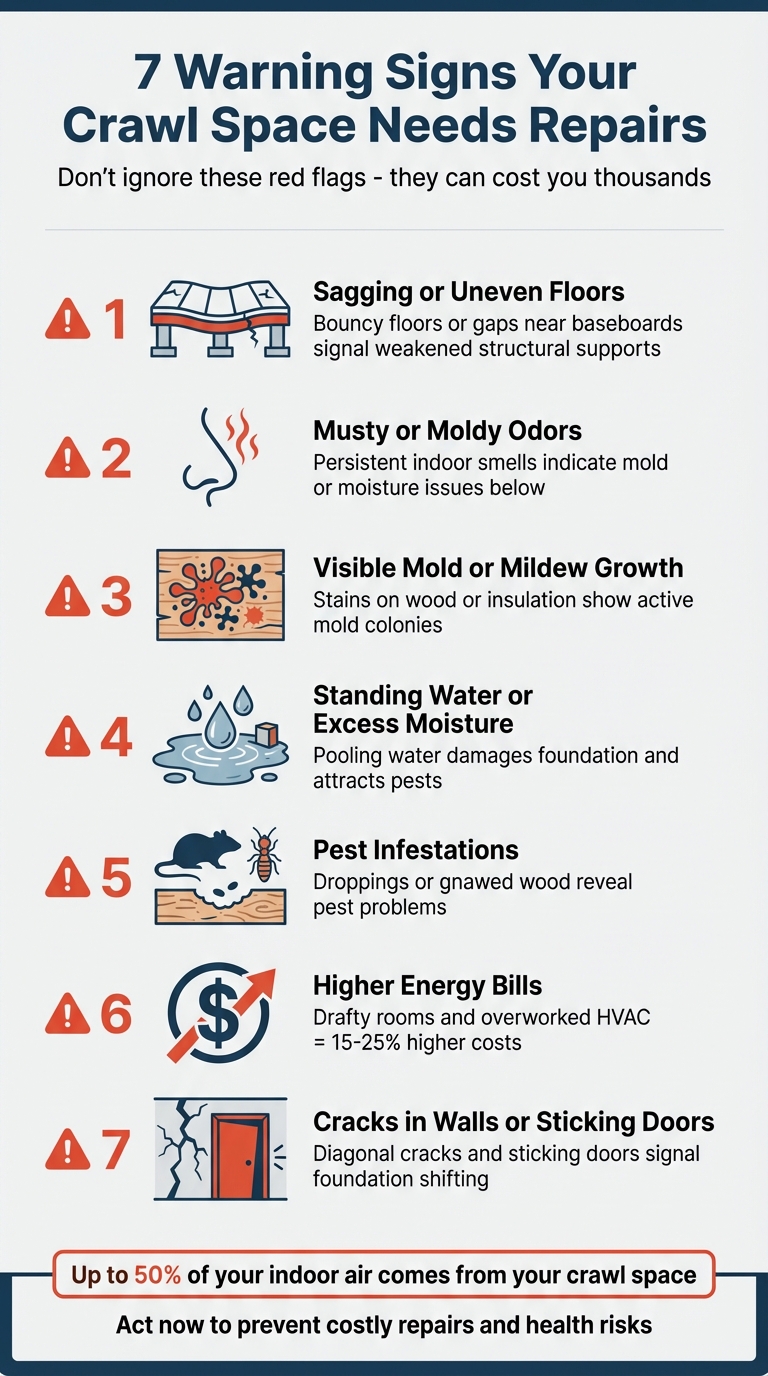
Your crawl space might be hidden, but ignoring its condition can lead to serious problems for your home and health. Here are the 7 key warning signs that demand immediate attention:
- Sagging or Uneven Floors: Bouncy floors or gaps near baseboards often signal weakened structural supports from moisture or pests.
- Musty or Moldy Odors: Persistent smells indoors could indicate mold or moisture issues in your crawl space.
- Visible Mold or Mildew Growth: Stains or discoloration on wood or insulation point to active mold colonies thriving in damp conditions.
- Standing Water or Excess Moisture: Pooling water or wet soil can damage your foundation and attract pests.
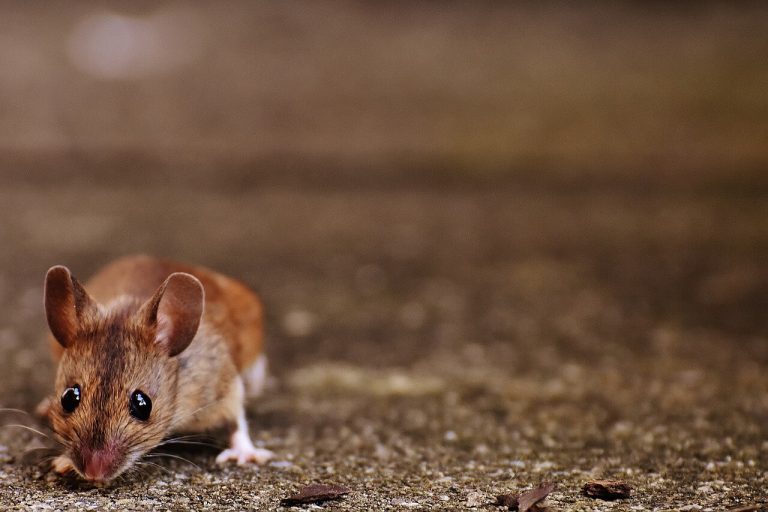
- Pest Infestations: Signs like droppings or gnawed wood suggest rodents or termites are taking advantage of a damp environment.
- Higher Energy Bills: Drafty rooms and increased HVAC usage may be caused by poor insulation or excess humidity below.
- Cracks in Walls or Sticking Doors: Shifting foundations or rotting supports often lead to visible damage inside your home.
Why act now? Left unchecked, these issues can lead to costly repairs, structural damage, and health risks. Addressing problems early can save thousands of dollars and improve your home’s safety and air quality.
Quick Tip: Regular inspections and moisture control are your best defenses. If you notice any of these signs, consult a professional to protect your home.
7 Warning Signs Your Crawl Space Needs Immediate Repair
1. Sagging or Uneven Floors
Observation/Symptom
Does your living room floor feel a bit bouncy or springy underfoot? Maybe you’ve noticed dips, gaps forming between the floor and baseboards, doors or windows that stick, or even diagonal cracks on your walls. These are telltale signs that the structural supports beneath your floor might be weakening.
Underlying Cause
The usual culprit? Moisture in the crawl space. When wooden beams are exposed to excessive moisture, they can warp or rot, compromising the floor’s support. Other contributors include shifting soil, damage from wood-destroying insects, or slow, unnoticed plumbing leaks – all of which chip away at your home’s structural integrity.
"A sagging floor above a crawl space is rarely a surface-level issue and typically reflects moisture, support, or soil-related problems below the home." – LUX Foundation Solutions
Potential Consequences
Ignoring sagging floors can lead to some serious problems. We’re talking about partial or even complete floor collapse, increased tripping hazards, and a noticeable dip in your home’s market value. Addressing the issue quickly not only ensures safety but also helps maintain your home’s worth.
sbb-itb-8db64ac
2. Musty or Moldy Odors
Observation/Symptom
Have you noticed an earthy or stale smell lingering indoors? That unexpected scent might be your first clue that something is wrong in your crawl space. A musty odor often resembles the smell of an old basement, while a sharper, more pungent moldy odor suggests that mold colonies have already settled on materials like wood or insulation.
Thanks to the stack effect, air from your crawl space – including any mold spores or odors – gets pulled upward into your living areas. If you’re detecting these smells on higher floors, it’s a strong indicator that the problem below has been brewing for some time. These odors typically point to moisture issues developing in the crawl space.
Underlying Cause
These odors are caused by mold byproducts released when moisture damages materials like wood, insulation, or debris. The main culprit? Excess moisture and high humidity levels. When relative humidity rises above 60%, and especially beyond 70%, conditions become ideal for mold growth and wood rot.
Moisture can come from several sources: groundwater seepage, rainwater entering through foundation cracks, or damp soil. Ironically, open vents meant to "air out" your crawl space can actually make the problem worse by pulling in humid air, which then condenses on cooler surfaces.
Potential Consequences
These odors are more than just an annoyance – they can affect both the air you breathe and the structural integrity of your home.
Ignoring musty or moldy smells can lead to serious problems. Prolonged mold exposure has been linked to worsening asthma, allergies, and sinus infections. Some homeowners even report symptoms like headaches and fatigue due to mold toxins.
From a financial perspective, moisture-related odors can significantly impact your home’s value. Properties with untreated mold or moisture issues often experience a value reduction of 10% to 30%. On top of that, mold doesn’t just smell bad – it weakens wooden supports over time, leading to sagging floors and warped structures. The longer you wait, the more expensive repairs become.
If these warning signs sound familiar, it’s time to act. Reach out to Envirosmart Solution for a thorough inspection and expert services. They specialize in crawl space cleaning, mold remediation, and moisture control to help protect your home’s air quality and structural soundness.
"Up to 50% of the air you breathe comes from your crawl space. A musty odor means contaminants are moving upward into your home."
3. Visible Mold or Mildew Growth
Observation/Symptom
Take a close look at your crawl space. Are there green, black, brown, or yellow stains on beams, insulation, or posts? These aren’t just harmless discolorations – they’re signs of active mold colonies breaking down your home’s structural materials. Mold can look different depending on the type: white mold often appears as a powdery layer on soil or floor joists, black mold tends to form fuzzy or slimy patches on damp wood and ductwork, while yellow mold usually shows up as a golden, slimy coating on wooden components. Any visible mold growth points to moisture problems that need immediate attention.
Underlying Cause
Mold thrives in dark, damp places with plenty of organic material to feed on. High humidity and excess moisture are the main culprits. This moisture can come from several sources: plumbing leaks, condensation when warm air meets cooler surfaces, or groundwater seeping through exposed dirt floors. Ironically, open vents – which were once thought to improve airflow – can actually worsen the problem. These vents allow humid outdoor air to enter, which then condenses on cooler surfaces, creating the perfect environment for mold.
Potential Consequences
The impact of mold goes far beyond what’s visible. Mold releases spores and microbial volatile organic compounds (mVOCs) into the air. Breathing these in can lead to respiratory problems, asthma flare-ups, and ongoing sinus infections. Structurally, mold eats away at wooden floor joists and beams, causing them to weaken. Over time, this can result in sagging floors, bouncy spots when you walk, and serious structural issues that require costly repairs. Ignoring mold allows it to spread and worsen the damage, so addressing it quickly is critical to protecting your home.
"If left to grow, crawl space mold will eventually travel to other areas of the house through vents and other connected systems, presenting risks to your health and your home."
- Jennifer Malgren, Laboratory Manager, JSE Labs
If you’ve spotted these signs, Envirosmart Solution provides expert mold remediation and crawl space encapsulation services. They can tackle the visible mold and fix the moisture issues behind it, helping to create a safer and healthier home environment for your family.
4. Standing Water or Excess Moisture
Observation/Symptom
Take a close look at your crawl space for any signs of standing water. This could show up on pipes, walls, vents, or even as wet, muddy soil. Other clues include water stains running down concrete walls or insulation on floor joists that appears to be sagging. These indicators might not be obvious from the entrance, so you may need to explore deeper to find pooling water, especially in low-lying areas or corners.
Even if you don’t spot puddles, hidden moisture often leaves other traces. Lingering odors, bouncy or uneven floors, and condensation on windows are all red flags that moisture is present.
Underlying Cause
There are several ways moisture can creep into your crawl space. Poor drainage outside your home is a common culprit. Clogged gutters, downspouts that release water too close to the foundation, or sloping ground that directs rainwater toward your home can all funnel water into this area. Groundwater might also seep in during heavy rains when the water table rises or when overly saturated soil pushes water into the crawl space.
Localized pooling can result from leaking or burst pipes, as well as air conditioning condensation. Open vents are another issue – they can draw in humid air, which then condenses on cooler surfaces. If the crawl space floor is bare dirt without a vapor barrier, moisture can evaporate directly into the space. These conditions can quickly damage structural supports and lead to further complications.
Potential Consequences
Excess moisture and standing water can cause serious problems over time. Wooden floor joists and support beams may start to rot, weakening their ability to hold weight. This can make the floors above sag or feel springy. If the soil beneath your home becomes too saturated, it can destabilize the foundation. This might result in cracks in the walls or make doors and windows stick.
Standing water doesn’t just harm the structure – it also affects air quality. Mold and mildew thrive in damp conditions, releasing spores that can trigger respiratory problems, allergies, or asthma. Pest infestations are another concern, as termites, carpenter ants, and rodents are drawn to moist environments, often requiring professional rodent proofing and cleanup services. On top of that, damp air is harder to heat and cool, which can increase energy bills by as much as 18%.
"The structural integrity of the home can be jeopardized by a damp or wet crawl space."
- Atlantic Foundation & Crawl Space Repair
If you’re dealing with standing water or persistent moisture, it’s important to act quickly. Envirosmart Solution offers services like vapor barrier installation, drainage adjustments, and dehumidification systems to help protect your home’s structure and improve indoor air quality.
9 Alarming Signs of Crawl Space Damage | Groundworks Home Repair Tips

5. Pest Infestations
Excess moisture doesn’t just weaken your home’s structure – it also creates a perfect haven for pests.
Observation/Symptom
Watch for telltale signs of pests in your crawl space. These might include rodent droppings (typically 1/8 to 1/4 inch long), greasy rub marks along walls, or small footprints in dusty areas. Look for physical damage like gnawed wooden beams, chewed electrical wires, or burrows in fiberglass insulation. Termites often leave mud tubes on foundation walls and may cause wood to sound hollow when tapped. Spiders may spin irregular webs in dark corners, and camel crickets can ruin stored fabrics or curtains. Even if you don’t see pests, listen for scratching or scurrying sounds under your floors, or take note of strong odors resembling rodent urine or musty waste. An increase in insects or rodents inside your home could also signal a crawl space infestation.
Underlying Cause
Crawl spaces are magnets for pests because they provide darkness, high humidity, and seclusion. Pests can squeeze through tiny gaps, such as those around utility lines or unsecured vents – mice, for instance, can fit through openings as small as a quarter-inch. Once inside, pests thrive on exposed dirt floors, decaying organic matter, and mold growth. Rodents often nest in cardboard boxes, while high humidity (above 70%) encourages mold, attracting even more moisture-loving pests. These vulnerabilities not only lead to infestations but also pose serious risks to your home’s structure and your health.
Potential Consequences
The damage pests cause isn’t limited to the crawl space. Termites and carpenter ants can weaken your home’s structural support by feeding on wooden beams, while rodents chewing on electrical wires pose fire hazards and electrical issues . Rodents can also destroy insulation, reducing energy efficiency and driving up your utility bills.
"Pests leave behind waste and bacteria, posing health hazards… [and] can damage wood, incurring expensive repairs." – JES Foundation Repair
Health risks are just as alarming. Pest droppings and carcasses can spread bacteria throughout your home. Cockroach droppings, for example, may worsen asthma and allergies, while rodent waste often carries dangerous pathogens. Combined with moisture problems, pest infestations can severely compromise your crawl space, leading to costly repairs.
If you notice signs of pests, act quickly. Envirosmart Solution provides rodent-proofing and attic and crawl space cleaning services to eliminate infestations and seal entry points – helping to safeguard both your home and your family’s well-being.
6. Higher Energy Bills
If your utility bills seem to be climbing for no clear reason, your crawl space might be the hidden source of the problem.
Observation/Symptom
You might notice your HVAC system running almost nonstop, even during mild weather. Floors could feel unusually cold in winter, or your home might stay humid and uncomfortable in summer despite the air conditioner working overtime. Some homeowners deal with drafty rooms or struggle to get certain areas of the house to match the thermostat’s setting. These signs often come alongside energy bills that have jumped by 15% to 25% compared to previous months. If you’ve noticed your heating or cooling system cycling more frequently, your crawl space could be the reason it’s working harder than it should.
Underlying Cause
The problem often ties back to the stack effect – around 50% of the air on your first floor originates from your crawl space. If that air is damp, unconditioned, or influenced by extreme outdoor temperatures, your HVAC system has to work harder to keep your home comfortable. Damaged or wet insulation loses its ability to prevent heat transfer effectively, making it harder to maintain a consistent indoor temperature. Open vents or unsealed gaps in the crawl space allow hot, humid air in summer and freezing air in winter to seep into your home. Humid air, in particular, is more expensive to cool because the moisture increases the latent heat load on your air conditioner, causing it to run longer cycles.
"A poorly insulated crawl space allows outside temperatures to affect your home’s internal climate, forcing your HVAC system to work overtime." – Tiger C Construction
Potential Consequences
The immediate effect is higher utility bills, but an overworked HVAC system can also wear out faster, leading to costly repairs or early replacement. Air leaks and poor sealing in the crawl space can account for 15% to 25% of your home’s total energy loss. Over time, this inefficiency not only increases costs but also reduces comfort and indoor air quality.
Fixing these problems usually involves sealing vents and gaps, replacing damaged insulation, and installing a vapor barrier to block moisture. Companies like Envirosmart Solution specialize in crawl space encapsulation and insulation, helping restore energy efficiency. They can also assist in finding rebates or incentives to help offset the cost of these upgrades.
7. Cracks in Walls or Sticking Doors and Windows
Observation/Symptom
Hairline cracks and widening gaps in walls are often a red flag for issues lurking below your home. Diagonal cracks extending from the corners of window and door frames are particularly telling – they’re a classic sign of foundation settling. Other warning signs include sticking doors, misaligned frames, and nail pops, all of which suggest that your home’s foundation may be shifting.
"Those hairline fissures snaking across your drywall aren’t just unsightly. They’re often the first clue that something’s amiss in your crawl space." – Vanco Crawlspace & Restoration, LLC
Underlying Cause
These symptoms typically point to foundation settling or weakened structural supports in your crawl space. Excess moisture or standing water can wreak havoc on wooden floor joists and beams, causing them to rot, warp, or decay. This weakens their ability to support your home’s weight. As these supports fail or shift – often due to weak soil or improper spacing – uneven pressure builds, leading to foundation movement. Pests like termites and carpenter ants can worsen the problem by further damaging the wood. Cracks wider than 1/8 inch are usually more than cosmetic; they indicate serious structural concerns.
Potential Consequences
Overlooking these signs can lead to major structural problems, including partial floor collapses and significant drops in your home’s market value. Selling a home with crawl space damage can be challenging, as these issues must be disclosed to potential buyers. Additionally, lenders may refuse to finance properties with unresolved foundation problems. Addressing the issue early is far more affordable than dealing with extensive foundation repairs later.
Foundation cracks can also create openings for rodents, insects, and even radon gas – a dangerous carcinogen and a leading cause of lung cancer. If you notice sticking doors paired with diagonal wall cracks, avoid quick DIY fixes and schedule a professional crawl space inspection. Companies like Envirosmart Solution specialize in identifying and addressing these problems before they escalate into costly repairs.
Quick Reference Table
Here’s a handy table summarizing common warning signs, their causes, and potential impacts. Use it as a quick diagnostic guide.
| Warning Sign | Common Causes | Potential Consequences |
|---|---|---|
| Sagging or Uneven Floors | Wood rot due to moisture, improperly spaced support beams, weak or shifting soil, termite damage | Floor collapse, structural instability, and safety hazards |
| Musty or Moldy Odors | Mold and mildew releasing microbial volatile organic compounds (MVOCs), high humidity drawn into living areas via the stack effect | Poor indoor air quality, respiratory problems, and persistent allergens throughout the home |
| Visible Mold or Mildew Growth | Relative humidity above 60%, standing water, condensation on cool surfaces, or lack of a vapor barrier | Wood decay, health risks like asthma and allergies, and mold spreading to living areas |
| Standing Water or Excess Moisture | Groundwater seepage, plumbing leaks, poor exterior grading directing rainwater toward the home, or humid air entering through open vents | Foundation settlement, warped sub-flooring, rapid wood rot, and extreme humidity |
| Pest Infestations | Moisture attracting termites and rodents, open vents providing entry points, and organic material (wood) serving as a food source | Damaged wiring and insulation, compromised structural wood, unhygienic conditions, and disease spread |
| Higher Energy Bills | High humidity making air harder to heat or cool, wet fiberglass insulation losing R-value, and overworked HVAC systems | Increased utility costs, HVAC strain, and premature system wear |
| Cracks in Walls or Sticking Doors and Windows | Foundation settlement, soil erosion, weakened floor joists, or excessive moisture causing wooden frames to swell | Structural integrity issues, costly foundation repairs, and difficulty operating doors or windows |
Note: Crawl space conditions significantly influence indoor air quality. Keep crawl space relative humidity between 30% and 50%. When it climbs above 60%, mold growth is likely. If you notice multiple warning signs, it’s time to schedule a professional inspection.
Conclusion
Your crawl space might be out of sight, but it should never be out of mind. Ignoring warning signs like sagging floors, musty odors, or standing water can lead to serious structural damage and health risks. The air in your crawl space directly impacts the air you breathe indoors. If that space is damp or moldy, it means you’re inhaling mold spores, allergens, and even pest waste every day.
Addressing issues early saves money and prevents bigger problems down the road. As Groundworks explains:
"The cheapest, fastest, and most effective repair solutions are always applied to minor issues and prevent bigger ones from developing".
Professional solutions like crawl space encapsulation, dehumidification, and mold remediation can transform a damp, unhealthy crawl space into a dry, protected area. These steps not only safeguard your home’s foundation but also improve your family’s health.
Encapsulation with a 20-mil (or thicker) vapor barrier blocks ground moisture effectively. High-capacity dehumidifiers help maintain humidity levels between 40% and 60%, which discourages mold growth. Structural support jacks reinforce weakened floor joists, while sealing vents keeps out pests and excess moisture. These upgrades also reduce energy costs by lightening the load on your HVAC system, which no longer has to work overtime to compensate for damp insulation. The result? Better energy efficiency and a stronger, healthier home.
In the Pacific Northwest, where seasonal moisture and high humidity are common, Envirosmart Solution offers a complete range of services to tackle crawl space problems. From inspections to energy efficiency upgrades, their team ensures your home stays in top shape. They also help you take advantage of rebates and incentives to make these improvements more affordable. With maintenance plans like the CRAWL SPACE & ATTIC CARE™ package for $199, you get regular inspections, insulation checks, and rodent monitoring to stay ahead of potential issues.
Don’t wait for minor moisture problems to spiral into costly repairs. Schedule a professional inspection today to protect your home’s structure, improve indoor air quality, and save on future expenses.
FAQs
What steps can I take to prevent moisture problems in my crawl space?
Preventing moisture issues in your crawl space starts with keeping it sealed and in good shape. Begin by sealing any cracks, gaps, or holes in the foundation and walls to keep moisture and pests out. Laying down a vapor barrier, such as a sturdy polyethylene sheet, can also help by stopping moisture from the soil from seeping into the space.
To control humidity, aim for levels between 45% and 55%. You can achieve this by ensuring proper ventilation and using a crawl space dehumidifier. It’s also important to address water pooling around your home. Installing sump pumps or drainage systems can help manage excess water and improve overall drainage.
Finally, regular inspections and upkeep are essential to maintaining a dry and healthy crawl space. Taking these steps can protect your home from mold, wood rot, and other moisture-related problems.
What health problems can mold in the crawl space cause?
Mold in your crawl space can have a serious impact on your health by releasing spores that travel through the air and spread throughout your home. Breathing in these spores can lead to allergic reactions, including sneezing, coughing, itchy eyes, and skin irritation. If you have asthma or other respiratory conditions, mold exposure can make symptoms worse, potentially causing wheezing or difficulty breathing.
Over time, prolonged mold exposure can lead to more severe health problems. These may include chronic sinus infections, persistent fatigue, and even neurological issues like headaches. Mold can also weaken your immune system, leaving you more susceptible to other illnesses. Taking quick action to address mold in your crawl space is crucial for safeguarding your health and ensuring your home remains a safe place to live.
How does my crawl space affect my home’s energy efficiency?
Your crawl space does more than you might think – it plays a crucial role in how efficiently your home uses energy. If it’s not insulated well or struggles with moisture problems, you could face drafts, uneven temperatures indoors, and higher energy bills as your HVAC system works overtime to keep things comfortable. Beyond energy concerns, moisture issues can lead to mold, wood rot, and even pest infestations, which can further affect your home’s efficiency and air quality.
Taking steps to properly seal and insulate your crawl space, along with managing moisture using tools like vapor barriers or dehumidifiers, can cut energy waste by as much as 15–18%. This means lower utility bills, better protection for your home’s structure, and a noticeable boost in comfort. Keeping up with regular crawl space maintenance is essential for an energy-efficient and healthy home.