
Radiant ceiling and wall panels offer an efficient and quiet way to heat your home by using infrared radiation to warm objects and people directly, rather than heating the air. They save energy, improve air quality, and fit seamlessly into modern spaces. Here’s what you need to know:
- How They Work: Infrared energy heats objects directly, avoiding energy losses from ductwork and air circulation. Proper placement and insulation are key for optimal performance.
- Types: Choose between electric panels for quick heating or hydronic systems for steady, long-term warmth. Electric panels are easier to install, while hydronic systems are ideal for larger spaces.
- Benefits: Reduce heating costs by 40%, improve air quality by eliminating dust circulation, and save space with wall or ceiling-mounted designs.
- Installation: Electric panels are simpler to install, while hydronic systems require plumbing and a heat source like a boiler. Both need proper insulation and professional setup.
- Maintenance: Minimal upkeep is needed, but annual inspections for hydronic systems and occasional cleaning for electric panels ensure efficiency.
- Cost Savings: Federal tax credits and rebates can offset installation costs, with up to $3,200 annually available through 2025.
Radiant panels combine energy efficiency, comfort, and a sleek design, making them a practical heating solution for homes.
Top 5 Radiant Ceiling Heating & Cooling FAQs
How Radiant Ceiling and Wall Panels Work
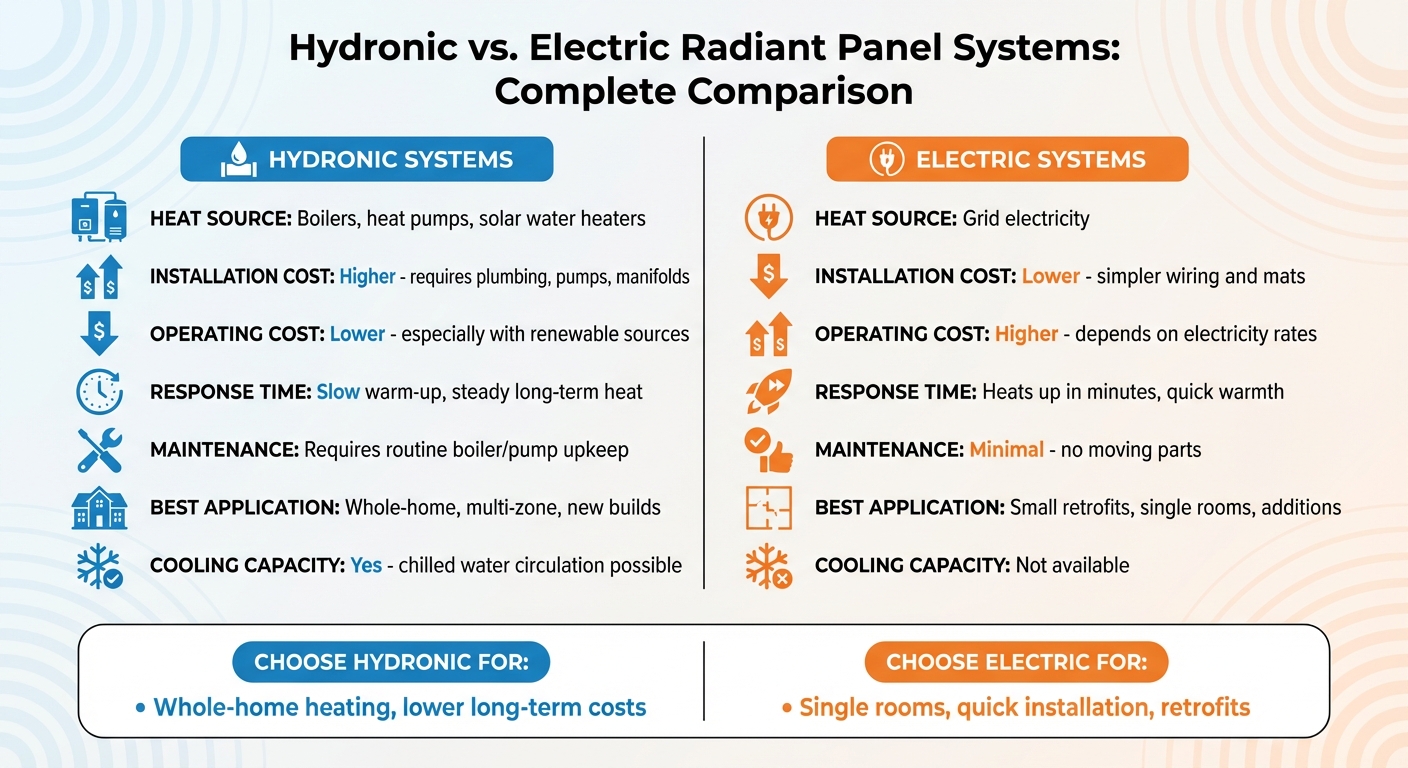
Hydronic vs Electric Radiant Panel Systems Comparison
Understanding Radiant Heating
Radiant panels rely on infrared radiation to deliver heat, much like the sun warming your skin. Instead of heating the air first, these panels emit infrared energy that travels directly through the space, warming solid objects like floors, furniture, and people almost instantly.
This heating method is often referred to as "line-of-sight" heating because the infrared waves heat whatever lies directly in their path. Placement is crucial – if a large object, like a bookshelf, blocks the panel, it can disrupt heat distribution in that area. Unlike traditional systems, radiant panels avoid convection losses entirely, as they don’t rely on ductwork, which can leak energy. Additionally, they eliminate drafts, reducing the circulation of dust or allergens. In some setups, walls or ceilings absorb the heat and gradually release it over time, helping to maintain an even temperature even after the system cycles off.
To get the most out of radiant panels, proper insulation is key. A well-sealed space ensures the heat absorbed by objects inside doesn’t escape. For optimal performance, avoid placing large furniture in front of wall-mounted panels, as this can block heat transfer. Using individual thermostats for separate rooms can further improve efficiency – radiant panels heat up quickly, allowing precise temperature control on a room-by-room basis.
Now, let’s break down the differences between hydronic and electric radiant systems to help you decide which one suits your needs.
Hydronic vs. Electric Systems
Once you understand how radiant heating works, it’s important to explore the two main types of systems: hydronic and electric.
Hydronic systems circulate heated water through flexible tubing (commonly PEX) embedded in the panels. These systems require a central heat source, such as a boiler or heat pump, along with circulator pumps to move the water. On the other hand, electric systems use resistance cables or mats placed behind or within the panels. When electricity flows through the cables, they generate heat that radiates into the room.
One major difference between the two is response time. Electric panels heat up in just a few minutes, making them perfect for spaces like bathrooms or home additions where quick warmth is needed. Hydronic systems, in contrast, warm up more slowly but provide steady, long-term heat, especially in high-mass installations. Hydronic systems also offer a unique advantage: they can double as cooling systems by circulating chilled water through the same network of pipes.
| Feature | Hydronic Systems | Electric Systems |
|---|---|---|
| Heat Source | Boilers, heat pumps, solar water heaters | Grid electricity |
| Installation Cost | Higher (requires plumbing, pumps, manifolds) | Lower (simpler wiring and mats) |
| Operating Cost | Lower (especially with renewable sources) | Higher (depends on electricity rates) |
| Maintenance | Requires routine boiler/pump upkeep | Minimal (no moving parts) |
| Best Application | Whole-home, multi-zone, new builds | Small retrofits, single rooms, additions |
| Cooling Capacity | Possible (chilled water circulation) | Not available |
If you’re working on a small project or retrofitting a single room, electric panels are a convenient choice. For larger homes or new builds in heating-heavy climates, hydronic systems are often the better option, thanks to their lower long-term operating costs. However, for high-mass hydronic systems, avoid setting the temperature too low during off-hours – these systems take time to warm back up due to their slower response rate.
Benefits of Radiant Ceiling and Wall Panels
Energy Efficiency and Lower Heating Costs
Radiant panels provide heat directly to surfaces, cutting down on energy waste and enabling precise, zoned heating. Unlike traditional systems that heat the air, these panels warm objects and people directly, avoiding the inefficiencies of heating an entire room. Homes using radiant panels can see energy savings of over 40% compared to conventional heating systems. With zoned heating, you can adjust temperatures room by room, focusing heat where it’s needed most. Plus, the warmed surfaces continue to emit heat, creating a cozy environment even at lower ambient temperatures. Pairing these systems with smart thermostats further fine-tunes energy usage, making them an efficient choice for modern households.
Better Indoor Air Quality
Radiant panels contribute to healthier indoor air by operating without moving air around. This eliminates the circulation of dust, allergens, and moisture that can lead to mold growth. Their silent operation not only ensures a peaceful environment but also maintains stable humidity levels, adding to overall comfort during colder months. Many users also find the gentle, even warmth helps alleviate sore muscles and joint discomfort, enhancing the feeling of well-being. These features collectively create a cleaner, more comfortable living space.
Space-Saving Design
Radiant panels are a practical solution for maximizing living space. Unlike traditional heating systems that take up room with bulky radiators, vents, or baseboard heaters, radiant panels mount flush to ceilings or walls, leaving floors and walls free for furniture and other uses. Interior designer Michelle Anderson highlights their versatility:
"Being ceiling-mounted, they free up floor and wall space – ideal for minimalist or compact interiors."
This design is especially useful in spaces with high ceilings or open layouts where conventional systems may struggle to distribute heat evenly. Some panels even double as decorative elements, blending style with functionality. Additionally, their cool-to-the-touch surfaces and silent operation make them a safe and discreet option for households with children and pets.
Installing Radiant Ceiling and Wall Panels
Preparation and Material Selection
Start by measuring the room’s dimensions and noting the ceiling height. This helps determine the number of panels you’ll need and their placement. It’s wise to consult a professional to ensure the layout works with your home’s existing electrical or plumbing systems. Also, check that the room is well-insulated to make the most of the panels’ heating capabilities. Lastly, identify the type of ceiling or wall – whether it’s drywall, suspended, or exposed – so you can pick the right mounting hardware and panel design.
Once you’ve chosen your materials and confirmed the room’s details, you’re ready to move on to the specific steps for installing either hydronic or electric panels.
Installing Hydronic Panels
Hydronic systems require a professional design since they circulate hot water through flexible PEX tubing connected to a boiler or water heater. A manifold is used to distribute the water evenly across all panels, and a thermostat is essential for controlling the temperature and timing. This setup is ideal for whole-house heating or new construction projects. While the installation is more complex, hydronic systems are known for their lower operating costs, especially when paired with a high-efficiency boiler. Regular inspections of the manifold and tubing are necessary to check for leaks.
Installing Electric Panels
Electric panels, on the other hand, are easier to install and require fewer changes to your home’s structure. They are perfect for retrofitting single rooms or smaller spaces. These systems use heating cables or mats installed behind the surface and connect directly to your home’s electrical system. Make sure to add an insulation layer beneath the heating elements to prevent heat loss into the structure. For safety and reliability, all electrical connections should be handled by a licensed professional. Like hydronic systems, electric panels need a dedicated thermostat for precise temperature control.
Electric panels generally cost between $200 and $500 each. While the upfront cost might seem high, energy savings over time can help balance out the expense. When deciding where to place the panels, think about future furniture arrangements or wall art that could block heat transfer.
| Feature | Hydronic Panels | Electric Panels |
|---|---|---|
| Installation Complexity | Higher; involves plumbing and boiler integration | Lower; integrates with existing electrical systems |
| Operating Cost | Lower; more efficient with modern boilers | Higher; varies with electricity rates |
| Best Use Case | New construction or major renovations | Single-room retrofits or additions |
| Maintenance | Requires regular leak inspections | Minimal maintenance after installation |
Proper installation is key to ensuring your radiant panels perform well over time. Next, we’ll explore maintenance tips to keep your system running efficiently.
sbb-itb-8db64ac
Maintaining Radiant Panels for Long-Term Performance
Regular Maintenance Tasks
Radiant panels are known for being low-maintenance since they don’t rely on moving parts, fans, or motors. Unlike forced-air systems, there’s no need to replace air filters or clean out ductwork. However, one critical task is regularly checking your home’s insulation. Poor insulation can force the panels to use more energy to maintain a comfortable temperature, so inspect for drafts around windows, doors, and attics frequently.
Keep the panel surfaces free of excessive dust to allow infrared radiation to work effectively. A quick wipe-down every few months should do the trick. For hydronic systems, an annual inspection is essential to check fluid levels and ensure the pump is functioning properly. Electric systems, on the other hand, require periodic checks of safety features like overheat protection sensors. If your home has high ceilings, make sure the panel positioning is optimized to reduce warm-up delays.
When regular upkeep doesn’t solve an issue, it’s time to troubleshoot.
Troubleshooting Common Problems
Cold spots in a room? This is often due to poor panel placement or inadequate insulation rather than a mechanical failure. For electric panels, start by checking the circuit breaker. A multimeter can help identify problems with wiring or the heating element.
In hydronic systems, gurgling sounds or uneven heating are common signs of trapped air in the lines. Bleeding the system can resolve this. Also, ensure all zone valves are open and check the transformer fuse, which typically costs between $5 and $20. If you hear unexpected noises, it might indicate a loose mounting bracket or an electrical problem that requires professional attention.
Annual Maintenance with Envirosmart Solution

Routine maintenance and troubleshooting are vital, but professional services can take system care to the next level. Professional inspections help ensure your radiant panels deliver reliable performance for years. Envirosmart Solution offers the SMART GOLD™ package for $699 annually, providing a complete maintenance plan that includes HVAC tune-ups, duct cleaning, and attic insulation inspections.
The package also covers furnace maintenance, such as heat exchanger cleaning and burner checks, as well as crawl space and attic inspections to confirm insulation is intact. Plus, it includes deep air duct cleaning with a camera inspection for added peace of mind.
Since radiant panels often depend on boilers or heat pumps, these energy sources also need annual tune-ups to avoid system-wide issues. Professional technicians can perform pressure tests and inspect tubing to catch leaks before they cause significant damage. The SMART GOLD™ package offers additional perks like a 20% discount on recommended services, priority scheduling, and emergency response – giving you extra support when you need it most. Combined with regular maintenance and troubleshooting, this professional service ensures your radiant panels stay efficient and effective for the long haul.
Using Rebates and Upgrades to Improve Efficiency
Available Energy Rebates and Incentives
In addition to energy savings and improved indoor air quality, federal rebates and smart upgrades can take your system’s performance to the next level. Radiant panel installations are a budget-friendly option, especially when paired with the Energy Efficient Home Improvement Credit (Section 25C). This credit covers 30% of qualified energy-efficient improvements, with an annual limit of $3,200. The best part? This isn’t a one-time deal – you can claim the maximum credit each year through December 31, 2025.
Here’s how the credit breaks down for radiant panels:
- Adding insulation or air sealing alongside your panels allows you to claim 30% of costs, up to $1,200 annually.
- High-efficiency hydronic systems powered by natural gas, propane, or oil boilers may qualify for a credit of up to $600.
- Electric radiant panels paired with air-to-water heat pumps can unlock a larger credit of up to $2,000 per year.
- Upgrading your electrical panel to a 200+ amp capacity can secure an additional 30% credit, capped at $600.
"The Inflation Reduction Act will make it more affordable for families to purchase energy efficient equipment when they need to, make repairs to their homes, and save money on their utility bills each month."
- Ann Bailey, ENERGY STAR Certified Products
Additional rebate programs like HEEHRA and the HOMES Rebate Program offer even more savings. HEEHRA provides point-of-sale rebates of up to $1,600 for insulation and air sealing, and up to $8,000 for heat pumps. The HOMES Rebate Program offers performance-based rebates: save 20% on energy, and you could earn up to $2,000; save 35%, and you might qualify for $4,000. In 2024, approximately 2.3 million U.S. families claimed over $2 billion in energy-efficiency credits, averaging $880 per household.
Pairing Radiant Panels with Other Home Upgrades
To get the most out of radiant panels, consider combining them with other home upgrades like insulation and heat pump technology. ENERGY STAR emphasizes the importance of optimizing attic insulation before upgrading your heating or cooling system.
"If your heating or cooling system is old… it is always wise to optimize your attic insulation first, so you don’t pay for more heating and cooling than you actually need."
- ENERGY STAR
When you pair radiant panels with modern heat pumps, the efficiency gains can be substantial. Heat pumps can cut electricity use for heating by about 65% compared to traditional electric resistance heating. Homeowners switching to heat pump-driven systems often see heating cost reductions of 40–60%. For hydronic radiant panels, using air-source or geothermal heat pumps – which transfer heat rather than generate it – can further boost efficiency.
Timing your projects strategically can also help you maximize federal tax credits. Since the $3,200 cap resets annually, you can spread upgrades over multiple years. For example, you could install radiant panels and insulation in one year (claiming up to $1,200) and then add a heat pump or boiler the next year (claiming up to $2,000). Start with a professional home energy audit, which qualifies for a $150 tax credit, to identify the most cost-effective upgrades for your home.
Companies like Envirosmart Solution streamline the process by offering coordinated energy upgrades and rebate optimization. Their services cover attic and crawl space insulation, HVAC installation and repair, air sealing, and electrical upgrades. By bundling these services, you can ensure proper sequencing, verify contractor credentials for rebate eligibility, and combine federal tax credits with state and utility rebates to lower costs even further. These upgrades not only improve system performance but also deliver long-term savings.
Conclusion
Main Points to Remember
Radiant panels are an efficient and effective way to heat your home in the Pacific Northwest. Unlike traditional forced-air systems that push warm air through ducts, these panels use infrared radiation to heat objects and people directly – similar to how sunlight works. This approach not only provides comfort but also helps reduce energy costs.
These systems require little maintenance and are built to last for decades. They operate quietly and don’t circulate air, which helps reduce dust and allergens – an important feature for anyone with respiratory issues. Plus, their sleek, flush-mounted design saves space while delivering consistent, draft-free heat.
Federal tax credits and rebate programs can make installation more affordable, adding to the appeal of radiant panels. When combined with proper insulation and modern heat pump systems, they create a home that’s comfortable, healthier, and more cost-efficient to run.
These features make radiant panels a smart choice for improving your home’s heating system.
Why Work with Envirosmart Solution?
To fully enjoy the benefits of radiant panels, professional installation and ongoing support are essential. Envirosmart Solution provides expert services across the Pacific Northwest, ensuring your system is installed and maintained for peak performance. Their team handles everything from attic and crawl space insulation to HVAC installation and repair, making sure your radiant panels work seamlessly with your home’s existing systems.
One of the standout advantages of choosing Envirosmart Solution is their dedication to helping homeowners take advantage of financial incentives. They assist with navigating federal tax credits, state programs, and utility rebates, reducing the upfront costs of your energy upgrades. Additionally, their annual maintenance packages – like the SMART GOLD™ plan for $699 – offer valuable perks such as priority scheduling, emergency support, and discounts on extra services.
Ready to upgrade your home’s heating system? Visit envirosmartsolution.com to schedule a consultation and take the first step toward a more comfortable and energy-efficient home.
FAQs
Will radiant ceiling or wall panels heat my whole home?
Radiant ceiling and wall panels work by heating specific areas or objects within a room instead of distributing heat evenly throughout an entire home. These panels use infrared radiation to directly warm people and objects in their path, making them a great choice for targeted zone heating. However, if you’re looking to heat an entire home, you’ll likely need multiple panels or a combination of these panels with other systems, like central HVAC, depending on factors like insulation and the home’s layout.
How do I choose between hydronic and electric panels?
Choosing between hydronic and electric radiant panels comes down to your heating requirements, budget, and how you plan to install them.
- Hydronic systems rely on heated water flowing through tubes to provide steady, efficient warmth. They’re a great choice for heating an entire home and can lead to long-term cost savings.
- Electric panels, on the other hand, are much simpler to install. They’re best for targeted heating in specific areas, like bathrooms or smaller spaces, offering quick heat. However, their running costs can be higher depending on electricity prices in your area.
Each option has its strengths, so the right choice depends on your specific situation.
What rebates or tax credits can I claim for radiant panels?
If you’re considering energy-efficient upgrades for your home, you might be eligible for federal tax credits under the Inflation Reduction Act. This program provides credits covering up to 50% of the cost for specific technologies, including radiant panels. Other eligible items may include insulation, HVAC systems, and energy-efficient ceiling solutions. To find out more about qualifying products and the application process, refer to official resources.