
Radiant barriers are a cost-effective way to reduce attic heat and improve cooling efficiency. By reflecting up to 95% of radiant heat, they help lower cooling costs by 8–12% annually, protect HVAC systems, and enhance indoor comfort. Proper installation is critical for success, requiring a 1-inch air gap and good attic ventilation to prevent heat transfer and moisture buildup.
Key Steps for Installation:
- Inspect the attic for hazards like exposed wiring or mold.
- Use tools like a staple gun, utility knife, and safety gear.
- Choose the right installation method: rafters, roof sheathing, or attic floor, and compare radiant barriers vs. insulation to ensure the best fit for your home.
- Avoid common mistakes like blocking ventilation or skipping air gaps.
For safety and optimal results, professional installation is recommended. Services like Envirosmart Solution offer packages starting at $199/year for inspections and maintenance. Radiant barriers, combined with proper ventilation, can reduce attic temperatures by 30°F and deliver long-term energy savings.
The Proper Way To Install Radiant Barrier
sbb-itb-8db64ac
Preparing Your Attic for Installation
Getting your attic ready for a radiant barrier installation is a crucial step. Proper preparation not only supports the promised 40% reduction in heat flow but also ensures safety and energy efficiency. Skipping this step could lead to hazards or reduced performance.
Inspecting Your Attic Space
Start by thoroughly inspecting the attic for electrical hazards and protruding nails. Identify all junction boxes and bare electrical wires. As the U.S. Department of Energy highlights:
Reflective foil will conduct electricity, so workers and homeowners must avoid making contact with bare electrical wiring.
To reduce the risk of electric shock, disconnect power in the attic before starting. Examine the roof deck for nails sticking out, which could cause injuries.
Check for obstacles like vents, exhaust fans, and recessed canister lights. These will require precise cut-outs in the barrier . Ensure that soffit and ridge vents are open and functional, maintaining at least a 1.0-inch air gap between the barrier and the roof for proper ventilation . Finally, look for mold, damaged insulation, or any other issues that need fixing before you proceed.
Required Tools and Materials
Gather the right tools to make the job safer and more efficient. Here’s what you’ll need:
- Heavy-duty staple gun with plenty of staples
- Utility knife or sharp scissors for cutting
- Tape measure and a straightedge for accurate measurements
- Flashlight or headlamp for visibility
- Tool belt to keep supplies handy
- Stable ladder for safe access
For materials, you’ll need reflective aluminum foil (perforated or unperforated) and aluminum foil tape for sealing seams . Buy 5% to 10% more material than your calculated square footage to account for overlaps or errors. Use plywood or 1×12 boards to create a stable walking platform – never step directly on insulation or ceiling drywall. A DIY roll caddy made from PVC pipe and chains can also help manage heavy foil rolls more easily.
Safety Precautions and Ventilation
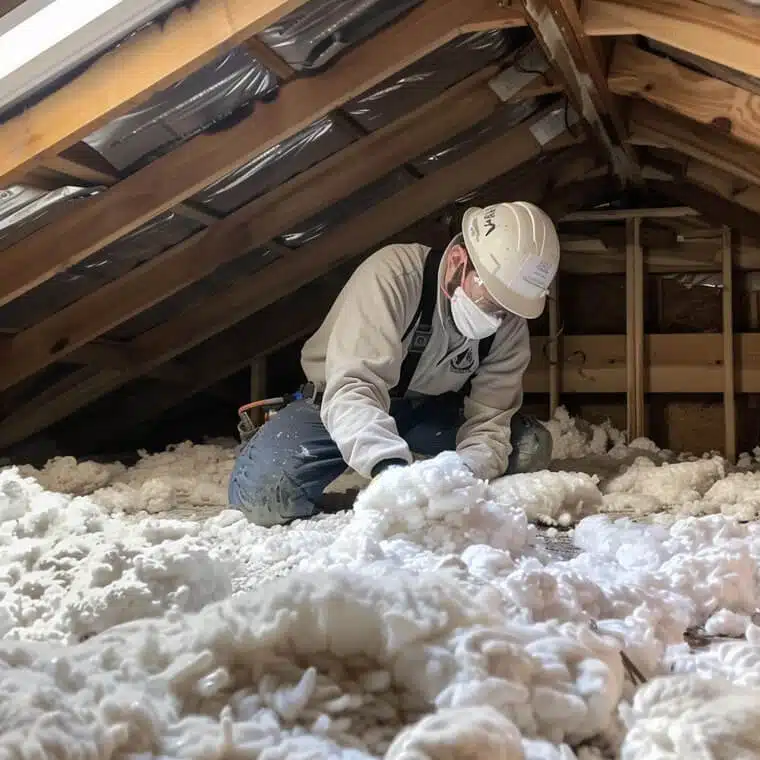
Working in an attic can be tough and dangerous, especially during summer when temperatures often exceed 100°F in regions like the Pacific Northwest . Plan to work during the cooler early morning hours . Wear protective gear, including a hard hat, goggles, long sleeves, long pants, and a particle mask to guard against irritation from insulation. Stay hydrated by drinking water regularly and take frequent breaks to avoid heat exhaustion .
Clear away clutter and debris from the attic floor to minimize the risk of trips and falls. When using a plywood platform, always stand in the center to avoid tipping. Most importantly, work with a partner. This not only improves safety but also makes handling large foil rolls much easier . Ryan Noonan, Content Editor at Angi, emphasizes:
Correctly installing insulation can be difficult. Health and safety risks are involved; therefore, we highly recommend contacting a pro to ensure the job is completed safely and correctly.
Installation Methods
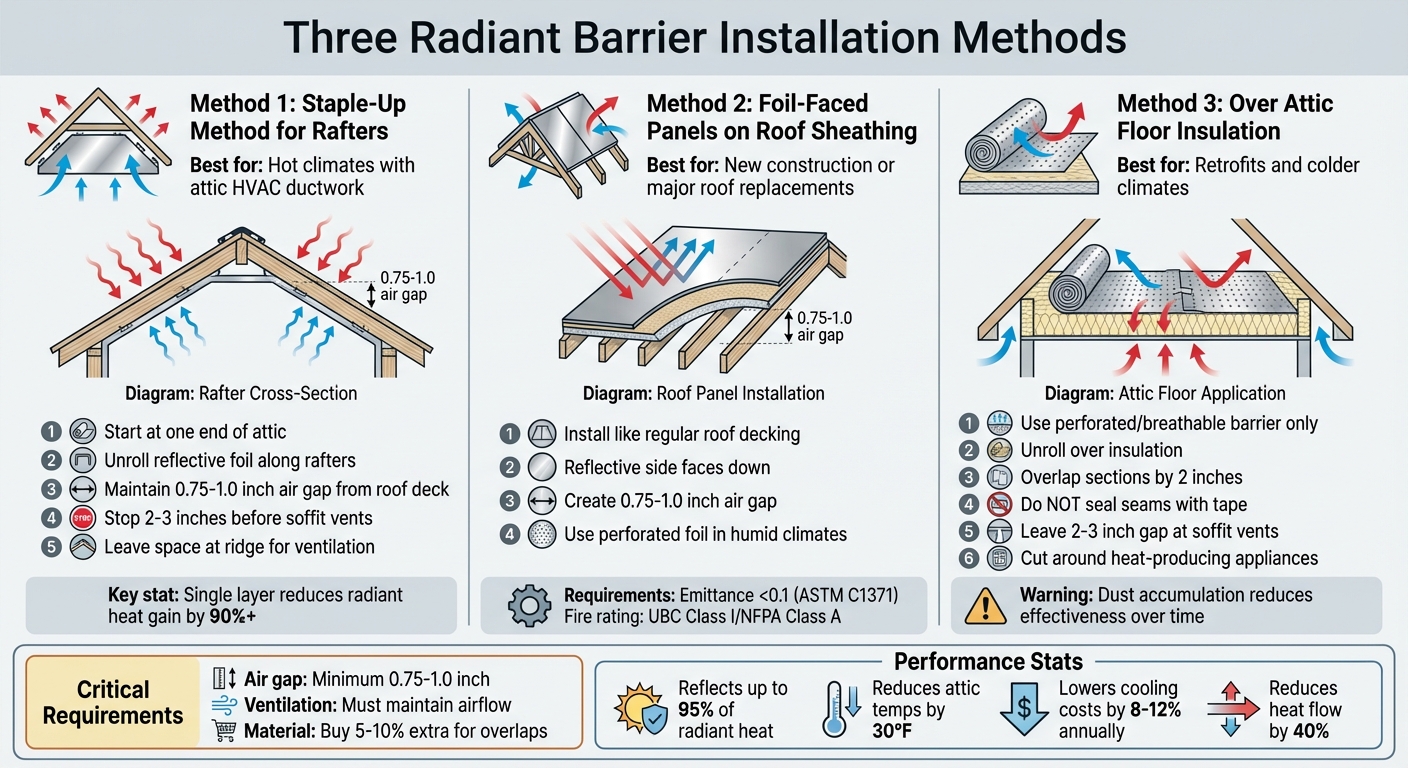
Radiant Barrier Installation Methods and Key Steps Guide
Selecting the right installation method depends on the type of attic insulation you’re using – new construction, a major renovation, or a retrofit. Each approach has its own steps and benefits, which can influence how well the radiant barrier performs. If you’re working in an attic, make sure the space is properly prepared, and always ensure there’s an adequate air gap to maximize heat reflection.
Staple-Up Method for Rafters
This method works well in hot climates, especially if your HVAC ductwork runs through the attic. It involves attaching the radiant barrier directly to the underside of roof rafters or trusses, leaving an air gap between the barrier and the roof decking. To install, start at one end of the attic and unroll the reflective foil along the rafters, keeping it tight. Maintain a 0.75- to 1.0-inch air gap between the foil and the roof deck so the barrier reflects heat instead of conducting it. Stop the material 2 to 3 inches before the soffit vents and leave space at the ridge to ensure proper ventilation. A single layer of foil can reduce radiant heat gain by over 90%, so additional layers aren’t necessary.
Installing Foil-Faced Panels on Roof Sheathing
For new construction or major roof replacements, foil-faced sheathing – usually made of OSB or plywood – is a practical choice. It installs just like regular roof decking but with the reflective side facing down to create a 0.75- to 1.0-inch air gap. As RadiantGuard explains:
Because a radiant barrier needs an air space on at least one side, installing it directly below felt and shingles will NOT allow the radiant barrier to block any radiant heat.
To prevent issues like wood rot in humid conditions, use perforated foil panels that allow moisture vapor to escape. Handle the panels carefully to avoid damaging the foil, as this can reduce their effectiveness. Make sure the material has a long-wave infrared emittance of less than 0.1 (per ASTM C1371) and meets fire safety standards like UBC Class I or NFPA Class A. The cost difference between foil-faced sheathing and standard decking is small, making it a cost-effective upgrade. For retrofits or simpler projects, you might consider the next method.
Placing Barriers Over Attic Floor Insulation
If you’re looking for a straightforward retrofit, placing radiant barriers over attic floor insulation is an option, though it comes with some compromises. Always use perforated or "breathable" radiant barrier products to allow moisture and vapor to escape from the living space below. Unroll the material over the insulation, overlapping sections by about 2 inches. Avoid sealing the seams with tape, as this could trap moisture. Leave a gap of 2 to 3 inches before the soffit vents to maintain airflow. Be sure to cut the material around heat-producing appliances and mark any covered electrical junction boxes for future access. Keep in mind, dust accumulation on the barrier can reduce its reflectivity and performance over time, as noted by the U.S. Department of Energy. This approach is often preferred in colder or mixed climates to help retain heat during winter, though it’s less effective for summer cooling compared to rafter installations.
Common Mistakes and How to Avoid Them
Even seasoned professionals can make errors during installation. Here’s how to sidestep some common pitfalls to ensure optimal performance and safety.
Preventing Gaps and Misalignment
One frequent mistake is eliminating the air space. For a radiant barrier to reflect heat effectively, it needs an air gap of at least 0.75 to 1.0 inch. Placing the barrier directly against roof shingles, felt, or other materials causes heat to transfer through conduction rather than being reflected. To maintain the necessary air gap when stapling the barrier to rafters, allow it to droop slightly instead of pulling it taut.
Another issue is blocking ventilation. Unlike traditional insulation, radiant barriers rely on airflow to function correctly. Maintain a 1- to 2-inch gap at the roof peak and stop the material 2 to 3 inches above the floor insulation near soffit vents. Proper attic and crawl space cleaning ensures these areas remain clear of debris that could block airflow. This airflow is essential for preventing condensation and preserving the insulation’s effectiveness. The U.S. Department of Energy explains:
The radiant barrier acts as a barrier against radiated, not convected, heat so there is no need to cut off air flow in the attic.
For proper coverage, overlap sections by at least 2 inches. While small tears or holes won’t significantly impact performance, larger gaps can compromise the barrier’s effectiveness. Secure the material to rafters every 6 to 12 inches to avoid sagging or misalignment over time.
Installation Do’s and Don’ts
Once alignment issues are addressed, focus on these practical tips to ensure a safe and effective installation.
Electrical safety is paramount. Since aluminum foil is an excellent conductor of electricity, inspect for exposed wiring before installation. Never staple the barrier over or through electrical lines, and clearly mark any junction boxes you cover to ensure easy access in the future.
Avoid moisture entrapment, especially in cold or mixed climates. Placing a non-perforated barrier directly over attic floor insulation can trap moisture and dust, leading to long-term issues. Opt for perforated barriers in these situations to allow moisture to escape.
Personal safety should never be overlooked. Always wear protective gear, including a hard hat, goggles, long sleeves, and a mask. Use a sturdy platform, such as a 1×12 board, to avoid falls. Schedule your work for early morning to avoid attic temperatures exceeding 100°F. Additionally, trim the barrier around heat-producing elements like recessed can lights to prevent potential hazards.
Ventilation and Energy Efficiency
Radiant barriers work by reflecting radiant heat, while proper attic ventilation removes built-up hot air. Together, these measures can reduce heat flow by up to 40%, leading to cooling cost savings of 8%–12% on average. In warmer, sunnier areas, homeowners might see cooling costs drop by 5% to 10%. This combination of heat reflection and airflow is key to improving energy efficiency.
Maintaining Proper Attic Ventilation
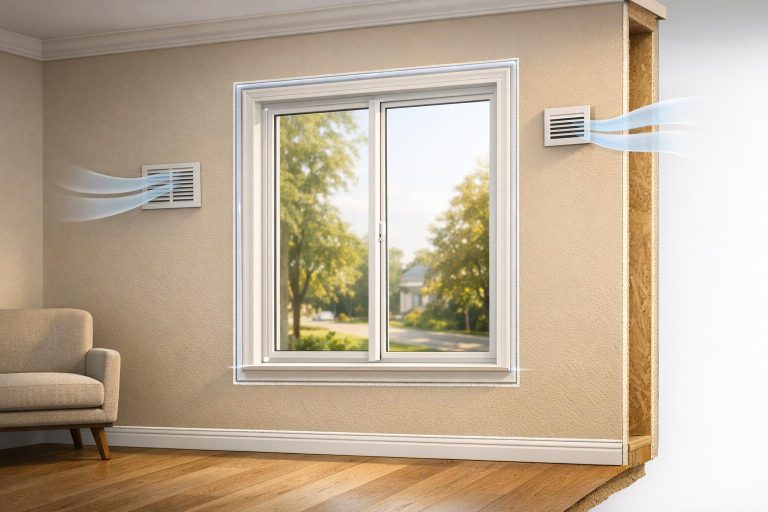
Consistent airflow in your attic is crucial for maximizing energy efficiency. Radiant barriers depend on proper ventilation to function effectively. Without it, moisture can accumulate, leading to mold growth and reducing the barrier’s performance. Ensuring clear air pathways – from soffit vents at the eaves to ridge vents at the roof peak – is essential.
To prevent insulation from blocking airflow, install rafter vents (also known as insulation baffles) at the eaves. When attaching a radiant barrier to the rafters, leave a 1-to-2-inch gap at the ridge vent and a 2-to-3-inch clearance above the floor insulation near the soffits. This setup allows for proper ventilation. For humid climates, perforated radiant barriers are a smart choice since they let moisture vapor escape, reducing the risk of wood rot in the roof decking.
In the summer, natural airflow helps expel super-heated air, protecting roof shingles and reducing the strain on your air conditioner. During winter, ventilation keeps the attic cool enough to prevent ice dams, while the radiant barrier can help minimize heat loss from the living areas below.
| Heat Management Feature | Radiant Barrier | Attic Ventilation |
|---|---|---|
| Heat Type Addressed | Radiant (sun’s electromagnetic energy) | Convective (hot air buildup) |
| Primary Function | Reflects heat back toward the roof | Removes hot air and moisture |
| Air Space Requirement | Needs at least a 1-inch gap | Requires clear intake and exhaust paths |
| Climate Effectiveness | Best in hot, sunny regions | Needed in all climate zones |
Working with Professional Installers
Because proper installation is critical for radiant barriers and attic ventilation, hiring professionals can ensure you get the most out of these systems. While DIY installation is possible, certified installers are trained to handle the finer details – like maintaining air gaps, ensuring electrical safety, and controlling moisture. According to the U.S. Department of Energy, "a radiant barrier’s effectiveness depends on proper installation, so it’s best to use a certified installer".
Professionals focus on key details, such as allowing the radiant barrier to droop slightly to maintain airflow, safely working around electrical wiring, and ensuring compliance with local building codes. They also check for water leaks, inspect outdated knob-and-tube wiring, and confirm that ventilation fans terminate correctly.
Envirosmart Solution offers expert radiant barrier installation as part of their energy efficiency services in the Pacific Northwest. Their team assesses your attic’s ventilation system, installs barriers properly, and helps you take advantage of available rebates and incentives. Their CRAWL SPACE & ATTIC CARE™ package, priced at $199 annually, includes regular inspections to ensure your radiant barrier and ventilation system are functioning together effectively, along with a 15% discount on recommended services. For a more comprehensive option, the SMART GOLD™ package at $699 covers annual attic inspections as well as HVAC, duct, and dryer vent maintenance – providing a complete approach to energy efficiency.
Lastly, professionals should verify that installing a radiant barrier won’t void your roof shingle warranty. While most modern products don’t affect warranties, this step ensures your investment is protected and your home performs well over time.
Conclusion
Radiant barriers are a smart way to make your home more comfortable while cutting down on energy costs. By reflecting up to 95% of radiant heat, they can lower attic temperatures by as much as 30°F and reduce annual cooling expenses by 8%–12%. On top of that, they help protect HVAC systems from overheating, allowing for the use of smaller, more efficient units.
To get the most out of these benefits, proper installation is critical. A 1-inch air gap and adequate attic ventilation are must-haves for optimal performance. These small but important details can make a big difference in how well the system works.
Beyond the numbers, radiant barriers bring real comfort. The U.S. Department of Energy highlights their ability to improve indoor conditions, reduce strain on air conditioning systems, and enhance performance during extreme heat.
While DIY installation is an option, professional help ensures that all safety and ventilation requirements are met. For a hassle-free experience and to maximize the benefits, professional installation is highly recommended.
Envirosmart Solution offers expert radiant barrier installation throughout the Pacific Northwest. They not only provide top-notch service but also assist with securing rebates and incentives. Their CRAWL SPACE & ATTIC CARE™ package, priced at $199 annually, includes regular inspections to ensure your radiant barrier and ventilation system are working together seamlessly. It also offers a 15% discount on recommended services. For a more comprehensive solution, the SMART GOLD™ package ($699) includes annual attic inspections along with HVAC, duct, and dryer vent maintenance to keep your entire system running smoothly year-round.
FAQs
Do I need a radiant barrier in my climate?
Radiant barriers work best in hot climates, where they can significantly reduce heat gain and help lower cooling bills. In areas with moderate or cold climates, they are typically less useful because attic insulation already does a good job of minimizing heat transfer. To decide if adding a radiant barrier makes sense for your home, take into account your local climate and the insulation you already have in place.
Will a radiant barrier cause moisture or mold?
A radiant barrier, when installed correctly, typically won’t lead to moisture or mold problems. That said, there’s a potential for condensation during colder weather if the barrier is placed directly on attic floors without adequate ventilation. This happens because moisture from inside the home can travel into the attic and condense on the surface of the barrier. To avoid such issues, it’s important to focus on proper installation and ensure the attic is well-ventilated.
Is DIY radiant barrier installation safe?
Installing a radiant barrier yourself can be done safely if you take the right precautions. This means using stable ladders, wearing protective gear like gloves and masks, and sticking to proper installation techniques. That said, attics come with their own set of hazards, such as the risk of falls, exposure to dust or mold, and dealing with exposed wiring. If you’re not confident in your skills or feel uneasy working in tight spaces, hiring a professional is a smart move. They can ensure the job is done safely and that the radiant barrier works effectively.