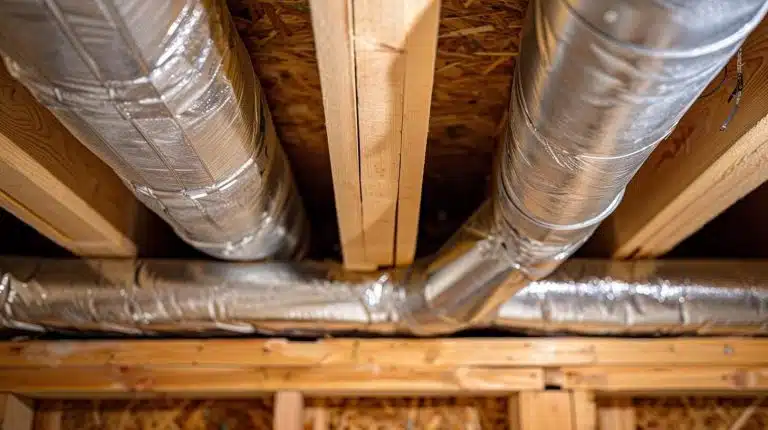

Energy Recovery Ventilation (ERV) systems are designed to improve indoor air quality by continuously replacing stale indoor air with filtered outdoor air while conserving energy. These systems are especially useful in modern, airtight homes where pollutants like VOCs, allergens, and moisture can accumulate. ERVs not only ensure a steady flow of fresh air but also regulate indoor humidity levels, making them ideal for regions with varying climates, such as the Pacific Northwest.
Key Benefits of ERV Systems:
- Efficient Ventilation: Removes stale air and introduces fresh air without energy waste.
- Humidity Control: Maintains indoor humidity between 30-50%, preventing mold growth and reducing dryness.
- Filtration: Uses high-performance filters (MERV 8-13) to reduce allergens, dust, and pollutants.
- Energy Savings: Recovers up to 80% of heating or cooling energy from outgoing air.
- Quiet Operation: Designed for minimal noise, comparable to a refrigerator.
How They Work:
- Two air streams (incoming and outgoing) pass through a heat exchanger, transferring energy and moisture without mixing.
- Balances indoor air pressure to avoid issues like back-drafting.
- Can be installed with dedicated ductwork or integrated into existing HVAC systems.
Proper installation and regular maintenance, such as cleaning filters every 3-6 months and inspecting the heat exchanger annually, are crucial for optimal performance. ERVs are particularly effective in climates with fluctuating humidity, making them a better choice over HRVs in such regions. For expert installation and advice, consult a professional HVAC service provider.
How a Whole Home ERV Cleans Your Air and Protects Your Lungs
sbb-itb-8db64ac
How ERV Systems Work
An ERV system relies on balanced ventilation to simultaneously remove stale air and bring in fresh air, all while recovering energy in the process. Two fans work together to ensure equal volumes of air are moved in and out of your home. This balance helps maintain neutral indoor pressure, which is crucial in preventing back-drafting – a situation where combustion gases from appliances like furnaces or water heaters might re-enter your living spaces. This balanced approach lays the foundation for the energy recovery process described below.
Energy Recovery and Ventilation Process
At the heart of every ERV system is the enthalpy core, also known as the heat exchanger. This essential component allows two air streams to pass through separate channels without mixing. Panasonic North America explains it best:
"Inside the unit, two separate air streams pass through a heat-exchanger core, transferring energy and moisture without mixing. The result? Fresh air that’s already close to indoor temperature and humidity."
In the winter, warm outgoing air transfers both heat and moisture to the incoming cold air, while in the summer, cool outgoing air absorbs heat from the incoming warm air. This process recovers between 60% and 95% of energy, reducing the workload on your HVAC system. You can calculate savings on home energy upgrades to see how these efficiencies translate into lower costs.
Main Components of ERV Systems
ERV systems are made up of four key components that work together to ensure efficiency and effectiveness:
- Intake and exhaust ducts: These create separate pathways – one for bringing fresh outdoor air into your home and another for expelling stale indoor air.
- Variable-speed fans: Equipped with DC brushless motors, these fans ensure steady and efficient air movement through the system.
- High-performance filters: Outdoor air is filtered through MERV-8 or higher filters, which capture dust, pollen, and other particulates before the air enters your living space.
- Smart controls: These controls can adjust airflow automatically based on factors like schedules, humidity levels, or indoor CO₂ concentrations.
Modern ERV units are designed to operate quietly, with some models producing noise levels as low as 0.8 to 1.0 sones – quieter than a typical refrigerator. With proper maintenance, these systems can last 10 to 20 years, making them a long-term solution for improving indoor air quality and energy efficiency.
Benefits of ERV Systems for Indoor Air Quality
Continuous Fresh Air Circulation
ERV systems work tirelessly to bring in fresh outdoor air while removing stale indoor air, ensuring a healthier and more comfortable living environment. This process not only eliminates built-up pollutants but also pre-conditions the incoming air to align with your indoor temperature.
Once in place, these systems run continuously, maintaining a neutral air pressure throughout your home. This means you can enjoy consistent air quality without needing to adjust anything manually. Plus, ERV systems are designed to handle indoor moisture levels effectively, adding another layer of comfort to your space.
Humidity Control and Mold Prevention
One of the standout features of ERV systems is their ability to regulate indoor humidity. Their specialized heat-exchanger core transfers moisture between the incoming and outgoing air streams, keeping humidity levels in the ideal range of 30% to 50%. During the summer, they remove excess moisture to combat stickiness, while in the winter, they help retain moisture to prevent dryness.
This balanced approach to humidity plays a key role in preventing mold growth by reducing condensation on surfaces like walls, windows, and furniture. As Ken Nelson explains:
"ERVs help homes find that balance between indoor and outdoor moisture levels, and there are a lot of benefits to that".
By maintaining proper humidity levels, ERV systems also help particles settle faster, minimizing the time harmful aerosols linger in the air. On top of that, they filter out allergens and pollutants, further improving indoor air quality.
Filtration of Allergens and Pollutants
Every bit of outdoor air brought in by an ERV system passes through high-performance filters before entering your home, promoting better respiratory health. Standard MERV 8 filters effectively capture dust and pollen, while upgrading to MERV 13 allows the system to trap finer particles, such as smoke and microscopic allergens. For the best results, filters should be cleaned or replaced every three to six months.
This multi-stage filtration system is especially helpful for removing common irritants like pet dander, pollen, and outdoor pollutants. Many modern ERV systems also feature smart sensors that can detect elevated levels of CO₂ or pollutants, automatically increasing ventilation as needed.
Installing and Maintaining ERV Systems
Steps for Installing an ERV System
To install an ERV system, start by matching its ventilation capacity to your home’s size. For homes up to 1,500 square feet, aim for 50 cfm (cubic feet per minute) of continuous ventilation. Homes ranging from 1,501 to 2,500 square feet require 70 cfm, while larger homes over 2,500 square feet should target 100 cfm.
Use dedicated ductwork to deliver fresh air directly to bedrooms and living spaces, following the manufacturer’s guidelines. Miguel Walker from Positive Energy emphasizes:
"The best distribution strategy for a balanced ventilation system with enthalpy (heat and moisture) recovery (such as an ERV) is an independently dedicated duct system that meets the equipment manufacturer’s installation requirements."
For retrofitting, an ERV can connect to your existing air handler’s return plenum. However, this setup may increase energy use. Ensure all duct seams are sealed with mastic or UL 181 tape, and insulate any ducts located outside the insulated envelope with R-8 insulation. Position the exhaust outlet at least 10 feet away from any air inlet to avoid cross-contamination. After installation, have a technician verify the airflow using a flow hood or anemometer to ensure it meets the target rates.
Maintenance Tips for Optimal Performance
To keep your ERV running smoothly, clean or replace the supply and exhaust filters every 3–6 months. In homes where the system sees heavy use, check the filters more frequently.
Inspect the heat-exchanger core annually. If dust has accumulated, vacuum or rinse it according to the manufacturer’s instructions. Additionally, check the intake and exhaust hoods twice a year to ensure they’re free from obstructions like leaves, snow, or bird nests. Regular maintenance like this can help your ERV last 15 years or more.
Professional HVAC Services for ERV Systems
While basic maintenance tasks like cleaning filters can be handled by homeowners, scheduling professional servicing every 12 to 18 months is essential for maintaining system balance. Certified technicians can inspect wiring, calibrate sensors, and adjust airflow to fit changing needs.
Professional installation becomes even more critical when integrating an ERV with systems like high-efficiency heat pumps or complex zoning setups. In fact, local building codes often require a licensed technician for mechanical ventilation work. Envirosmart Solution, for example, provides HVAC services across the Pacific Northwest, including ERV installation, maintenance, and energy efficiency upgrades. They can also guide you through rebates and incentives to help you get the most out of your investment in improved indoor air quality.
These professional practices and regular upkeep are key to maximizing your ERV’s performance, paving the way for a deeper look at how ERV systems compare to HRV systems for your home.
ERV vs. HRV: Which Is Better for Your Home?
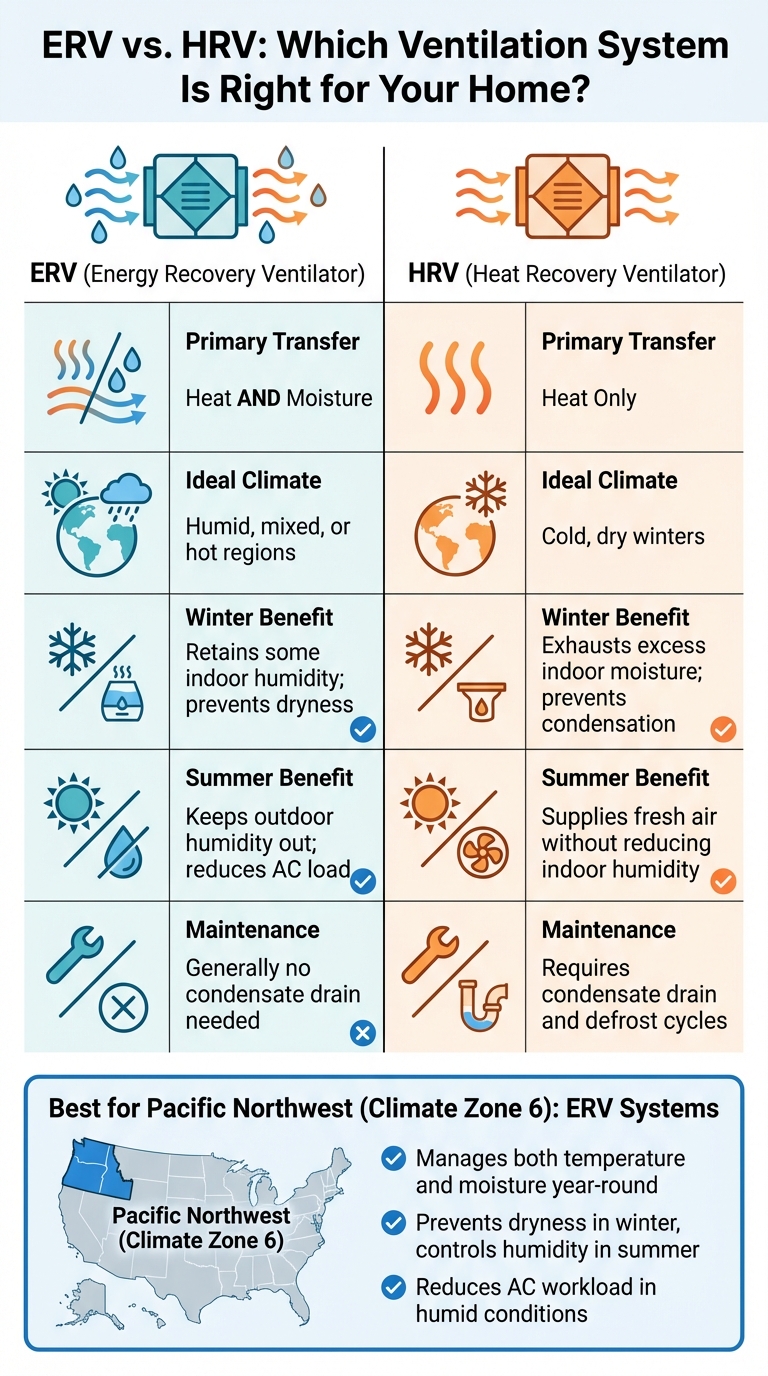
ERV vs HRV Systems Comparison Chart for Home Ventilation
Comparison of Air Quality Metrics
ERVs and HRVs both work to improve indoor air quality by bringing in fresh outdoor air and expelling stale indoor air. The main difference lies in what they transfer during this process. HRVs focus exclusively on heat recovery, transferring warmth from outgoing air to incoming air. ERVs, on the other hand, handle both heat and moisture, making them more versatile in certain climates.
This ability to manage moisture makes ERVs particularly useful in areas where humidity varies throughout the year. For example, during summer, an ERV reduces the workload on your air conditioner by removing excess moisture from incoming air. In winter, it helps maintain a comfortable indoor environment by returning some humidity to the air, preventing it from becoming too dry. HRVs, which only recover heat, are better suited for very cold, dry climates where controlling condensation, like on windows, is a priority.
| Feature | ERV (Energy Recovery Ventilator) | HRV (Heat Recovery Ventilator) |
|---|---|---|
| Primary Transfer | Heat and Moisture | Heat Only |
| Ideal Climate | Humid, mixed, or hot regions | Cold, dry winters |
| Winter Benefit | Retains some indoor humidity; prevents dryness | Exhausts excess indoor moisture; prevents condensation |
| Summer Benefit | Keeps outdoor humidity out; reduces AC load | Supplies fresh air without reducing indoor humidity |
| Maintenance | Generally no condensate drain needed | Requires condensate drain and defrost cycles |
The table above highlights how ERVs offer additional benefits, particularly in regions with fluctuating humidity levels, such as the Pacific Northwest.
Why ERV Systems Are Ideal for the Pacific Northwest
The Pacific Northwest’s climate presents unique challenges, making ERVs an excellent choice for homes in this region. Falling within U.S. Climate Zone 6, the area experiences humid summers and damp winters. ERVs are well-suited for this mixed climate because they manage both temperature and moisture effectively throughout the year. Panasonic North America explains:
"In mixed or humid regions, like much of U.S. climate zone 6, ERVs usually offer the best balance by managing both temperature and moisture, easing the load on AC systems."
In modern, airtight homes, ERVs not only prevent the buildup of stale air and odors but also maintain balanced humidity levels. This means your indoor air won’t feel excessively dry in the winter, and outdoor humidity won’t overwhelm your home in the summer. However, if you live in an extremely cold region where indoor activities like cooking or showering produce significant moisture, an HRV might be the better option.
When choosing a system, consider models with MERV 13 filtration to trap allergens and particulates while managing moisture. Many ERVs also include variable-speed motors, which adjust airflow to ensure consistent ventilation, even when duct pressure changes.
For expert advice on selecting, installing, and maintaining the right ventilation system for the Pacific Northwest, reach out to Envirosmart Solution for professional HVAC services (https://envirosmartsolution.com).
Conclusion and Next Steps
ERV systems play a vital role in improving indoor air quality while cutting energy costs. They work by continuously circulating fresh air, diluting indoor pollutants, and recovering up to 80% of the energy used for heating or cooling. With advanced MERV 13 filtration, these systems can capture pollen, dust, and fine particles – especially important during wildfire season. However, to enjoy these benefits, proper installation is essential.
A professional installation ensures your ERV integrates seamlessly with your existing HVAC system and complies with ASHRAE 62.2 standards, delivering balanced ventilation to every room in your home.
Routine maintenance is equally important for keeping your ERV running efficiently for 10–15 years. This includes vacuuming or replacing supply and exhaust filters every three to six months, as well as scheduling annual professional inspections to clean the heat-exchanger core and check that exterior hoods remain unobstructed. As Ken Nelson, Ventilation and IAQ Expert at Panasonic, puts it:
"ERVs are wonderful because you install them, and you just let them work".
By following these steps, you can ensure your ERV maintains top performance and provides lasting comfort.
Envirosmart Solution offers expertise in ERV installation and maintenance, helping homeowners in the Pacific Northwest make the most of available rebates and incentives. Their team can guide you through federal programs like the High-Efficiency Electric Home Rebate (HEEHR), which provides up to $8,000 for income-qualified households, and combine these with utility rebates and smart thermostat incentives. Working with participating contractors ensures proper documentation for Quality Installation Verification bonuses and helps avoid common errors that could disqualify rebate claims.
Take the next step in improving your home’s air quality and reducing energy costs. Reach out to Envirosmart Solution for professional ERV guidance in the Pacific Northwest.
FAQs
Do I need an ERV if my home already has bathroom fans?
Bathroom fans are great for targeted ventilation, effectively clearing out moisture and odors from spots like bathrooms. However, they don’t offer ongoing, whole-home ventilation or help regulate humidity levels across your living space. On the other hand, an ERV (Energy Recovery Ventilator) can significantly boost your home’s indoor air quality. It works by exchanging stale indoor air with fresh outdoor air while also recovering heat and moisture. If you’re aiming for balanced ventilation and improved air quality throughout your entire home, pairing an ERV with your bathroom fans can be a smart move.
How do I know what ERV size (CFM) my home needs?
To figure out the right ERV size (measured in CFM) for your home, you’ll need to take into account the square footage and the number of bedrooms. These factors help estimate the airflow your home requires. To ensure your system provides adequate ventilation, maintains good indoor air quality, and operates efficiently, it’s best to consult a professional. They can assess your home’s unique needs and make sure everything aligns with local building codes.
Will an ERV help with wildfire smoke and allergies?
ERVs can play a big role in improving indoor air quality, especially during wildfire season or in areas with high allergen levels. By continuously ventilating your space with fresh outdoor air, they help filter out pollutants like particulate matter (PM2.5). At the same time, they work to balance indoor humidity levels, creating a more comfortable and healthier living environment.