
Did you know indoor air can be 2 to 5 times more polluted than outdoor air? For allergy sufferers, this means more sneezing, itchy eyes, and even worsened asthma. But there’s a solution: upgrading your HVAC system.
Here’s why it matters:
- Modern HVAC systems with high-efficiency filters (like HEPA or MERV 13) trap pollen, pet dander, and dust mites.
- Humidity control keeps mold and dust mites at bay by maintaining levels between 30-50%.
- Air circulation ensures allergens don’t settle, while UV lights and air purifiers neutralize mold and bacteria.
- Regular maintenance – like cleaning ducts and replacing filters – prevents allergens from recirculating.
These upgrades not only improve air quality but also create a healthier home environment. Keep reading to learn how these systems work and the best ways to maintain them.
How HVAC Systems Help Reduce Allergens in Your Home
sbb-itb-8db64ac
How HVAC Filters Reduce Allergens
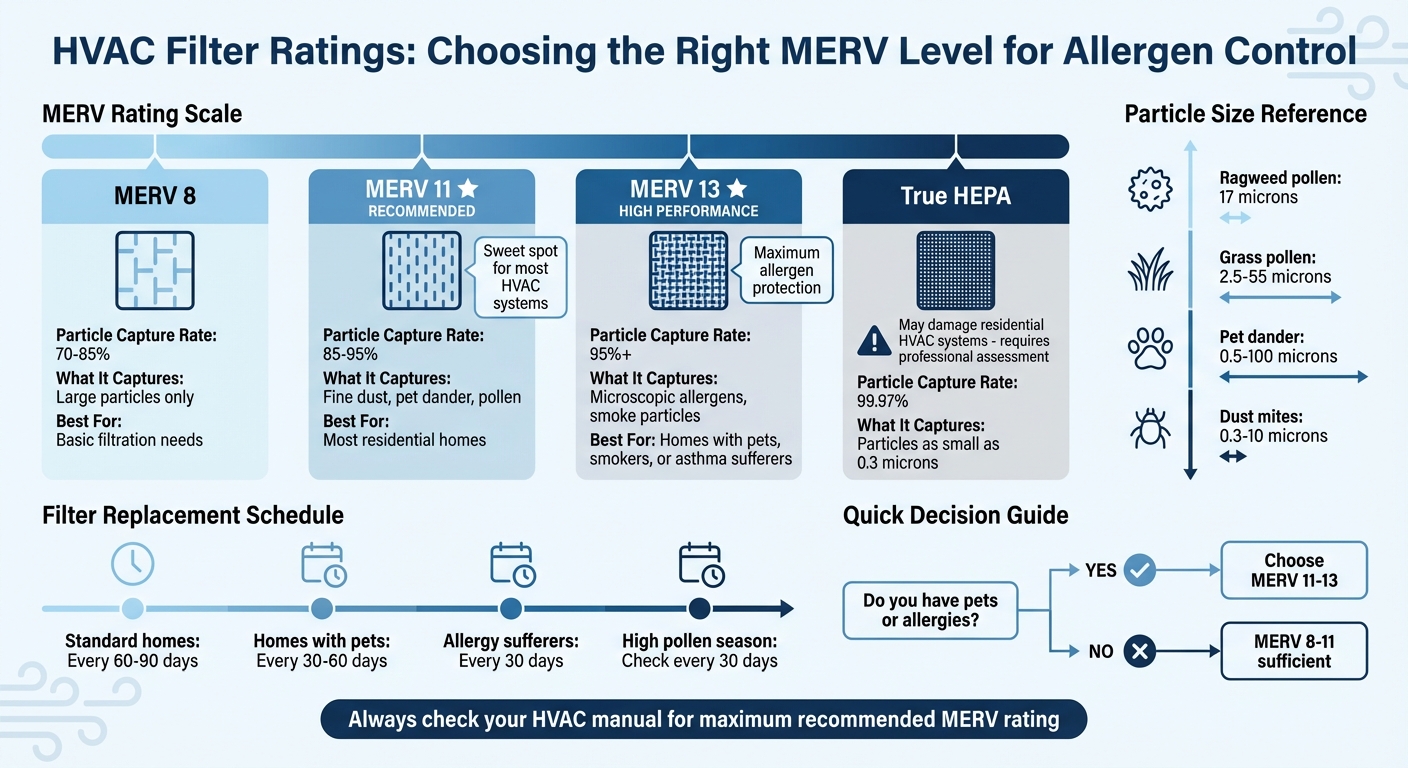
MERV Filter Ratings Comparison Chart for HVAC Allergen Control
Modern HVAC systems play a key role in reducing allergens in your home, but their effectiveness heavily depends on the filter you use. Your HVAC filter acts as the first barrier against airborne allergens, using mechanical filtration to trap particles like pollen, pet dander, and dust mites. High-efficiency filters, especially pleated ones, are designed to catch these tiny irritants while letting clean air flow through. Unlike basic fiberglass filters that only capture larger debris, pleated filters provide more surface area to trap microscopic allergens.
Some advanced filters go a step further by incorporating electrostatically charged fibers. These fibers attract and hold even the smallest particles, making the filtration process even more thorough. By combining physical trapping with electrostatic attraction, these filters prevent allergens from circulating in your home.
However, finding the right filter is a balancing act. Overly restrictive filters can strain your HVAC motor and lower efficiency, while filters that are too basic won’t effectively capture allergens. Additionally, a poorly fitted filter can leave gaps, allowing unfiltered air – and allergens – to bypass the media entirely.
Why HEPA Filters Work Better
When it comes to air filtration, True HEPA filters are unmatched, capable of capturing 99.97% of airborne particles as small as 0.3 microns. This includes allergens like ragweed pollen (17 microns) and grass pollen (2.5 to 55 microns). Studies reveal that HEPA filters can reduce indoor fine particulate matter (PM2.5) by 55% and limit outdoor particle infiltration from 28% to just 5%.
That said, HEPA filters aren’t suitable for all systems. Residential HVAC systems often lack the power to handle the high resistance these filters create, which can lead to motor damage and higher energy bills. For most homes, MERV 13 filters are a great alternative, capturing over 95% of microscopic allergens while remaining compatible with standard HVAC setups.
How to Select the Right Filter
Choosing the right filter starts with understanding MERV ratings (Minimum Efficiency Reporting Value). This rating measures how well a filter captures particles between 0.3 and 10 microns. Higher ratings offer finer filtration but also increase airflow resistance, which can strain your system.
"MERV 11 represents a sweet spot in air filtration, effective enough to significantly improve indoor air quality while compatible with most residential HVAC systems." – Andrew Gillman, Marketing Director, All Filters LLC
For most households, MERV 11 to 13 filters strike the best balance between removing allergens and maintaining system performance. Here’s a quick breakdown:
- MERV 8: Captures 70–85% of large particles.
- MERV 11: Captures 85–95% of fine dust and dander.
- MERV 13: Captures over 95% of microscopic allergens.
If you have pets, smoke indoors, or live with someone with asthma, aim for the higher end of this range. Before buying, check your HVAC system’s manual or consult a professional to confirm the maximum MERV rating your system can handle. Filters that are too dense can restrict airflow, damage equipment, and spike energy costs.
When to Replace Your HVAC Filter
Keeping your HVAC filter clean is just as important as choosing the right one. Even the most efficient filter becomes ineffective when clogged with dirt and particles. Most 1- to 3-inch filters need replacement every 30–90 days, but allergy sufferers should aim for the shorter end of this range. Homes with pets may require monthly replacements due to fur and dander buildup. During heavy heating, cooling, or pollen seasons, inspect your filter every 30 days.
A quick way to check: hold your filter up to a light source. If light doesn’t pass through or the surface looks gray and fuzzy, it’s time for a replacement.
"If the filter looks gray, dusty, or clogged when held to light, replace it – even if you are ahead of schedule." – Rene Langer, Senior Comfort Specialist, PICKHVAC
Signs of a clogged filter include increased dust around vents, worsening allergy symptoms, or your HVAC system running longer than usual. When installing a new filter, make sure the airflow arrow points toward the blower motor to ensure proper operation and prevent damage.
Controlling Humidity to Prevent Mold and Dust Mites
Your HVAC system does more than just filter air – it also helps regulate humidity, a crucial factor in managing allergens like mold and dust mites.
Mold and dust mites thrive in damp environments, and keeping humidity in check is key to reducing their presence. Air conditioning systems naturally remove water vapor as they cool, with variable-speed systems being especially effective due to their longer, lower-speed cycles.
When indoor humidity rises above 60%, conditions become ideal for black mold. Dust mites also multiply rapidly when relative humidity exceeds 50–60%. Conversely, maintaining humidity below 50% over time can eliminate dust mites entirely.
"When relative humidity is maintained below the 40% to 50% range for a prolonged period, dust mites die." – Lawrence Berkeley National Laboratory
However, excessively low humidity isn’t ideal either. During winter, indoor humidity can drop as low as 15% – drier than the Sahara Desert’s average of 25%. This can irritate your skin, eyes, and nose, while also increasing the risk of respiratory infections. Proper humidity control, paired with effective filtration, creates a healthier indoor environment.
The Best Indoor Humidity Range
For most homes, the sweet spot for indoor humidity is between 30% and 50%. This range prevents mold growth and limits dust mite activity while ensuring comfort. In households with asthma or severe allergies, keeping humidity between 40% and 60% may help reduce respiratory irritation.
| Humidity Level | Impact on Indoor Environment |
|---|---|
| Below 30% | Can dry out skin, eyes, and nasal passages, increasing the risk of respiratory infections. |
| 30% – 50% | Optimal Range: Reduces mold and dust mites while maintaining comfort. |
| 50% – 60% | Promotes dust mite activity. |
| Above 60% | Encourages mold growth, musty odors, and potential structural damage. |
To monitor indoor humidity, use a digital hygrometer or a smart thermostat with a built-in humidity sensor. These tools provide real-time data, allowing you to adjust HVAC settings as needed. Set your thermostat to ensure the AC runs long enough to dehumidify effectively – keeping it too high in summer can prevent it from running enough to remove moisture. Also, exhaust fans in kitchens and bathrooms can help manage localized humidity spikes.
Using Dehumidifiers with Your HVAC System
If your air conditioner alone can’t handle the humidity, a whole-home dehumidifier can provide extra moisture control. These systems connect directly to your HVAC return air duct, drawing in humid air and passing it over cooling coils to condense water vapor. The drier air is then circulated back into your home, while the condensed water drains automatically.
Whole-home dehumidifiers operate independently of your AC, using a humidistat to maintain consistent moisture levels. Depending on your home’s needs, they can remove anywhere from 10 to 50 pints of water daily.
"Humidity levels within the 30% to 50% range are generally comfortable for most people, and a whole-home dehumidifier helps you keep indoor moisture levels in this balanced range." – HVAC.com
For best results, set your HVAC fan to "Auto" instead of "On." A continuously running fan can reintroduce moisture from the cooling coils back into your home. Aim for a 50% humidity level to balance comfort with allergen control. Finally, ensure your system is correctly sized – a unit that’s too small won’t dehumidify effectively, while an oversized AC may short-cycle and fail to remove moisture properly.
How Air Circulation Reduces Allergens
Efficient air circulation is a key player in minimizing indoor allergens, working alongside filtration and humidity control. Your HVAC system ensures continuous airflow, which helps keep particles like dust, pollen, and pet dander from settling on surfaces. Instead, these particles are directed toward return vents for filtration, while indoor pollutants are diluted, contributing to cleaner air overall. This steady movement enhances the effectiveness of filtering and humidity management, creating a more comprehensive approach to reducing allergens.
"In many cases, more allergens are found on surfaces than in the air. Then, when you disturb them by sitting, lying, or moving around, they circulate in the air and may end up in your HVAC system." – Bell Brothers
Beyond trapping allergens, consistent airflow also helps prevent moisture buildup, which can lead to mold and other issues.
Adjusting Your HVAC Settings for Better Airflow
To improve airflow and filtration, switch your thermostat fan setting from "Auto" to "On." When set to "Auto", the fan only runs during active heating or cooling cycles, allowing allergens to settle during downtime. By running the fan continuously, air is constantly filtered, even when temperature regulation isn’t happening.
"Maintaining air movement within indoor spaces helps to reduce opportunity for regions of germ concentration build-up." – National Institute for Occupational Safety and Health (NIOSH)
Keep in mind that running the fan continuously may increase energy consumption.
Additionally, ensure that vents remain unobstructed by furniture, curtains, or rugs to maintain proper airflow. For outdoor condenser units, clear at least 2 feet of space around them to ensure they operate efficiently.
Why Proper Ventilation Matters
Good airflow is just one part of the equation – proper ventilation is equally important. Replacing stale indoor air with fresh outdoor air can significantly reduce allergen levels. On days when outdoor allergen levels are low, opening windows can improve ventilation. However, during high-pollen seasons, it’s better to keep windows closed and rely on your HVAC system for filtration.
For a year-round solution that avoids introducing outdoor allergens, consider installing an Energy Recovery Ventilator (ERV). These systems exchange stale indoor air with fresh outdoor air while maintaining balanced humidity levels, making them an excellent option for managing allergens effectively.
Professional HVAC Maintenance for Allergen Control
Filters and airflow adjustments help manage allergens in motion, but professional maintenance tackles the allergens that settle quietly inside your HVAC system. Over time, dust, pollen, pet dander, and mold can build up in your ducts. Each time your system runs, these trapped allergens are recirculated throughout your home. Professional maintenance disrupts this cycle by targeting allergens at their source, enhancing your system’s efficiency and improving your indoor air quality. This step complements earlier efforts like filtration and humidity control to create a healthier living environment.
Air Duct Cleaning Removes Hidden Allergens
Professional air duct cleaning takes allergen removal to the next level, addressing what standard filters simply can’t catch. Using specialized tools, technicians extract debris such as dust mites, pollen, pet dander, and mold – especially mold that can form when moisture builds up in your ducts. Many services also include sanitizing treatments to tackle bacteria and mold that basic vacuuming might miss.
"Simply put, what accumulates in your ducts doesn’t stay in your ducts – it becomes part of the air you breathe." – Superior Air Duct Cleaning
The cleaning process often involves creating negative air pressure to ensure dislodged particles are removed safely, without spreading into your living spaces. While the EPA doesn’t recommend regular cleaning for every home, experts advise scheduling professional duct cleaning every 3 to 5 years for most households. If you or your family suffer from severe allergies, consider cleaning every 2 to 3 years. On average, a thorough duct cleaning costs between $450 and $1,000 for a typical home.
Annual HVAC Inspections Keep Systems Running Efficiently
In addition to duct cleaning, annual HVAC inspections play a critical role in allergen control. During these inspections, technicians clean coils, motors, and drain pans, flush condensate drains, recalibrate thermostats, and check refrigerant levels. They also inspect ductwork for leaks or gaps that could allow unfiltered allergens from attics or crawlspaces to bypass your filters. These comprehensive checks not only reduce allergens but can also boost system efficiency by up to 15% and lower indoor air pollutants by around 30%.
Experts recommend scheduling professional HVAC maintenance once a year, ideally in spring before allergy season kicks into high gear. Between visits, remember to check your filters monthly and replace them every 1 to 3 months – or more frequently if you have pets.
Envirosmart Solution‘s HVAC Services
Envirosmart Solution offers tailored HVAC maintenance services designed to improve allergen control and system efficiency. Their SMART DUCTS™ annual service, priced at $199, includes deep cleaning, camera inspections, disinfectant applications, and filter maintenance, along with priority scheduling. For a more comprehensive approach, their SMART GOLD™ package ($699) combines air duct cleaning with furnace care, dryer vent cleaning, and attic and crawl space inspections. Customers also enjoy a 20% discount on additional services.
Envirosmart Solution also helps homeowners take advantage of government, local, and vendor rebates for energy-efficient upgrades. Their technicians conduct detailed inspections of all HVAC components, ensuring both immediate allergen reduction and long-term system performance. These services provide peace of mind by addressing today’s air quality concerns while setting your system up for sustained efficiency.
Additional HVAC Upgrades for Better Allergen Control
Taking allergen control a step further means incorporating advanced HVAC upgrades. These upgrades don’t just filter out allergens; they also neutralize biological contaminants and keep tabs on your indoor air quality. Designed to work alongside your existing HVAC system, these solutions address living microorganisms that basic filtration systems might miss.
UV Light Systems Kill Mold and Bacteria
UV light systems, which use ultraviolet germicidal irradiation (UVGI), are a powerful tool for neutralizing biological contaminants within your HVAC system. These systems feature UV‑C lamps that emit light at a wavelength of 254 nanometers. This light penetrates the cell walls of microorganisms, disrupting their DNA and RNA so they can no longer reproduce. Studies show that UV light systems can neutralize up to 99.7% of bacteria in a room within 24 hours.
There are two main types of UV installations: coil-mounted and in-duct UV lights. Coil-mounted UV lights are placed near the evaporator coil to stop mold and biofilm from forming on damp surfaces. In-duct UV lights, on the other hand, are installed within the air handler or ductwork to treat air as it circulates, which helps reduce the spread of airborne illnesses. These systems are energy-efficient, with most residential UV bulbs consuming between 15 and 75 watts and costing less than $36 annually to operate.
While UV lights are highly effective against biological allergens like mold spores, bacteria, and viruses, they don’t remove physical particles such as dust or pet dander. For that, high-efficiency filters are still necessary. Coil-sanitizing UV systems range from $60 to $280, while air-sanitizing models cost between $80 and $400. Professional installation typically adds $100 to $295 to the total cost. To maintain effectiveness, replace UV‑C bulbs every 12–24 months and clean them every three months with a soft cloth to prevent dust buildup. Be sure to choose systems certified as UL 2998 to ensure they don’t produce harmful ozone as a byproduct.
When paired with other advanced systems, like whole-home air purifiers, UV lights can create a comprehensive strategy for managing indoor allergens.
Whole-Home Air Purifiers and Humidity Sensors
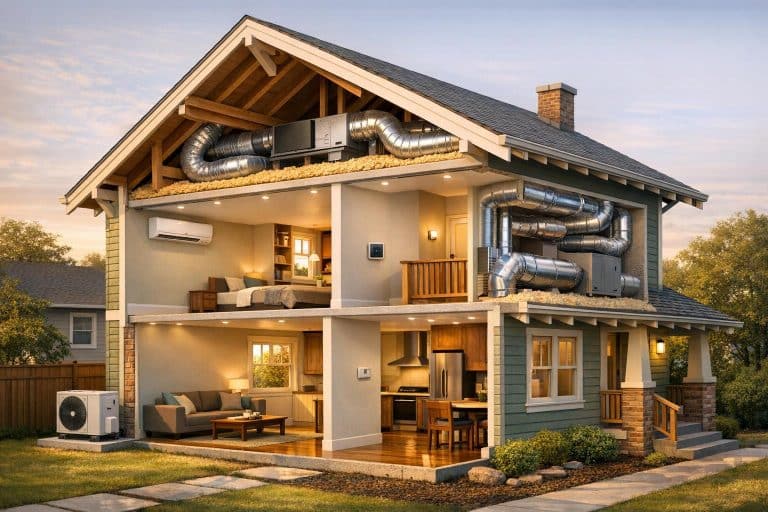
For a more complete approach to allergen control, consider integrating whole-home air purifiers with your HVAC system. Unlike portable units that only clean one room, these purifiers connect directly to your ductwork, filtering air throughout your entire home. They often feature multi-stage filtration systems, combining HEPA filters – which capture 99.97% of particles as small as 0.3 microns – with electrostatic precipitation and carbon filters to remove odors and chemical vapors. Some models even include advanced technologies like photocatalytic oxidation or ionization to neutralize allergens at the molecular level.
Humidity control is another key element in allergen management. Pairing air purifiers with dehumidifiers and humidity sensors creates an even stronger defense. The EPA recommends keeping indoor humidity between 30% and 50%, a range that discourages both mold growth and dust mite survival while maintaining comfort for your respiratory system. Modern smart thermostats equipped with air quality monitors can track levels of particulate matter and VOCs in real time. These systems can automatically adjust filtration and ventilation when allergen levels rise.
Because these upgrades can increase airflow resistance, professional installation is essential. A technician will ensure your blower motor can handle the added load without sacrificing efficiency. Regular maintenance is also crucial – replace whole-home purifier filters every three to six months and coordinate UV bulb replacements with your annual HVAC inspection to keep everything running smoothly.
Conclusion
Upgrading your HVAC system can significantly reduce indoor allergens and promote a healthier home environment. Features like HEPA filters and proper humidity control tackle common allergens directly. Advanced tools, such as UV-C lamps and whole-home air purifiers, go a step further by neutralizing biological contaminants. Together, these upgrades provide a more thorough approach to managing allergens.
However, even the best systems require regular professional maintenance to maintain peak performance. Without routine servicing, HVAC systems can become hotspots for mold, bacteria, and dust mites. Professional care ensures your system runs efficiently and prevents allergens from circulating throughout your home.
For homeowners in areas like the Pacific Northwest, these solutions are particularly important. The region’s damp climate encourages mold growth, while seasonal pollen and urban dust can infiltrate homes through neglected ductwork. Tailored HVAC services, including air duct cleaning, mold remediation, and humidity control, are essential for addressing these challenges. Companies like Envirosmart Solution offer specialized services, including annual maintenance plans such as FURNACE CARE™, SMART DUCTS™, and the comprehensive SMART GOLD™ package, to provide year-round protection.
Beyond allergen control, investing in modern HVAC technology and regular maintenance brings long-term rewards. Cleaner air contributes to better sleep, fewer respiratory issues, and greater comfort for everyone in your home. Take the step toward healthier living with advanced HVAC care – you’ll breathe easier and feel better every day.
FAQs
Will a higher MERV filter hurt my HVAC system?
If your HVAC system is compatible, using a higher MERV filter shouldn’t cause any issues. That said, filters with ratings that are too high for your system might restrict airflow, potentially putting unnecessary strain on the system. To avoid this, always refer to your system’s specifications to ensure the filter rating matches what it can handle.
Do I need a whole-home dehumidifier for allergies?
A whole-home dehumidifier can be a helpful tool for cutting down on mold and dust mites – two common culprits behind allergies. That said, it might not be a must-have if your HVAC system is already equipped with high-quality filters and proper ventilation. When maintained properly, modern HVAC systems can do a great job of keeping allergens in check.
Is air duct cleaning worth it for allergy relief?
Yes, cleaning your air ducts can lower indoor allergens such as dust, pollen, and pet dander. This can lead to better air quality and relief from allergy symptoms. To get the most out of it, make sure the cleaning is done thoroughly and included as a regular part of your HVAC maintenance routine.