
Rodents can cause serious damage to your home’s insulation, leading to higher energy bills, health risks, and long-term structural problems. Here’s what you need to know:
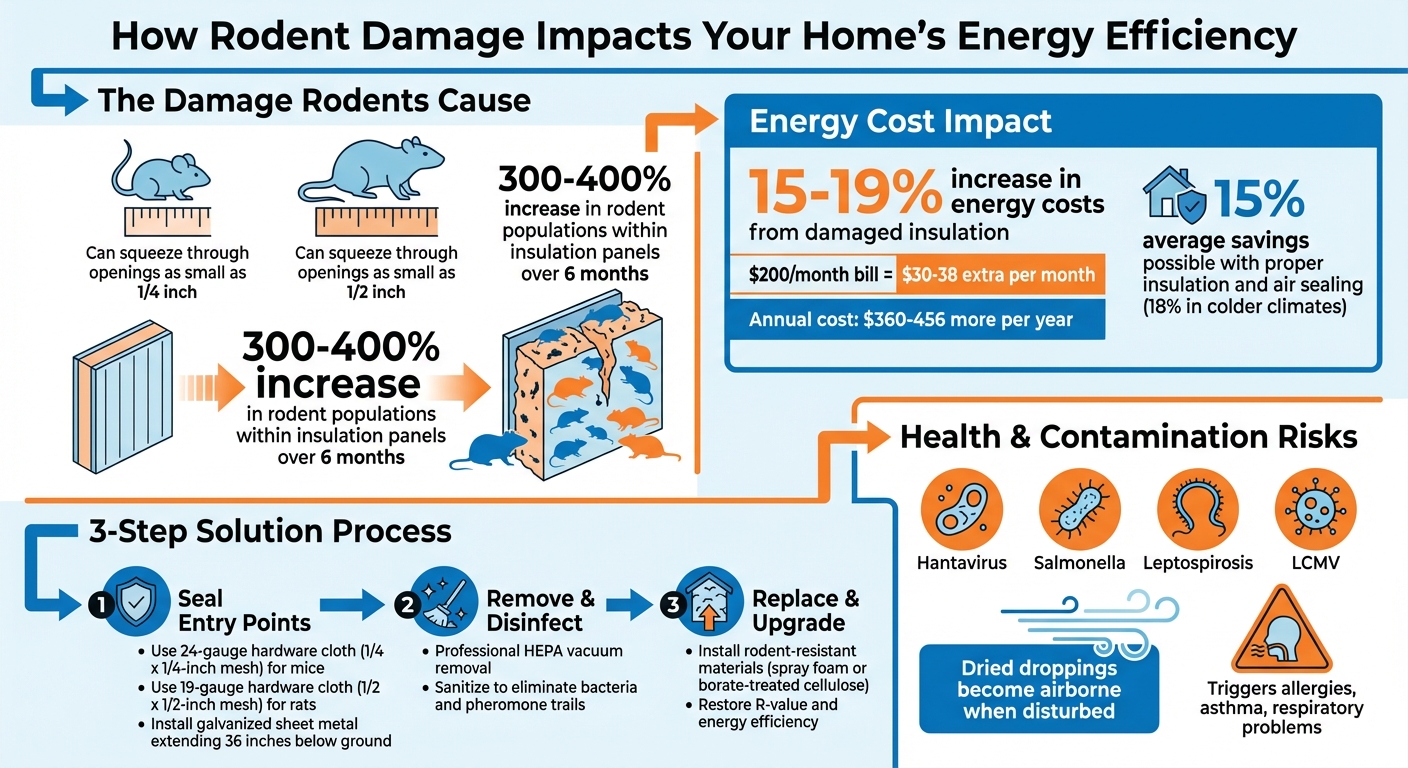
- Damage to Insulation: Rodents shred, burrow, and compress insulation, reducing its R-value (thermal resistance). This forces your heating and cooling systems to work harder, increasing energy costs by 15–19%.
- Contamination Risks: Rodent waste, including urine and droppings, saturates insulation, spreading bacteria and pathogens like hantavirus and salmonella. Contaminated insulation can also degrade air quality.
- Moisture Issues: Damaged insulation can trap moisture, encouraging mold growth and further reducing its effectiveness.
- Health Concerns: Airborne particles from rodent waste can trigger allergies, asthma, and respiratory issues.
Solutions:
- Seal Entry Points: Use materials like hardware cloth or steel wool to block gaps and prevent rodents from entering.
- Remove Damaged Insulation: Professional teams can safely remove contaminated insulation and disinfect the area.
- Replace and Upgrade: Install rodent-resistant materials, such as spray foam or treated cellulose, to restore energy efficiency and prevent future infestations.
Don’t ignore scratching sounds or rising energy bills – quick action can save money and protect your health.
Impact of Rodent Damage on Home Insulation and Energy Costs
Mouse Damage to Insulation
Professional rodent proofing and cleanup services are often necessary to restore your home’s efficiency and safety after an infestation.
sbb-itb-8db64ac
How Rodents Physically Damage Insulation
Rodents can wreak havoc on insulation by burrowing, shredding, and compressing it. These activities destroy the material’s ability to trap air, which is essential for maintaining thermal resistance. As a result, the insulation’s R-value drops, making it harder for your home to regulate temperatures effectively. Here’s a closer look at how rodents compromise insulation.
Tunneling and Burrowing
Mice and roof rats often burrow into fiberglass batts and blown-in insulation to create nesting spaces. As they carve out tunnels, they displace the material and disrupt the thermal barrier. These tunnels frequently run along rafters and joists, creating well-worn paths that leave gaps in the insulation. Roof rats are particularly adept at this, squeezing through openings as small as a quarter to access attics. Regular attic inspection services can help identify these entry points before significant damage occurs. These pathways allow heat to escape during colder months and seep in during warmer ones, undermining your home’s energy efficiency.
Shredding and Nesting
Rodents also shred insulation fibers to build nests. According to World Class Wildlife Removal:
Rats and mice burrow into fiberglass batts to build warm nests. They shred the material, compress it, and tunnel through it for pathways. Over time, once-fluffy insulation gets matted down into flat, useless clumps, often requiring professional insulation removal and installation services
. This shredding leaves thin, uneven sections and exposed spots in your attic or crawl space, further diminishing the insulation’s effectiveness.
Compression and Compaction
Beyond burrowing and shredding, rodents flatten insulation as they move through it. This compression destroys the air pockets that are critical for trapping heat. Unfortunately, once insulation is compacted, it cannot regain its original form. A 1996 study by Scott E. Hygnstrom at the University of Nebraska-Lincoln examined the impact of house mice on 4-inch thick insulated panels over six months. The research revealed a 300% to 400% increase in mouse populations within the panels, leading to extensive damage. The study noted:
All of the insulation materials tested (insulation board, fiberglass batt, rockwool, beadboard, and vermiculite) sustained significant levels of damage as measured by increased thermal conductance
. When insulation is compacted, it becomes less effective at slowing heat transfer, forcing HVAC systems to work harder and driving up energy costs.
Contamination and Moisture Damage
Rodent contamination and moisture don’t just physically damage insulation – they also weaken its efficiency and create health risks.
While physical destruction is an issue, the real trouble often lies in the contamination left behind. Rodent waste introduces bacteria, allergens, and pathogens that speed up insulation breakdown and pose significant health dangers. Urine, droppings, and dander infiltrate insulation fibers, turning areas like attics and crawl spaces into potential contamination hotspots.
Rodent Waste and Insulation Saturation
Rodent urine is particularly damaging, staining and saturating fiberglass batts or blown-in insulation. In humid environments, these stains can spread quickly, worsening odors and encouraging bacterial growth. The result? A strong ammonia-like smell that’s hard to ignore. Insulation also traps dander, hair, and dried waste, all of which can harbor harmful pathogens. These pathogens may even circulate through your home’s HVAC system, spreading contaminants further. This waste saturation often leads to moisture accumulation, which amplifies insulation deterioration.
Moisture Build-Up and Reduced R-Value
When insulation becomes soaked with urine or moisture, it loses its ability to trap air and regulate temperature effectively. Energy Smart highlights this issue:
Once insulation becomes damp, it loses its insulating properties and becomes a breeding ground for mold spores.
This dampness not only lowers the insulation’s R-value (its ability to resist heat flow) but can also affect nearby structures like wood framing, drywall, and ceilings. Rodents often create openings in walls or attics, allowing external humidity to seep in and worsen the problem. The result? Insulation that’s permanently compromised, forcing your HVAC system to work overtime and increasing energy bills.
Health Risks from Contaminated Insulation
Contaminated insulation isn’t just an energy problem – it’s a health hazard. It can release airborne particles that trigger allergies, asthma, and other respiratory issues. Rodent waste may carry dangerous pathogens like Hantavirus and Leptospirosis. Hantavirus is especially worrisome because it can become airborne when dried droppings are disturbed, posing severe respiratory risks. According to the Florida Department of Health:
Dried droppings and urine can become airborne when disturbed, spreading harmful pathogens.
10-Eleven Nuisance Wildlife Control, LLC further warns:
Contaminated insulation can release harmful particles into the air, triggering allergies, asthma, and other respiratory problems.
It’s crucial to avoid sweeping or vacuuming contaminated insulation with standard household tools, as this can spread infectious particles throughout your home. Addressing these issues not only protects your family’s health but also helps maintain energy efficiency in the long run.
Energy Cost Impact of Damaged Insulation
When insulation is damaged by rodents, the financial consequences can hit your energy bills hard. Beyond the physical and contamination issues already discussed, compromised insulation directly increases your utility costs.
Increased Heating and Cooling Expenses
Damaged insulation forces your heating and cooling systems to work overtime. Rodents degrade materials like fiberglass and cellulose, reducing their R-value – the measure of insulation’s effectiveness. This loss of thermal resistance means your furnace has to run longer in the winter, and your air conditioner works harder in the summer, consuming more energy. As Energy Smart puts it:
Damaged insulation forces your HVAC system to work harder, increasing energy bills
.
The numbers back this up. ENERGY STAR reports that maintaining a properly sealed and insulated home can save homeowners an average of 15% on heating and cooling costs. In colder climate zones like CZ 7, those savings can climb to 19%. On the flip side, if rodents compromise your insulation, you could be spending 15–19% more each month. For a household with a $200 monthly heating and cooling bill, that’s an extra $30–$38 per month – or about $360 to $456 annually.
Uneven Indoor Temperatures and Comfort Problems
Higher energy bills aren’t the only issue. Damaged insulation can lead to noticeable comfort problems. Rodent damage often impacts specific areas, leaving some rooms colder in winter or hotter in summer. This uneven temperature distribution can make your home feel less comfortable and your thermostat less reliable, as your HVAC system struggles to maintain balance. Drafts near walls or ceilings – often caused by rodent entry points – can further disrupt your home’s thermal envelope.
Long-Term Damage Accumulation
Rodent infestations can escalate quickly. A single pair of mice can produce dozens of offspring in just one year. What starts as minor damage can quickly spiral into a much larger issue. As the infestation grows, so does the contaminated area, with more entry points and further degradation of your insulation. Urine stains, droppings, and pheromone trails can spread throughout your attic or crawl space, turning a small repair into a full-blown replacement project.
Waiting to address the problem only increases the costs. Not only does damaged insulation lead to higher energy bills, but it also puts additional strain on your HVAC system. Over time, this strain can shorten the lifespan of your system, leading to expensive repairs or even premature replacement.
Solutions for Rodent-Damaged Insulation
Fixing insulation damaged by rodents involves three critical steps: rodent-proofing, removing the damaged material, and restoring energy efficiency. Skipping any of these can leave your home vulnerable to recurring infestations and continued energy loss.
Rodent Proofing and Prevention
The first step is to seal off entry points. Did you know mice can squeeze through openings as small as 1/4 inch, and rats only need 1/2 inch? That’s why using gnaw-resistant materials is essential. For mice, opt for 24-gauge hardware cloth with a 1/4 x 1/4-inch mesh; for rats, use 19-gauge with a 1/2 x 1/2-inch mesh.
Pay close attention to areas where pipes and wires enter your walls. Fill these gaps with copper or stainless steel wool, then seal them with expanding foam or concrete. For exterior insulation, install galvanized sheet metal (24-gauge or thicker) or aluminum flashing that extends at least 36 inches below ground level. Cover crawl space and attic vents with 1/4-inch galvanized hardware cloth to allow airflow while blocking rodents. Additionally, install door sweeps with metal mesh to ensure the gap between the door bottom and threshold is less than 1/4 inch.
Outside, a 3-foot-wide weed-free zone around your foundation can make a big difference. Use 1.5-inch crushed rock, applied to a depth of 3 inches, in a 24-inch-wide strip to deter burrowing. Remember, rats are capable of digging as deep as 36 inches into the ground.
Once you’ve sealed all entry points, removing the damaged insulation is critical to protect your indoor air quality.
Professional Insulation Removal and Replacement
Rodent droppings and urine are more than just unpleasant – they can carry serious health risks. Diseases like Hantavirus, Salmonella, and Lymphocytic choriomeningitis virus (LCMV) are linked to these contaminants. As World Class Wildlife Removal explains:
Dried droppings and urine can become airborne when disturbed… Professional removal with proper protective equipment matters so much.
Professional teams use industrial-grade vacuums equipped with HEPA filters to ensure contaminated particles don’t spread through your home’s HVAC system. They also disinfect the area to kill bacteria and viruses, as well as remove pheromone trails that could attract more rodents. When replacing insulation, consider materials like borate-treated cellulose, which repels rodents, or spray foam, which creates a durable barrier that rodents find tough to penetrate. This process not only removes the damaged material but also prepares your home for thorough cleaning and restoration.
Sanitization and Air Sealing
After the damaged insulation is removed, the next step is sanitization and air sealing. This step is essential for eliminating health hazards and improving energy efficiency. Professional sanitization not only removes allergens and odors but also prepares the space for new insulation. Air sealing, meanwhile, tackles gaps that allow conditioned air to escape. According to ENERGY STAR:
EPA estimates that homeowners can save an average of 15% on heating and cooling costs… by air sealing their homes and adding insulation.
Sealing also prevents moisture intrusion, which can lead to mold growth in the insulation. Once the space is cleaned and sealed, new insulation is installed to restore the R-value lost to rodent damage.
Envirosmart Solution offers a comprehensive approach to rodent-proofing, insulation repair, and energy efficiency upgrades across the Pacific Northwest. Their team handles everything from attic and crawl space cleaning to air sealing and energy optimization. They also assist property owners in taking advantage of rebates and incentives to help offset repair costs. For more details, visit envirosmartsolution.com.
Conclusion
Rodent damage to insulation isn’t just a nuisance – it’s a serious issue that impacts your energy bills, home comfort, and even health. When rodents compress, shred, or contaminate insulation, they destroy the thermal barrier your home relies on. This leads to higher heating and cooling costs, uneven indoor temperatures, and the risk of airborne pathogens circulating through your HVAC system.
Taking action quickly is crucial. Damaged insulation can trap moisture, encourage mold growth, and act as a magnet for more rodents due to lingering pheromone trails. Professional sanitization and sealing are key to stopping the cycle of infestation and preventing further damage.
Rodent-damaged insulation also erodes the energy savings that proper insulation provides. According to the EPA, homeowners can save an average of 15% on heating and cooling costs by properly air sealing and insulating their homes. In colder climates, these savings can climb as high as 18% annually. However, these benefits are only achievable once damaged insulation is replaced and entry points are sealed.
Envirosmart Solution specializes in rodent-proofing, insulation removal, and energy efficiency upgrades throughout the Pacific Northwest. Their services include attic cleaning, air sealing, and assistance with maximizing rebates and incentives. Ready to restore your home’s insulation and reduce energy costs? Visit envirosmartsolution.com or contact their team today.
Don’t let rising energy bills or potential health risks catch you off guard. If you hear scratching sounds or notice an unexplained spike in energy costs, schedule a professional inspection right away.
FAQs
How can I tell if rodents damaged my insulation?
Look out for telltale signs of rodent activity, such as gnaw marks, chewed or shredded insulation, droppings, and nesting materials. These are often found in spaces like your attic or basement and can signal both rodent presence and possible insulation damage.
Will damaged insulation really raise my energy bill?
Yes, damaged insulation caused by rodents and pests can drive up your energy bills significantly. When insulation is compromised, it becomes less effective at regulating temperature, allowing more heat to escape in the winter or enter during the summer. This puts extra strain on your heating and cooling systems, making them work harder and use more energy. Taking steps to address rodent problems quickly and maintaining your insulation can help keep your energy costs under control and improve overall efficiency.
Should I replace insulation myself or hire a pro?
If your insulation has been damaged by rodents, it’s a smart move to hire a professional for the replacement. Rodent-damaged insulation isn’t just unsightly – it can lead to health risks, higher energy costs, and even repeated infestations if not handled the right way.
Professionals know how to safely remove the old insulation, install the new material correctly, and often offer rodent-proofing services to keep pests from coming back. While DIY might seem like a cheaper option, improper installation can cause persistent issues, ultimately costing you more over time.