
HVAC systems account for over 50% of building energy use in the U.S., making energy optimization a priority for cost savings and reducing emissions. There are three main approaches:
- Hardware Upgrades: Replace or improve equipment like heat pumps, insulation, or energy recovery ventilators. These energy upgrades can save up to 50% on energy use but come with high upfront costs ($50,000–$500,000).
- Control Systems: Use AI-driven tools or predictive controls to adjust HVAC operations in real-time, saving up to 40%. These systems require integration and ongoing maintenance.
- Operational Improvements: Simple adjustments like sealing air leaks or using smart thermostats can save up to 30% with minimal costs but offer smaller overall savings.
Quick Comparison
| Criteria | Hardware Upgrades | Control Systems | Operational Improvements |
|---|---|---|---|
| Energy Savings | 30%–50% | 13%–40% | Up to 30% |
| Upfront Cost | High ($50k–$500k) | Moderate to High | Low to None |
| Implementation | Complex, requires contractors | Complex, requires calibration | Simple, DIY-friendly |
| Payback Period | Long | Moderate | Short |
Each method has its pros and cons. Combining these strategies often yields the best results, balancing energy efficiency, cost, and ease of implementation.
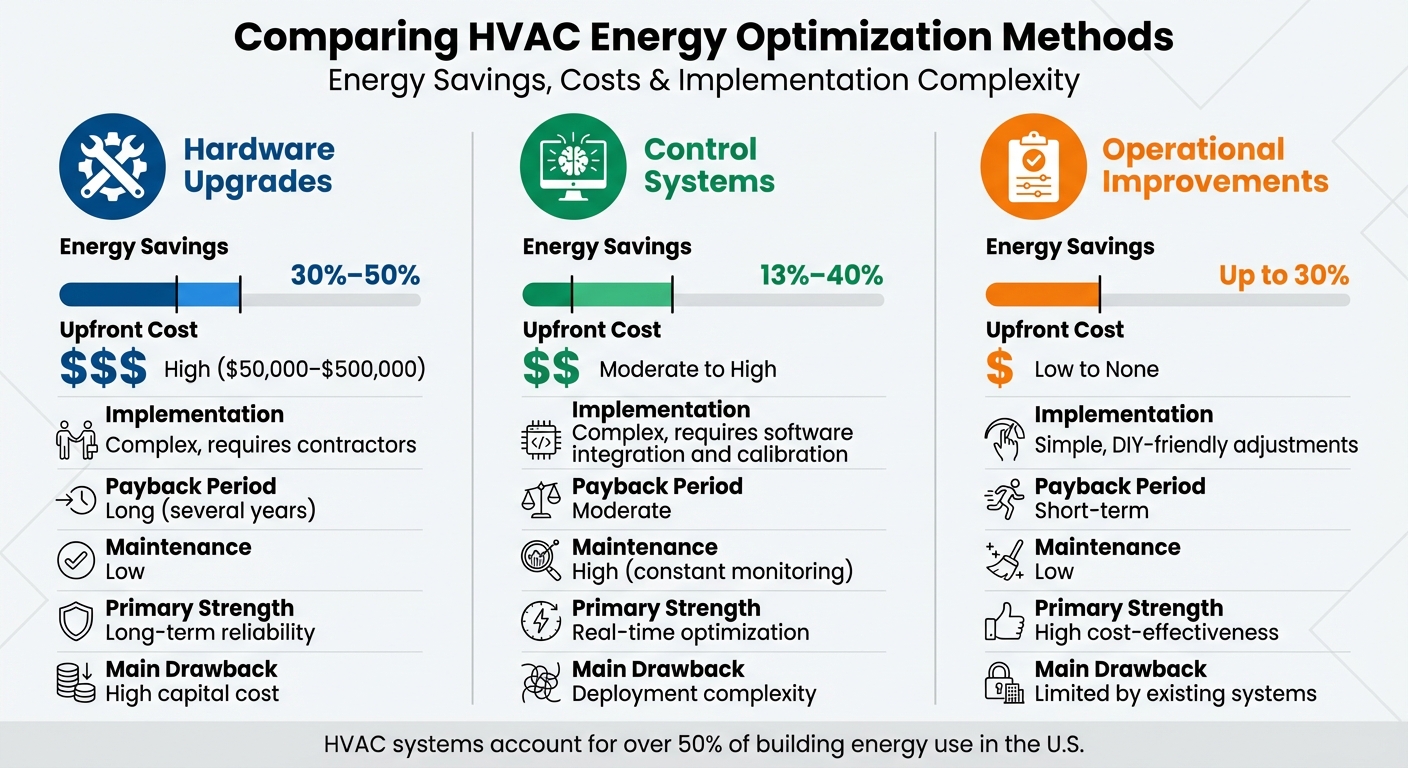
HVAC Energy Optimization Methods Comparison: Costs, Savings, and Implementation
Top 6 Control Startegies to Save Energy
sbb-itb-8db64ac
1. Hardware Upgrades
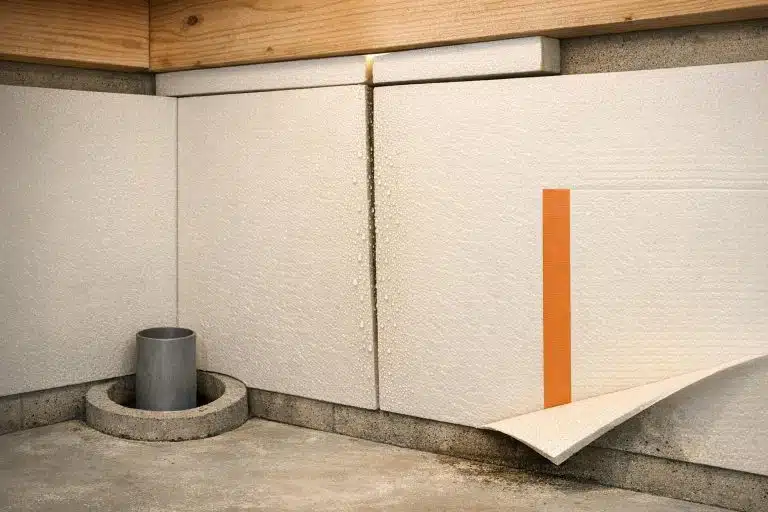
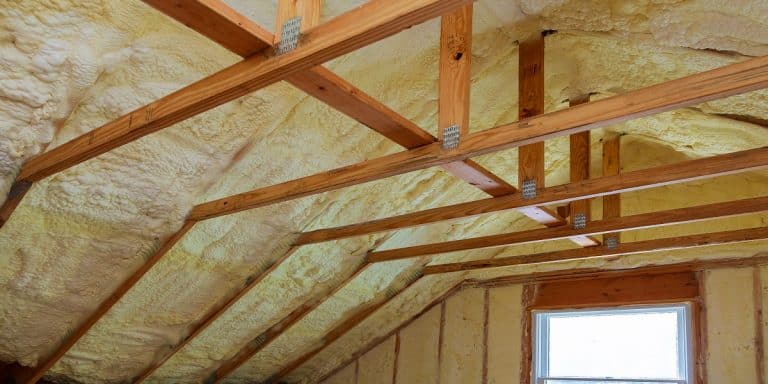
Improving HVAC systems often starts with upgrading or replacing hardware. This can include building envelope improvements – like better insulation and air sealing – or swapping out old equipment for newer options such as heat pumps, condensing boilers, or energy recovery ventilators. The key is to select upgrades that fit your building’s specific needs and budget.
Here’s how these upgrades can lead to measurable energy savings and cost reductions.
Energy Savings
Switching to heat pumps can cut electricity use for heating by as much as 75% compared to electric resistance heating systems. For example, a 2024 retrofit in Colorado replaced an electric resistance system with a cold-climate air-source heat pump (18 SEER2, 9 HSPF2). This change reduced the winter electricity peak draw from 6.2 kW to an average of 2.4 kW under similar outdoor conditions.
Building envelope improvements – like air sealing and adding R-38 insulation – can save around 15% on heating and cooling costs. A 1998-built home in northern Illinois saw a 17% reduction in heating runtime over 60 days after air sealing and insulation upgrades in January 2025. Air leakage dropped from 5.8 ACH50 to 3.9 ACH50. Similarly, condensing boilers boost efficiency from about 80% to between 86% and 98%, and Energy Recovery Ventilators reclaim 70% to 80% of thermal energy from exhaust air.
Implementation Cost
HVAC retrofit costs typically range from $50,000 to $500,000, depending on the size and complexity of the building. For residential projects, payback periods are relatively short: attic insulation (R-38+) often pays for itself in 2 to 4 years, while air sealing has a return on investment in 1 to 3 years. Federal tax credits from the Inflation Reduction Act also make upgrades more affordable, offering up to $2,000 annually for heat pumps and $1,200 for insulation and air sealing, available through 2032.
"Energy-efficient home upgrades in the United States are no longer incremental improvements. They are strategic infrastructure decisions." – Ethan Caldwell, Author
By weighing these costs and incentives, you can identify the upgrades that make the most sense for your building.
Suitability for Building Types
Different types of buildings benefit from specific hardware upgrades:
- Single-family homes: Best suited for envelope improvements, air-source heat pumps, and smart thermostats.
- Multi-family units: Ideal for Variable Refrigerant Flow (VRF) systems – offering individual apartment temperature control – high-efficiency condensing boilers, and ERV systems to manage moisture in crowded spaces.
- Commercial buildings: Benefit from high-efficiency chillers, Variable Frequency Drives (VFDs) for large fans and pumps, and Demand-Controlled Ventilation systems for spaces with varying occupancy levels .
Upgrading hardware delivers immediate energy performance improvements. When paired with advanced control systems and operational strategies, these upgrades create a well-rounded approach that enhances both short-term efficiency and long-term sustainability.
2. Control Systems
Modern control systems use advanced techniques to predict conditions and adjust settings ahead of time. Model Predictive Control (MPC) and Reinforcement Learning (RL) are replacing traditional rule-based methods by forecasting variables like weather and occupancy, then proactively fine-tuning system settings. These advanced systems coordinate components such as district heating and ventilation to strike a balance between energy costs and occupant comfort.
Energy Savings
Upgrading control systems can lead to noticeable energy reductions. Advanced strategies have been shown to cut HVAC energy use by 25% to 30% across different building types while maintaining a comfortable indoor environment. Field data highlights savings of 16% in residential buildings and 13% in commercial spaces.
Take the example of a 167,970 sq ft office building in Long Beach, CA, which upgraded to a model-predictive HVAC optimization system between August 2016 and August 2017. The result? 8.9% HVAC electricity savings (17,200 kWh annually), which translated to $2,410 in yearly cost savings. The system achieved this by lowering air handler static pressure by an average of 0.41 psi and raising supply air temperature, cutting fan energy use by about 50%. Similarly, a hospital floor in Denmark with 12 conditioned zones saw heating energy reductions of 7.3% and 8.5% in two rooms, while thermal comfort time increased by up to 86.51%.
These energy savings often make the higher upfront costs worthwhile.
Implementation Cost
When paired with necessary hardware upgrades, these systems become part of a broader energy optimization strategy.
Smart control systems do come with higher initial costs due to the complexity of software and hardware integration. Expenses include hardware, integration, tuning, troubleshooting, and connecting to existing building automation systems. However, the energy savings they generate help recoup these costs over time. While the cost savings may not match the energy reductions dollar-for-dollar, they still demonstrate the financial viability of these systems.
"Smart control system incurred higher costs compared to traditional control system… however, the HVAC energy cost savings achieved offset the additional cost incurred to deploy this system." – Journal of Building Engineering
A major hurdle to adoption is the lack of transparent cost data – only 13% of field studies currently detail deployment, operational, and maintenance expenses. To address this, building owners should consider installing submeters to separate HVAC energy use from total building consumption, making it easier to calculate return on investment.
Complexity of Setup
While the potential savings are impressive, setting up advanced control systems can be challenging. Developing accurate physics-based models requires significant computational effort and customization for each building. Additional complications include infrastructure issues like limited bandwidth, diverse system designs, and sensor inaccuracies. Ensuring consistent data access and integration with existing automation systems also poses difficulties.
"The technology performs best when HVAC systems are in good working condition… however it may not provide extensive additional savings over cases where best practice sequences of operation and reset strategies are already comprehensively implemented." – OSTI
It’s important to note that these systems can’t compensate for faulty equipment or inaccurate measurements. Building owners should also evaluate whether their current systems already employ advanced manual reset strategies, as the additional savings from automated controls might be minimal in such cases.
Suitability for Building Types
The effectiveness of control systems varies depending on the building type and its existing efficiency levels. Office buildings typically show the greatest potential, with savings ranging from 8.9% to 35%, thanks to predictable occupancy and load patterns . Hospitals, on the other hand, see moderate savings of 7% to 8.5%, as their round-the-clock operations and complex baseline strategies limit further improvements . High schools and courthouses usually experience smaller gains of 1% to 2%, especially when baseline control sequences already include setpoint resets.
For residential properties, simpler adaptive HVAC controls combined with tiered utility tariffs can often achieve similar financial benefits without the complexity of advanced systems. The key is to align the control system’s sophistication with the building’s operational needs and infrastructure.
3. Operational Improvements
Operational improvements aim to boost the efficiency of your HVAC system without requiring major hardware upgrades. These adjustments can range from straightforward DIY fixes to advanced, software-driven strategies that fine-tune how your system operates throughout the day. By focusing on these improvements, you can make the most of your existing equipment, often at a relatively low cost.
Energy Savings
Small changes can lead to noticeable savings. For example, setting your thermostat back by 7–10°F for eight hours can cut energy bills by up to 10%. Even a single degree adjustment over an eight-hour period can save around 1% on heating and cooling costs. In commercial buildings, where HVAC systems can account for nearly half of the total energy demand, these tweaks become even more impactful.
From basic thermostat programming to sophisticated Energy Management Systems (EMS), these strategies can be tailored to fit the unique needs of a building. EMS, in particular, can reduce energy use by as much as 30% in large buildings through centralized control and predictive maintenance. For example, office buildings equipped with intelligent technologies have achieved energy savings of about 18%, while retail spaces typically see savings closer to 12%. A high school in Washington, D.C., demonstrated the potential of these strategies, achieving a 1.9% reduction in electricity use and a 1.0% overall HVAC energy savings by optimizing its central chiller/boiler plant and air handling units over a year.
Implementation Cost
The cost of these improvements can vary widely. Many tasks, like sealing air leaks with caulk or weatherstripping, replacing air filters every 1–3 months, or using mastic tape to seal ductwork (recovering 20–30% of conditioned air lost due to poor installation), are affordable and can often be done yourself. Smart thermostats require a higher upfront investment but typically pay for themselves over time through energy savings and better system control.
On the other hand, implementing advanced EMS requires more significant investment due to software and hardware integration. However, the long-term reduction in energy and maintenance costs can offset these initial expenses. While many operational improvements are low-cost and straightforward, more advanced strategies may involve challenges related to integration and setup.
Complexity of Setup
The ease of implementing these improvements depends on the approach. Simple steps, like programming your thermostat, replacing filters, or sealing air leaks, can be done quickly and with minimal effort. Even small changes, such as setting ceiling fans to rotate counterclockwise in summer for a cooling effect and clockwise in winter to circulate warm air, can deliver immediate results.
However, advanced strategies are more complex. For instance, AI-driven models require careful calibration and ongoing monitoring to work effectively. Challenges like poor sensor data quality and integrating new software into different building systems can complicate the process.
"The technology performs best when HVAC systems are in good working condition… however it may not provide extensive additional savings over cases where best practice sequences of operation and reset strategies are already comprehensively implemented." – OSTI Field Evaluation Report
To maximize savings, it’s crucial to ensure your HVAC system is in good condition before implementing advanced optimization software. Mechanical issues can significantly limit the potential benefits.
Suitability for Building Types
Operational improvements can be applied to a wide variety of buildings, though the outcomes will vary. In residential buildings, simple measures like programming thermostats, maintaining filters, sealing ducts, and using passive strategies (like closing curtains during peak sunlight) can be highly effective.
In commercial office buildings, where occupancy patterns are predictable and Building Management Systems are often in place, more advanced strategies can yield energy savings of about 18%. Retail spaces, which face fluctuating foot traffic and longer operating hours, typically see savings around 12%. Industrial facilities can benefit the most from EMS, with potential energy reductions of up to 30% thanks to predictive maintenance and improved reliability management.
Choosing the right operational improvements depends on your building’s current HVAC setup and whether optimal control sequences are already in place. These measures work best when paired with investments in hardware and control systems to maximize efficiency.
Advantages and Disadvantages
This section breaks down the strengths and weaknesses of hardware upgrades, control systems, and operational strategies, building on earlier discussions about their roles in improving energy efficiency.
Each approach comes with its own set of trade-offs:
Hardware upgrades offer the most dramatic improvements, with potential energy savings of 30%–50% and enhanced long-term reliability. This is achieved by replacing outdated components with modern, high-efficiency equipment . However, these upgrades require significant upfront costs – ranging from $50,000 to over $500,000 – and involve complex installations that can disrupt daily operations. The extended payback period makes hardware upgrades a better fit for property owners with long-term investment plans.
Control systems, such as Model Predictive Control (MPC) and AI-driven platforms, can achieve 13%–40% energy savings by optimizing existing equipment in real time . These systems do not require replacing physical hardware, making them a less invasive option. However, their implementation is complex, requiring integration with Building Automation Systems (BAS), ongoing calibration, and consistent monitoring. As highlighted in an OSTI field study:
"The technology performs best when HVAC systems are in good working condition… however it may not provide extensive additional savings over cases where best practice sequences of operation and reset strategies are already comprehensively implemented".
Operational improvements, on the other hand, involve minimal initial costs and can often be implemented immediately by building occupants. While these changes deliver modest energy savings, they offer the quickest return on investment and cause little to no disruption. The downside is that their effectiveness is limited by the capabilities of the existing equipment.
Here’s a quick comparison of the three approaches:
| Criteria | Hardware Upgrades | Control Systems | Operational Improvements |
|---|---|---|---|
| Energy Savings | 30%–50% | 13%–40% | Modest |
| Upfront Cost | High | Moderate to High | Low to None |
| Implementation Complexity | High (requires contractors) | Complex (software integration) | Low (adjustments, maintenance) |
| Maintenance Requirements | Low | High (constant monitoring) | Low |
| Payback Period | Several years | Moderate | Short-term payback |
| Primary Strength | Long-term reliability | Real-time optimization | High cost-effectiveness |
| Main Drawback | High capital cost | Deployment complexity | Limited by existing systems |
A combined strategy – leveraging operational adjustments, advanced controls, and selective hardware upgrades – can deliver the best results. This sets the stage for a deeper look at how these methods can work together effectively.
Conclusion
When deciding on an HVAC optimization method, consider your budget, building characteristics, and operational goals. Hardware upgrades, like replacing or modifying critical components, can lead to substantial long-term savings, but they often come with high upfront costs. On the other hand, control systems – such as AI-driven platforms and Model Predictive Control – strike a balance by delivering energy savings without requiring major physical changes . For quicker results with lower initial investment, operational improvements are an appealing option, offering a fast return on investment.
Before committing to control systems, it’s wise to perform a load analysis to compare your building’s actual usage with its design capacity. Most HVAC systems run well below their maximum potential. If your budget is tight, focus on control strategies or operational tweaks, which can yield energy savings of 30% to 40% through software and sensor optimization . However, if your building already operates efficiently, advanced controls may provide limited additional benefits. These considerations help craft a strategy that takes advantage of each approach’s strengths.
A well-rounded plan combines operational adjustments, smart controls, and targeted hardware upgrades, balancing efficiency, cost, and complexity. By tailoring these strategies to your building’s specific needs, you can achieve optimal energy performance.
For property owners in the Pacific Northwest, expert guidance can make all the difference. Envirosmart Solution offers a complete range of HVAC services, energy efficiency improvements, and assistance with securing government and vendor rebates – providing a seamless path to the right optimization strategy for your building and budget.
FAQs
How do I choose between upgrades, controls, and operational fixes?
Choosing the right approach – whether upgrades, controls, or operational fixes – depends on your system’s condition, budget, and energy goals.
- Upgrades: Investing in high-efficiency equipment can lead to long-term energy savings. While the upfront cost may be higher, the payoff often comes in the form of reduced energy bills over time.
- Controls: These help fine-tune your system’s performance in real-time, typically cutting energy use by 10-15%.
- Operational fixes: Adjustments like refining setpoints or tweaking schedules are quick and budget-friendly ways to improve efficiency without major investments.
For the best results, combining these strategies often delivers the most well-rounded and impactful energy optimization.
What should I do first to get the fastest HVAC payback?
To get the quickest return on investment for your HVAC system, prioritize energy efficiency upgrades that deliver fast results. Begin with straightforward actions like sealing ductwork, fine-tuning thermostat settings, and adding smart controls, such as demand control ventilation. These affordable changes can noticeably cut energy expenses in just a few months. Also, make sure your HVAC system is the right size for your space to prevent unnecessary energy waste and overspending on oversized equipment.
Do AI HVAC controls work if my equipment is old or poorly maintained?
AI-driven HVAC controls can function even with older or less-maintained equipment. However, to achieve the best performance, you might need to consider hardware upgrades or ensure proper calibration. A well-configured system can significantly improve energy efficiency and overall functionality.