
Managing indoor humidity is key to cutting energy costs and improving comfort. High humidity forces air conditioners to work harder, increasing energy bills. By controlling moisture effectively, you can set your thermostat higher without losing comfort, saving money in the process. Here’s a quick breakdown of the best solutions:
- Whole-Home Dehumidifiers: Reduce humidity through your HVAC system, saving energy by lessening the load on your AC.
- Smart Humidity Controls: Use programmable thermostats with built-in hygrometers to maintain ideal moisture levels (30%-50%) and optimize HVAC performance.
- HVAC System Optimization: Upgrade to two-stage or variable-capacity units for better moisture removal and energy efficiency.
- Ductwork Sealing: Prevent leaks that let in humid air, improving system efficiency and reducing energy waste.
- Regular HVAC Maintenance: Clean filters, coils, and drain lines to ensure effective moisture removal and system performance.
- Portable Dehumidifiers: Tackle specific problem areas like basements or bathrooms without relying on central systems.
- Ventilation Systems: Energy Recovery Ventilators (ERVs) manage incoming and outgoing air, balancing humidity while saving energy.
Each method offers unique benefits, from long-term savings to improved comfort. By combining these strategies, you can lower energy costs, reduce HVAC strain, and maintain a healthier home environment.
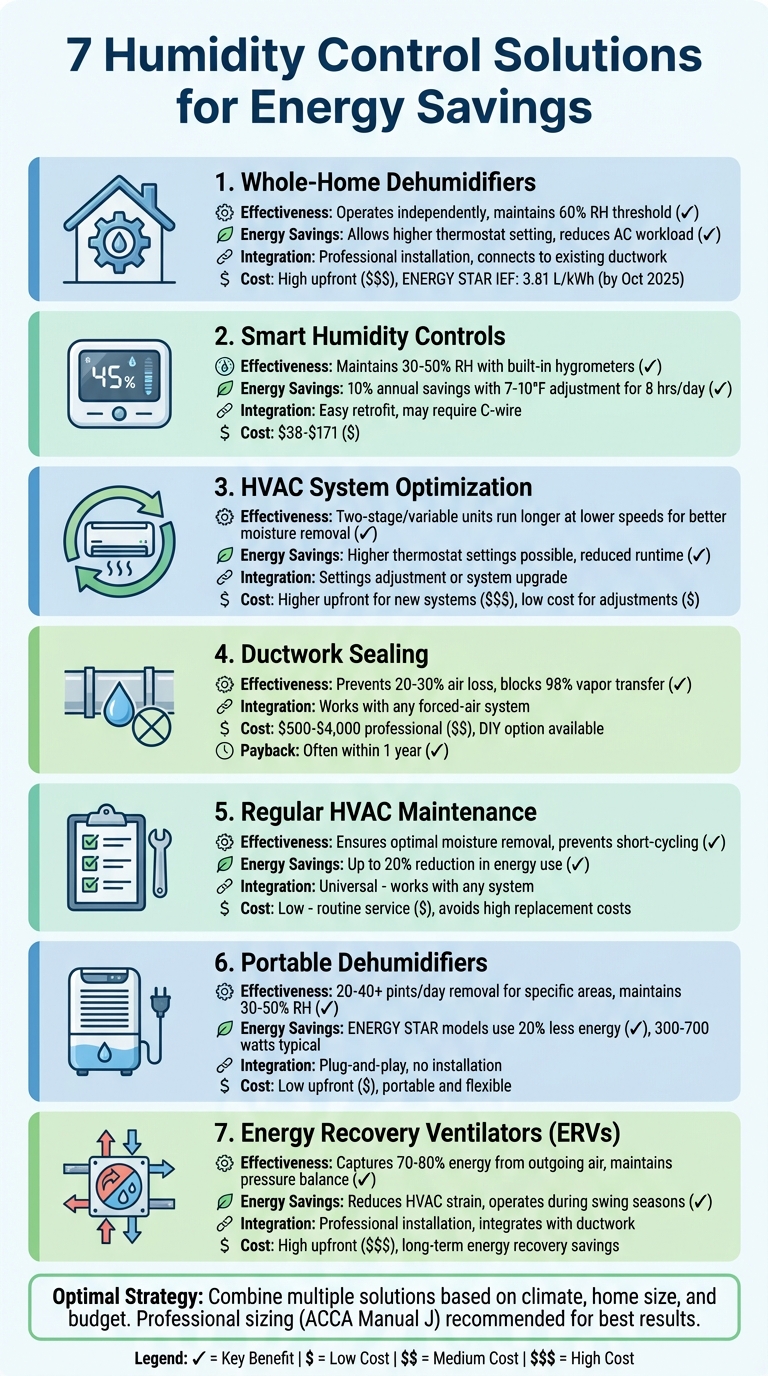
7 Humidity Control Solutions for Energy Savings Comparison
Why Your House Is Humid (Even With New HVAC SYSTEM)
1. Whole-Home Dehumidifiers Integrated with HVAC Systems
Whole-home dehumidifiers connect directly to your HVAC system, utilizing the existing ductwork to evenly manage humidity across every room in your house.
Effectiveness in Managing Humidity
One of the standout benefits of integrated dehumidifiers is their ability to operate independently of your air conditioner’s cooling cycle. Unlike AC units, which only reduce humidity while cooling, these systems can run during mild "swing seasons" when cooling isn’t needed but moisture levels remain high.
Whole-home dehumidifiers activate whenever indoor humidity rises above your desired level, typically around 60% relative humidity. They pull in air, remove excess moisture, and circulate the drier air back into your home. This ensures consistent humidity control throughout large or multi-level houses – something portable units simply can’t achieve. This steady moisture control also helps lower energy use, creating a more efficient home.
Energy Savings Potential
By reducing the need to lower your thermostat just to combat humidity, integrated systems lighten the workload on your AC, which can lead to noticeable energy savings. This approach eliminates the discomfort of damp indoor air while avoiding wasted energy.
The U.S. Department of Energy highlights this benefit:
"The reduced humidity may allow you to set your thermostat higher, potentially leading to overall energy savings and increased comfort".
Additionally, these dehumidifiers consume less energy compared to running your central air handler solely to manage moisture levels.
Ease of Integration with Existing Systems
Installing a whole-home dehumidifier is a professional job. It involves connecting the unit to your ductwork, wiring it to a humidistat for control, and plumbing it to a drainage line. When done correctly, this setup significantly reduces indoor humidity, as confirmed by case studies.
HVAC professionals use an ACCA Manual J calculation to ensure the dehumidifier is properly sized for your home, eliminating the need for supplemental units. The system is typically installed in a utility space and connected to an existing drain line, so there’s no need for manual water removal.
Cost-Effectiveness (Initial Cost vs. Long-Term Savings)
While the upfront cost of a whole-home dehumidifier is higher than that of portable units, the long-term savings make it a smart investment. These systems are more energy-efficient, with ENERGY STAR standards requiring larger models (over 8.0 cubic feet) to achieve an Integrated Energy Factor (IEF) of at least 3.81 L/kWh by October 1, 2025. In comparison, portable units only need to meet 3.30 L/kWh for their largest models.
This efficiency reduces strain on your AC, potentially extending its lifespan and eliminating the need to overcool your home to manage moisture. For homeowners in humid regions or those with tightly sealed, energy-efficient homes, integrated dehumidifiers often become a necessity rather than a luxury.
2. Smart Humidity Controls and Programmable Thermostats
Smart humidity controls are a practical and cost-effective solution to managing indoor moisture while cutting down on energy bills. These devices, when paired with programmable thermostats, not only help regulate humidity but also improve the efficiency of your HVAC system.
How They Manage Humidity
Today’s programmable thermostats come equipped with built-in hygrometers, which monitor indoor humidity levels in real time. They can trigger dehumidification processes as needed, ensuring moisture levels stay within the ideal range of 30% to 50%. Advanced systems even adjust fan speeds to optimize moisture removal while maintaining a comfortable indoor environment.
Energy-Saving Benefits
By simply adjusting your thermostat by 7°F–10°F for eight hours a day, homeowners can save up to 10% annually on heating and cooling costs. Lower humidity levels allow you to feel comfortable at higher temperatures during the summer, reducing the need for excessive cooling. Additionally, smart controls enhance energy efficiency by using algorithms to optimize heat pump performance, minimizing reliance on backup electric resistance heating during temperature recovery. Setting your thermostat to the highest comfortable temperature when at home also reduces the gap between indoor and outdoor temperatures, further lowering cooling expenses.
Easy Integration with Existing HVAC Systems
Upgrading your current HVAC system with smart humidity controls is often more affordable than installing a standalone dehumidifier. Many smart thermostats are designed to integrate seamlessly with various HVAC setups. However, some models require a "C-wire" for constant power, so it’s essential to check your existing wiring before making a purchase. To avoid overcooling during transitional seasons, set enhanced dehumidification to activate at 55% relative humidity. Proper installation is key – placing the thermostat on an interior wall away from direct sunlight, drafts, or doorways ensures accurate readings and prevents unnecessary system cycling.
Balancing Costs and Long-Term Savings
Smart humidity controls and programmable thermostats are a budget-friendly investment. Entry-level models start around $38, mid-range options range from $78 to $98, and premium versions cost between $109 and $171. For example, the Honeywell Home RTH8560D is praised for its user-friendly touchscreen and programming capabilities, while the Honeywell Home Vision Pro 8000 stands out for its performance and affordability. These initial costs are significantly less than the price of whole-home dehumidifiers, making them a smart choice for homeowners looking to improve indoor comfort without breaking the bank.
3. HVAC System Optimization (Two-Stage Units and Fan Settings)
Fine-tuning your HVAC system can improve moisture control and energy efficiency without requiring a complete replacement.
Effectiveness in Managing Humidity
Two-stage and variable-capacity HVAC systems are particularly effective at removing moisture. Unlike traditional single-stage units, these systems operate for longer periods at lower speeds, giving indoor air more time to pass over the cold evaporator coil. This process allows water vapor to be extracted more effectively. On the other hand, single-stage systems tend to short-cycle, which limits their ability to dehumidify and often leaves indoor spaces feeling damp.
"Variable capacity equipment… runs frequently but mostly at efficient low speeds, controlling both temperature and moisture better than single-speed units."
– Department of Energy
A 2024 field study found that optimized HVAC controls kept indoor humidity levels below 60% for most of the cooling season, significantly enhancing moisture removal capabilities.
These improvements don’t just enhance comfort – they also pave the way for energy savings.
Energy Savings Potential
Better humidity control allows homeowners to set their thermostats at higher temperatures without sacrificing comfort. This reduces the air conditioner’s runtime, cutting down on electricity use. Additionally, operating the fan at lower speeds during dehumidification maximizes moisture removal without wasting energy through overcooling.
These adjustments not only save energy but can also be easily implemented with existing HVAC systems.
Ease of Integration with Existing Systems
You don’t need to overhaul your HVAC system to achieve better moisture control – simple adjustments to control settings can make a big difference. Adding dehumidification controls to an existing setup is often more cost-effective than installing a separate dehumidifier. Many modern thermostats and control boards support "ramping profiles", where the fan starts at a low speed and gradually increases. This allows the coil to reach the optimal temperature for immediate moisture condensation.
"This study demonstrates that air conditioners or heat pumps with a single-stage compressor can provide good humidity control without the need for a two-stage or variable-stage compressor system."
– David Mallay, Home Innovation Research Labs
Proper system sizing is crucial for effective dehumidification. Oversized systems often fail to remove moisture efficiently, so an HVAC contractor should perform ACCA Manual J and Manual S calculations to ensure the right fit. Also, avoid setting your thermostat fan to the continuous "on" mode in humid climates, as this can reintroduce moisture into your home during the compressor’s off-cycle.
Cost-Effectiveness (Initial Cost vs. Long-Term Savings)
Here’s a quick comparison of single-stage units versus two-stage and variable-capacity systems:
| Feature | Single-Stage Units | Two-Stage / Variable Units |
|---|---|---|
| Operation | Runs at 100% capacity, cycling on and off frequently | Operates mostly at low speed, switching to high speed only when needed |
| Humidity Removal | Limited due to short-cycling | Excellent moisture removal thanks to longer, consistent operation at lower speeds |
| Energy Efficiency | Less efficient due to frequent startups | More efficient, maintaining comfort with extended low-power operation |
| Indoor Comfort | Can leave interiors feeling cold and damp | Delivers steady temperatures and lower humidity for better comfort |
Upgrading to a two-stage or variable-capacity system does come with a higher upfront cost, but the long-term savings on energy bills and the improved comfort often make it worth the investment. If you’re not ready to replace your current system, optimizing fan speeds and control settings offers a cost-effective way to achieve better humidity control. Studies confirm that these adjustments won’t compromise the reliability of your cooling equipment.
4. Ductwork Sealing and Air Leak Prevention
Hidden duct leaks can quietly drive up your energy bills while making it harder to control indoor humidity. In fact, 20% to 30% of the air traveling through a typical home’s duct system is lost due to leaks, holes, or poorly connected sections. This not only wastes energy but also allows humid outdoor air to infiltrate your home. Sealing your ducts effectively bridges the gap between better humidity control and improved energy efficiency.
How It Helps Manage Humidity
Sealing ductwork plays a major role in keeping indoor humidity levels in check. Over 98% of water vapor transfer in building cavities happens through air movement. If your return ducts have leaks in unconditioned spaces like an attic or crawlspace, they can pull in hot, humid air, forcing your HVAC system to work overtime to dehumidify it. By sealing these leaks, you prevent moisture from sneaking in through unintended pathways and ensure that conditioned air reaches its intended destination.
Saving Energy (and Money)
Leaky ducts don’t just compromise comfort – they also waste energy. When ducts leak, your HVAC system has to work harder and longer to maintain the desired temperature, which can add hundreds of dollars to your annual heating and cooling costs. Worse yet, duct leaks can make a high-efficiency 13 SEER air conditioner operate as if it’s a much less efficient 7 or 9 SEER unit. Properly sealed ductwork reduces this strain, lowering your utility bills and extending the life of your HVAC equipment. Over time, this can also help reduce maintenance costs.
Balancing Costs and Long-Term Savings
Professional duct sealing typically costs around $2,250, with prices ranging from $500 to $4,000 depending on your home’s size and the accessibility of your ducts. If you’re handy, you can seal accessible areas yourself using mastic sealant or metal tape – just steer clear of standard cloth-backed duct tape, which isn’t durable. For hard-to-reach leaks, aerosol-based sealing is a popular option, averaging about $1,300. Whether you go DIY or hire a pro, the investment often pays for itself within a year through energy savings.
Compatibility with Existing Systems
The good news? Duct sealing integrates seamlessly with any forced-air HVAC system – no need to replace your equipment. Focus on sealing ducts in unconditioned spaces like attics, crawlspaces, and garages. Pay special attention to areas where vents and registers meet floors, walls, or ceilings, as these are common leak points that are often easy to address. For gaps larger than 1/4 inch, use drywall tape before applying mastic. While DIY sealing works for accessible sections, professional contractors bring specialized tools to locate hidden leaks and perform pressure tests to ensure the system is airtight. This straightforward upgrade boosts your system’s efficiency and enhances other humidity control strategies you may already have in place.
sbb-itb-8db64ac
5. Regular HVAC Maintenance for Humidity Control
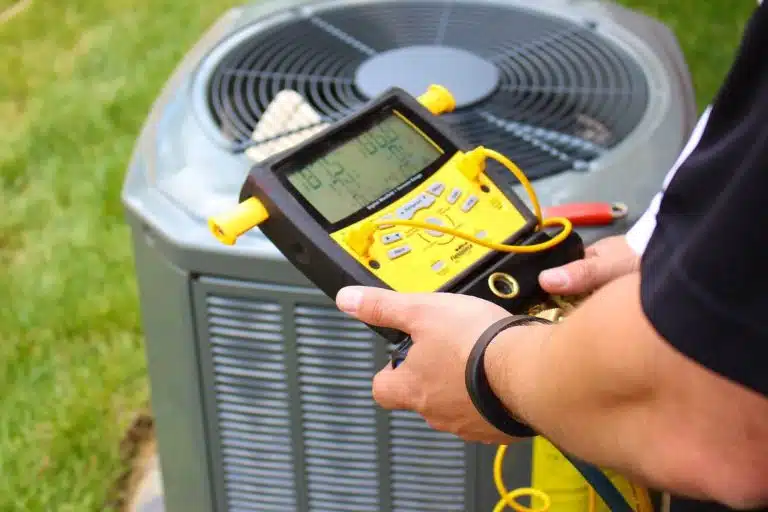
Once you’ve optimized your HVAC equipment and sealed the ducts, the next step is maintaining that performance through regular upkeep. Routine maintenance not only keeps humidity levels in check but also helps lower energy costs. Even the most efficient systems can falter if filters are clogged, coils are dirty, or drain lines are blocked.
How Maintenance Helps Manage Humidity
Keeping coils and filters clean is critical for effective moisture removal. Clean components allow the air to reach the dew point on the coil surfaces, extracting moisture efficiently. On the flip side, dirty coils or clogged filters can trap moisture in the air, leaving your home feeling damp and uncomfortable.
Short-cycling – when the system shuts off prematurely – can also be a problem. It cools your home but leaves humidity levels high. Proper system sizing and calibration are essential to avoid this. A professional maintenance check should include verifying the system’s capacity using accurate load assessments, especially after making upgrades like adding insulation or sealing air leaks. Additionally, regular inspections of condensate drain lines ensure that moisture is properly expelled, preventing water damage and keeping your system running smoothly. These maintenance tasks work hand-in-hand with upgrades like integrated dehumidifiers and duct sealing to ensure consistent performance.
Save Energy, Save Money
Proper maintenance goes beyond comfort – it also reduces energy use. When HVAC systems aren’t maintained, their efficiency drops below their rated performance. Considering that heating and cooling account for about 40% of the average home’s energy consumption, even small efficiency gains can translate into noticeable savings on your utility bills.
"Research conducted by the U.S. Department of Energy (DOE) has shown that Americans can significantly improve the energy efficiency, safety, and comfort of their homes while reducing emissions and utility bills. Studies show that upgrading a home’s heating and cooling equipment can reduce energy use by up to 20% or more."
Balancing Upfront Costs with Long-Term Savings
Investing in routine maintenance is a cost-effective way to protect your HVAC system. A typical service call – which might include replacing filters, cleaning coils, checking refrigerant levels, and inspecting drain lines – costs far less than replacing an entire system, which can run anywhere from $4,500 to over $10,000. Simple adjustments, like fine-tuning fan speeds or control settings, can also improve dehumidification without requiring expensive hardware upgrades.
Works with Any HVAC System
The beauty of regular maintenance is that it applies to any HVAC system, whether brand-new or years old. Tasks like cleaning coils, replacing filters, clearing drain lines, and checking ductwork ensure your system performs as intended. Adjustments to fan speeds during cooling cycles can further enhance moisture removal. These straightforward practices make maintenance one of the easiest and most effective ways to manage indoor humidity while boosting energy efficiency across the board.
6. Dehumidifiers for Specific Problem Areas
Sometimes, addressing the humidity in an entire home isn’t necessary – or even practical. If you’re dealing with a damp basement, a steamy bathroom, or a humid laundry room, portable dehumidifiers can be a game-changer. These handy units tackle moisture in specific areas, targeting the problem directly without relying on your whole HVAC system. Plus, they use far less energy than cooling your entire home just to manage humidity in one or two rooms.
Effectiveness in Managing Humidity
Portable dehumidifiers are particularly good at controlling humidity without dropping the temperature significantly. This makes them perfect for cooler spots like basements or crawl spaces, which often feel clammy rather than warm. Modern units are tested at 65°F to reflect typical basement conditions, ensuring they perform well in those environments.
To get the best results, choose a unit that matches your space’s needs. For instance:
- A highly damp area over 2,000 square feet might need a unit that removes 40+ pints of moisture per day.
- Smaller, moderately damp rooms may only require a unit capable of removing 20–30 pints per day.
Look for models with built-in humidistats, which automatically maintain your desired humidity level (usually between 30–50%) while avoiding unnecessary energy use. For basements or crawl spaces, units with hose connections or built-in pumps are ideal, as they allow continuous drainage into a floor drain or sump pump. By focusing on specific problem areas, these dehumidifiers work efficiently and complement whole-home systems without wasting extra energy.
Energy Savings Potential
When it comes to energy use, portable dehumidifiers are a smart choice. ENERGY STAR-certified models consume 20% less energy than standard options while removing the same amount of moisture. Some even go a step further, operating 13% more efficiently than conventional units and saving enough energy to power a refrigerator for two months. Most units use between 300 and 700 watts – about the same as a typical refrigerator – and only run when needed, especially if they include a humidistat.
One of the biggest energy-saving benefits comes from avoiding the need to overcool your home. When a room feels humid, many people instinctively lower the thermostat, which not only wastes energy but also creates that uncomfortable "cold and clammy" feeling. A well-placed dehumidifier eliminates moisture in specific areas, so you don’t have to overuse your air conditioning. During mild seasons like spring and fall, when outdoor temperatures are comfortable but indoor humidity remains high, these units can operate independently of your AC system, providing efficient moisture control without adding to your cooling costs.
Cost-Effectiveness (Initial Cost vs. Long-Term Savings)
Portable dehumidifiers are also a budget-friendly solution. They don’t require installation – just plug them in, and they’re ready to go. Over time, these units save energy by addressing localized humidity issues without relying on central air systems. They have a lifespan comparable to more expensive, ducted systems but offer the added flexibility of being portable. You can move them between rooms or store them away during drier seasons.
To keep them running efficiently, regular maintenance is key. Clean the water tank every one to two weeks and wash the filters as needed. If you’re using one in a space below 65°F, make sure it’s rated for low temperatures to avoid issues like coil frost. With proper care, portable dehumidifiers provide a cost-effective way to manage moisture while improving your home’s overall energy efficiency.
7. Ventilation System Integration
Pairing your ventilation system with your HVAC setup is a smart way to keep humidity under control. Energy Recovery Ventilators (ERVs) are especially effective in humid climates because they manage both heat and moisture by transferring them between outgoing and incoming air streams. This helps maintain steady indoor humidity levels and works hand-in-hand with other dehumidification methods.
How ERVs Handle Humidity
ERVs do more than just bring in fresh air – they condition it. Unlike exhaust fans, which can pull humid air inside through gaps, ERVs maintain a pressure balance and filter moisture efficiently. This is a game-changer in hot, humid areas where air conditioners often struggle to keep relative humidity below 60%.
Another benefit? Integrated ventilation systems can operate during spring and fall when your AC isn’t running, but humidity levels are still high. Systems like supply ventilation setups filter and dehumidify outdoor air before it enters your home, offering better control compared to exhaust-only systems. Exhaust-only setups, particularly in humid climates, can depressurize your home and allow moisture to seep into walls, creating long-term problems.
Energy Efficiency Benefits
According to the U.S. Department of Energy, ERVs capture 70%–80% of the energy from outgoing air, which significantly reduces the strain on your HVAC system. This energy recovery approach avoids the inefficiency of overcooling to manage moisture, saving energy while keeping your home comfortable.
Seamless Integration with Existing Systems
Installing an ERV requires professional expertise. Most systems can integrate directly into your current ductwork, simplifying the process. However, proper installation is critical – ducts need to be correctly sized, sealed with mastic, and insulated if they pass through unconditioned areas like attics or crawl spaces.
To ensure optimal performance, contractors should use ACCA Manual J and Manual S calculations to size the system based on your home’s specific temperature and humidity needs. Additionally, it’s essential to sync the air handler fan with the ventilation system to evenly distribute air throughout your home. Advanced systems can even monitor outdoor humidity levels and adjust ventilation rates automatically.
Balancing Costs and Savings
ERVs and Heat Recovery Ventilators (HRVs) come with higher upfront costs compared to simpler ventilation systems, but they deliver significant long-term savings by recovering energy. On the other hand, basic exhaust or supply systems are cheaper to install but can drive up heating and cooling costs since they don’t condition incoming air.
The cost-effectiveness of these systems largely depends on your local climate. ERVs and HRVs are most beneficial in areas with extreme temperatures and high energy costs. In milder regions, the energy used by the fans might outweigh the savings, making them less appealing. For humid climates, ERVs are the better option since they handle both heat and moisture, unlike HRVs, which only transfer heat and are better suited for cold, dry conditions. Regular maintenance, such as cleaning heat exchanger surfaces and filters, is essential to keep these systems running efficiently.
Envirosmart Solution: Complete Energy Efficiency Services

Envirosmart Solution brings specialized energy efficiency and moisture control services to the Pacific Northwest, perfectly complementing advanced humidity control strategies. Their services focus on tackling common issues like air leaks, poor insulation, and improperly sized HVAC systems, all while helping homeowners take advantage of rebates and incentives.
To prevent moisture intrusion, Envirosmart uses precise air and duct sealing techniques, applying high-grade duct mastic in unconditioned spaces. They also offer attic and crawl space upgrades, installing 6-mil polyethylene vapor barriers and proper insulation to help regulate temperatures and minimize condensation.
For HVAC systems, they rely on Manual J calculations to ensure proper sizing and incorporate variable-capacity units and energy recovery ventilators. These systems efficiently remove excess moisture while recovering up to 80% of the energy from outgoing air, boosting energy savings. Paired with smart controls, regular maintenance, and duct sealing, this approach creates a well-rounded strategy for managing humidity and improving energy efficiency.
One of their standout offerings is rebate maximization. Through partnerships with Energy Trust of Oregon and Seattle City Light, they deduct available rebates directly from your invoice. Homeowners can benefit from rebates like $1.50 per square foot for attic insulation and up to $3,000 for ducted heat pumps.
Conclusion
Controlling indoor humidity effectively can lower energy bills and make your home more comfortable. Since heating and cooling account for nearly 50% of household energy use, poor humidity management can lead to short-cycling, wasting energy in the process. Maintaining relative humidity between 30% and 50% not only prevents that unpleasant "cold and clammy" feeling but also reduces the temptation to overcool your home. This balance helps minimize energy waste while protecting against issues like mold, mildew, and structural damage.
The solutions discussed – such as whole-home dehumidifiers, smart controls, duct sealing, and proper ventilation – are most effective when customized for your home’s specific needs. These strategies work together to enhance system performance. For example, choosing the right system size avoids the wear and tear caused by frequent on-and-off cycling. Additionally, sealing ducts properly improves overall efficiency. These upgrades not only lower utility costs but also help avoid expensive repairs. By combining integrated systems, regular maintenance, and targeted upgrades, you can create a practical and efficient approach to managing humidity.
Professional expertise is essential for getting it right. ACCA Manual J calculations ensure your HVAC system is appropriately sized – not too large or too small. Oversized systems can cool the air too quickly without removing enough moisture, while undersized systems may struggle to maintain comfort and run excessively. A knowledgeable contractor can assess your home’s specific needs, whether that means supplemental dehumidification, improved air sealing, or a combination of solutions tailored to your climate and home construction.
To get started, monitor your indoor humidity with a hygrometer and watch for warning signs like condensation, musty odors, or damp walls. If humidity levels are consistently above 60% or your energy bills are unusually high, it’s time to call in a professional for an evaluation. Taking a comprehensive approach to humidity control doesn’t just enhance comfort – it can lead to significant energy savings over time. With the right strategy, you’ll enjoy lower energy costs, fewer HVAC issues, and a healthier, more protected home environment.
FAQs
How can whole-home dehumidifiers help reduce energy costs compared to portable units?
Whole-home dehumidifiers offer a smarter way to manage humidity compared to portable units. These systems connect directly to your HVAC setup, allowing them to regulate moisture levels across your entire house. Unlike portable models that often run non-stop and rely heavily on cooling cycles, whole-home dehumidifiers efficiently remove excess moisture without putting extra strain on your air conditioner. The result? Lower energy consumption, reduced utility costs, and a consistently comfortable home environment.
By keeping humidity in check, whole-home dehumidifiers also help your HVAC system run more smoothly. This reduces wear and tear, potentially extending the lifespan of your equipment. It’s a practical choice that not only saves energy but also enhances long-term comfort in your home.
What are the advantages of using smart humidity controls with programmable thermostats?
Using smart humidity controls alongside programmable thermostats can make a big difference in your home’s comfort and energy use. These systems work to keep indoor humidity levels in the sweet spot – typically between 30% and 50%. This range helps prevent mold, cuts down on allergens like dust mites, and boosts air quality.
Programmable thermostats take the guesswork out of maintaining comfort by automatically adjusting temperature and humidity settings based on your daily routine. This means less hassle for you and a consistent indoor environment. Plus, by keeping humidity levels balanced without overcooling or overheating, these systems can help trim down energy bills – especially in places where humidity swings with the seasons. The result? A healthier, cozier home that’s also more energy-efficient.
Why is sealing ductwork essential for controlling humidity and saving energy?
Sealing your ductwork is an important step in maintaining a comfortable and energy-efficient home. When ducts have leaks, they allow conditioned air to escape and unconditioned air to seep in. This not only disrupts indoor humidity levels but also forces your HVAC system to work harder, driving up energy costs and reducing its overall efficiency.
By properly sealing your ductwork, you can improve airflow, boost your system’s performance, and cut down on energy waste. The result? Lower utility bills and a more comfortable living space. It’s a straightforward way to enhance both energy savings and indoor air quality.