
The energy rebate landscape in 2026 has shifted significantly. Federal tax credits for clean energy upgrades expired at the end of 2025, leaving state-managed programs as the primary source of savings. Funded by the Inflation Reduction Act (IRA), these programs offer instant rebates at the point of sale, rather than tax credits, making energy-efficient upgrades more accessible. However, funding is limited and allocated on a first-come, first-served basis, so early action is essential.
Key takeaways:
- State programs like HOMES and HEAR provide rebates up to $14,000 for energy-efficient upgrades, with higher benefits for low-income households.
- Eligibility often depends on income, with simplified processes for those already enrolled in assistance programs like SNAP or LIHEAP.
- In the Pacific Northwest, Oregon and Washington have active programs, with Oregon allocating $113 million starting Spring 2026.
- Federal credits for energy-efficient home improvements (Section 25C and 25D) expired in 2025, but Section 45L (energy-efficient homes) and Section 30C (EV chargers) remain available until June 30, 2026.
To maximize savings and calculate your potential energy rebates:
- Reserve rebate funds before starting projects.
- Work with state-approved contractors.
- Combine state, federal, and utility incentives for maximum cost reductions. These strategies are particularly effective for those looking to save money on energy bills in Puget Sound.
Act now to secure your rebates before funds are depleted.
Here’s when federal tax credits are ending for energy efficiency home improvements on LI | News 12
sbb-itb-8db64ac
Federal Energy Rebates and Deadlines
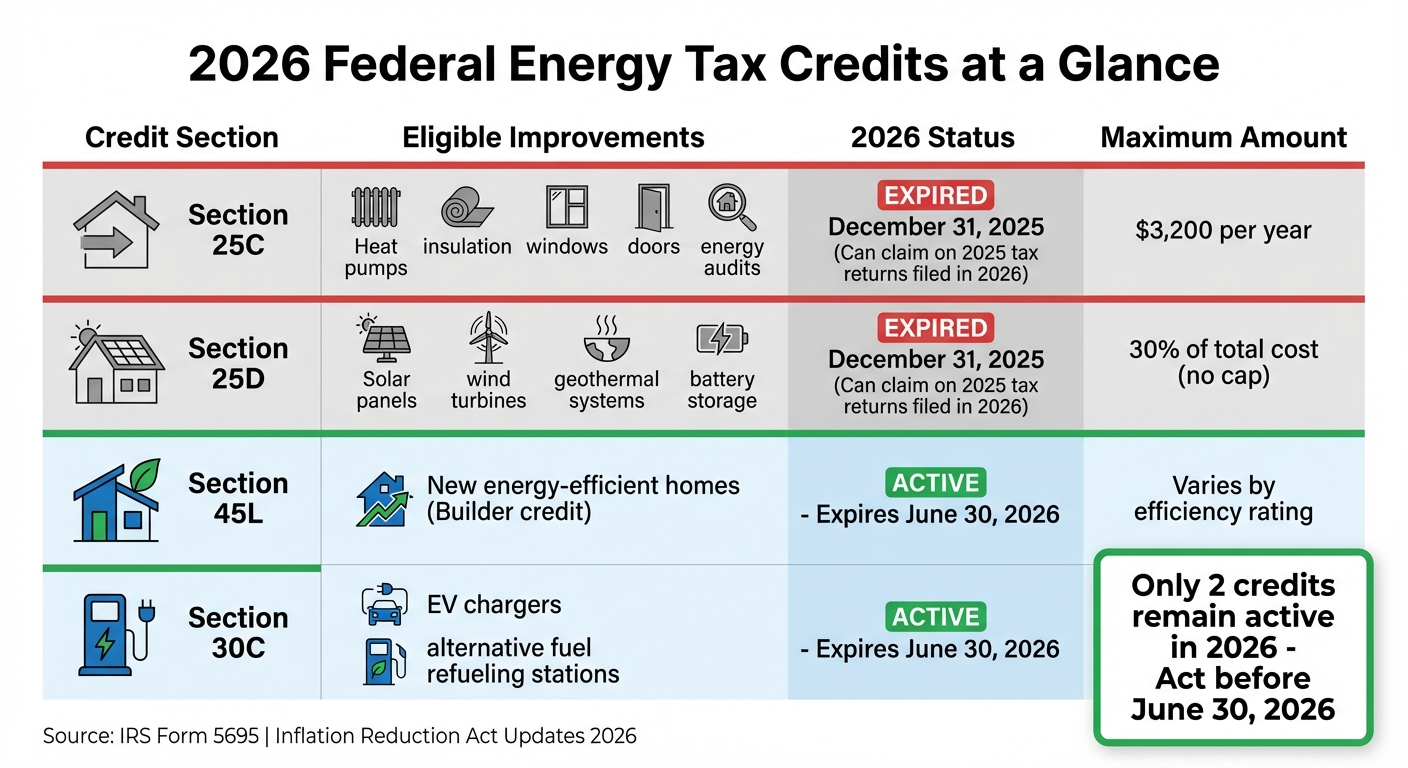
2026 Federal Energy Tax Credits: Status, Deadlines, and Maximum Rebate Amounts
In 2026, federal energy rebates underwent a shift following the "One Big Beautiful Bill" (enacted July 4, 2025), which accelerated the expiration timeline for most Inflation Reduction Act credits. The majority of these credits ended on December 31, 2025, meaning homeowners can only claim them on their 2025 tax returns for qualifying projects completed before that date. With state programs vying for limited funds, it’s essential to stay informed about federal deadlines when planning energy upgrades.
"For taxpayers investing in clean energy, the message for 2026 is clear: eligibility now hinges on precise timing, careful documentation, and a deeper understanding of new compliance rules." – Stephano Slack LLC
Only two federal credits – Section 45L and Section 30C – remain available beyond December 2025. However, projects must be fully installed and operational by June 30, 2026, to qualify. Below, we break down the specifics of each credit and their respective deadlines.
Section 25C: Energy Efficient Home Improvement Credit
Although this credit expired on December 31, 2025, it can still be claimed on 2025 tax returns filed in 2026. It covered 30% of eligible costs, with an annual cap of $3,200. Certain items, like heat pumps and biomass stoves, qualified for a higher limit of $2,000, while general weatherization improvements (windows, doors, insulation) were capped at $1,200 annually. Each item had its own cap, so careful review of limits was necessary when filing IRS Form 5695.
To claim the credit, homeowners needed to include the Qualified Manufacturer Identification Number for most items (excluding insulation and air sealing). Additionally, invoices had to separate equipment costs from labor charges, as labor for windows, doors, and insulation was not eligible.
Section 25D: Residential Clean Energy Credit
The Residential Clean Energy Credit, which supported solar panels, wind turbines, geothermal systems, and battery storage, also expired on December 31, 2025. It provided a 30% credit on total project costs with no annual or lifetime cap. While non-refundable, it allowed unused credits to be carried forward to future tax years if the credit exceeded the homeowner’s current tax liability.
For example, if a homeowner’s credit exceeded their tax bill, the remaining amount could be applied to reduce future tax liabilities. Projects had to be finished by December 31, 2025, and claims were filed using Form 5695.
Section 45L: New Energy-Efficient Homes Credit
This credit, which remains active until June 30, 2026, is aimed at builders and developers of energy-efficient homes. It applies to qualifying homes acquired by that date, with the credit amount based on the home’s energy efficiency rating. Homebuyers should confirm with their builder that the acquisition will be finalized before the deadline to ensure eligibility.
Section 30C: Alternative Fuel Vehicle Refueling Property Credit
The credit for EV charger installations offers 30% of costs, up to $1,000, for residential installations. It remains available until June 30, 2026, for property placed in service by that date. While this credit applies to both residential and commercial properties, residential eligibility is limited to specific census tracts. To qualify, installations must be completed on time.
| Credit Section | Eligible Improvements | 2026 Status | Maximum Amount |
|---|---|---|---|
| 25C | Heat pumps, insulation, windows, doors, audits | Expired (Dec 31, 2025) | $3,200 per year |
| 25D | Solar, wind, geothermal, battery storage | Expired (Dec 31, 2025) | 30% of total cost |
| 45L | New energy-efficient homes (Builder credit) | Expires June 30, 2026 | Varies by efficiency |
| 30C | EV chargers, alternative fuel refueling | Expires June 30, 2026 | $1,000 (Residential) |
State Energy Rebate Programs in 2026
With the expiration of most federal credits, including Section 25C, on December 31, 2025, state programs have taken center stage for energy savings in 2026. Unlike federal credits, these programs provide direct financial aid, helping homeowners offset upfront costs for energy-efficient upgrades. The Inflation Reduction Act allocated $8.8 billion to two key state-managed initiatives: Home Efficiency Rebates (HOMES) and Home Electrification and Appliance Rebates (HEEHRA/HEAR).
Currently, about 23 states have rolled out these programs, with funding distributed on a first-come, first-served basis. For instance, California received $590 million in IRA funding, but by February 24, 2026, single-family HEEHRA rebates were fully reserved, leaving only waitlist options – underscoring the importance of acting quickly.
HOMES and HEEHRA Programs
The HOMES program focuses on rewarding homeowners for improving overall energy efficiency. To qualify, an energy assessment must show at least a 20% reduction in energy usage. Rebates are tiered based on the percentage of energy savings achieved and household income, with higher incentives available for low-income households (those earning less than 80% of the Area Median Income).
The HEEHRA program (also known as HEAR) provides upfront rebates for specific high-efficiency electric appliances, such as heat pumps, water heaters, and electric stoves. This program is available to households earning up to 150% of the Area Median Income, with a maximum rebate of $14,000 per household. Low-income households can receive up to $8,000 for heat pump installations alone.
Both programs generally require the use of state-approved contractors to qualify for rebates. Before starting any project, confirm that your contractor meets eligibility requirements to ensure you can claim the rebate.
Pacific Northwest Rebate Availability
In the Pacific Northwest, the rollout of these programs is well underway. Oregon plans to launch both HOMES and HEAR programs in Spring 2026, with $113 million in funding from the U.S. Department of Energy. The rollout will occur in three phases: individual units in Spring, multifamily shared systems in Summer, and in-store retail coupons in Fall. Energy Trust of Oregon will manage about $25 million for each program, offering up to $10,000 through HOMES based on energy savings and up to $14,000 for qualifying upgrades through HEAR.
Washington’s HEEHRA program is already active and administered by the Washington State Department of Commerce. Low-income households can receive up to $8,000 for heat pump installations, with additional rebates available for upgrades like electrical panels and heat pump water heaters.
Homeowners in the Pacific Northwest can also combine state rebates with local utility incentives. For example:
- Puget Sound Energy offers up to $1,200 for central air source heat pumps.
- Seattle City Light provides a $2,000 instant rebate for oil-to-electric heat pump conversions, which rises to $6,000 for income-eligible households. Additional rebates include $750 for heat pump water heaters and $50 for smart thermostats. Most of these incentives are available until December 31, 2026.
Since funding is limited and operates on a first-come, first-served basis, it’s crucial to reserve your rebate before starting any work. In Oregon, homeowners must submit a pre-application through the ODOE online portal to secure funding. In Washington, contractors are required to reserve funds prior to installation. Companies like Envirosmart Solution can assist homeowners in navigating these systems and maximizing available rebates in the Pacific Northwest.
How to Maximize Rebates with Energy Efficiency Services
With limited funds and a first-come, first-served approach, getting the most out of your rebate opportunities requires careful planning and expert advice. In 2025, households missed out on an average of $2,400 by not layering available incentives. For 2026, working with professionals who understand the rebate landscape can help ensure you claim every dollar available. A professional energy audit not only verifies eligibility but also helps you strategically combine incentives for maximum savings.
Professional Home Energy Audits
A certified home energy audit is a must for HOMES rebates. This audit sets your home’s current energy usage as a baseline and models the potential savings from planned upgrades. Without this documentation, you won’t qualify for performance-based rebates, which can range from $2,000 to $8,000 – or even up to $16,000 for low-income households.
During the audit, tools like thermographic cameras, blower door tests, and electrical panel evaluations identify inefficiencies and ensure your home is ready for high-efficiency upgrades. This prevents potential delays caused by electrification bottlenecks.
The audit itself qualifies for a 30% federal tax credit, up to $150. More importantly, it helps prioritize upgrades for the best return. For example, adding attic insulation and sealing air gaps might lower your heating demand enough to install a smaller, more affordable heat pump while still achieving the 35%+ energy reduction needed for higher-tier HOMES rebates.
Combined Services for Maximum Savings
The most effective rebate strategies involve combining four types of incentives: HEAR equipment rebates, HOMES performance rebates, state programs, and utility incentives. Coordinating these layers requires precise planning, and bundling services can simplify the process. Since funds are limited and deadlines strict, this approach can make a big difference in capturing the highest savings.
Take a real-life example from early 2026 in Detroit, Michigan. A low-income household replaced an oil furnace with a cold-climate heat pump, added attic insulation, and upgraded their electrical panel. By combining a HEAR equipment rebate ($12,800), a HOMES performance rebate ($8,000), and a DTE Energy utility rebate ($500), they secured over $21,300 in incentives for a project costing between $22,000 and $28,000.
An "envelope-first" strategy is crucial for maximizing rebates. Focusing on insulation and air sealing before upgrading HVAC systems reduces the size and cost of new equipment while increasing energy savings. For example, combining a heat pump installation with insulation and electrical panel upgrades in a single project can help your home achieve the 35%+ energy savings needed to unlock the highest HOMES rebates.
Envirosmart Solution specializes in managing these bundled projects. They handle HVAC upgrades, insulation installation, air duct cleaning, and electrical work, ensuring the project qualifies for multiple rebate programs. Their expertise in navigating contractor requirements and utility pre-registration processes helps avoid costly mistakes that could jeopardize rebates.
Annual Maintenance Plans for Continued Efficiency
Getting rebates is only part of the equation – maintaining energy efficiency over time is just as important. High-efficiency equipment needs regular maintenance to perform at its best. Without it, performance can decline, reducing the energy savings you worked hard to achieve.
Envirosmart Solution offers the SMART GOLD™ annual maintenance package for $699. This plan includes furnace inspections, air duct cleaning with camera inspections, dryer vent cleaning, and attic and crawl space checks. Members also get a 20% discount on additional services, which makes it easier to address potential issues before they escalate.
Regular maintenance also protects your investment. Many manufacturers require documented annual servicing to keep warranties valid, and some utility rebate programs include performance verification clauses. Keeping detailed maintenance records ensures your upgrades stay compliant and continue delivering value over time.
Conclusion
The expiration of federal credits at the end of 2025 leaves state-administered programs like HOMES and HEEHRA as the primary sources of incentives. With $8.8 billion in funding allocated on a first-come, first-served basis, acting quickly is crucial.
Some programs have already hit capacity, forcing applicants onto waitlists. As of March 2026, only 23 states still have active programs accepting applications. These rebates can provide up to $14,000 per household.
"Applying sooner rather than later is strongly advised… once a state depletes its allocation, the program closes." – Standard Chronicle
To navigate 2026 successfully, preparation is key. Start by checking your state’s program status using the DOE Rebate Program Tracker. Confirm your eligibility with HUD income tools and book an energy audit early to meet HOMES program requirements. Work only with state-registered contractors who can document rebate reservations before starting any work.
This is where expert guidance can make all the difference. Envirosmart Solution offers a streamlined approach to maximize your incentives. They manage certified energy audits, coordinated upgrades, and rebate applications, ensuring no detail is overlooked. From contractor enrollment to utility pre-registration and reservation portal management, they handle the complexities, reducing the risk of errors that could jeopardize your savings. With limited funds and strict deadlines, their expertise ensures homeowners can secure the maximum benefits available.
FAQs
Which rebates can I still get in 2026?
In 2026, several energy rebate programs remain available, offering opportunities to save on energy-efficient upgrades. These include state-specific incentives, such as Maryland’s programs, as well as rebates introduced under the Inflation Reduction Act for home efficiency and electrification. Additionally, certain commercial energy incentives may still apply.
To take advantage of these rebates, it’s crucial to meet key deadlines – like starting construction by June 30, 2026 – and adhere to eligibility requirements. Be sure to review the details of each program carefully to understand the specific qualifications and timelines involved.
How do I reserve state rebate funds before I start work?
To secure state rebate funds, start by identifying the specific program available in your state, such as HOMES or HEAR under the IRA. Many of these programs require you to complete a pre-application or registration process before beginning any work.
Make sure to check the program’s availability, deadlines, and requirements by reaching out to your local utility provider or program administrator. Follow their guidelines carefully – this might involve submitting necessary forms, providing documentation, or scheduling inspections before starting your project.
Can I stack state rebates with utility and federal incentives?
Yes, in 2026, it’s possible to combine state rebates with utility and federal incentives to boost your savings. Many programs let you layer multiple incentives – federal, state, utility, and even manufacturer promotions – to cut costs significantly. Just make sure to review the terms of each program to confirm they can be used together.